
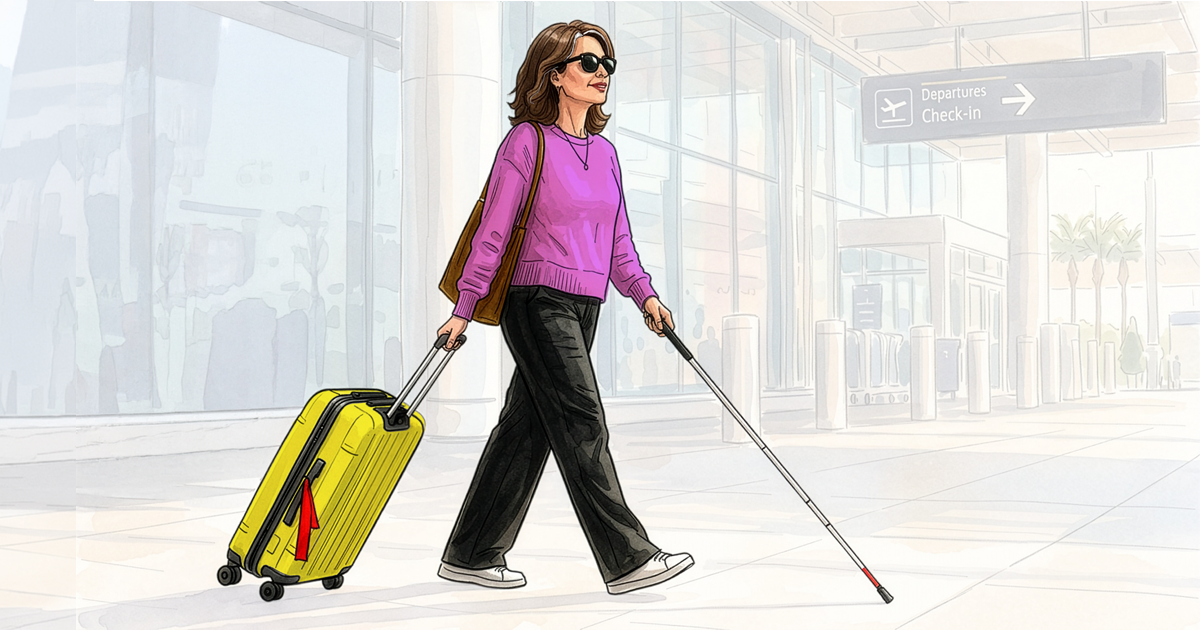
Do you love taking vacations? And have you wondered how to travel with vision loss? More than 50 Hadley members joined the Recreation Chat discussion group in May 2026 to share advice on how they plan and adapt when traveling. Their tips included researching services, tools, and other accommodations that may be provided for people with vision loss, bringing the devices and equipment you need, considering identification options, navigating unfamiliar places, and more.
Here are some of the top ideas from this conversation and from other Hadley travelers.
11 Tips for Traveling with Vision Loss
Research vision loss accommodations before you book
Planning is always a good idea, and by searching online or making a few phone calls ahead of time, you can check with your airline and airport, your train station or cruise line, and your hotel or other destinations, to find out what accommodations they offer. One low-vision traveler mentioned that planning a trip with help from a certified accessible travel advocate is a great way to ensure your needs are being considered, right from the start.
Request accessibility assistance early
It’s always best to make your accessibility requests in advance—such as guided assistance or large-print information—so the company can have what you need, when you need it. Our vision loss experts noted that some places require 48 or 72 hours’ notice, or more.
Be ready to ask for help
Sometimes you’ll have a personal guide to help you out, but Hadley members agree that sometimes you’ll need to speak up and even ask strangers for assistance. Be prepared to self-advocate, and recognize that most people want to help. That can make asking for help a bit easier.
Pack essential vision tools in your carry-on
Checked baggage can get lost or delayed, so it’s best to keep certain things close at hand. With vision loss, this might include medications, magnifiers, tech devices, or an extra folding cane. One Hadley member mentioned that his favorite pair of sunglasses—which enhance contrast, reduce glare, and make it easier to switch between bright light and shadows—are always in his carry-on.
Carry ID that supports your accessibility needs
Identification that notes your vision impairment can be helpful when you’re explaining your needs or requests. One member said she went to the DMV to get a non-driving ID that has the word “Blind” on it, and other options included “Legally blind” and “Low vision.” Some states may require medical documentation to issue an ID with a disability indicator.
Consider a hidden disabilities sunflower lanyard
A lanyard with sunflowers signals that you have a disability which people might not readily notice—and this can also be useful when you’re asking for help. You can buy hidden disability sunflower lanyards online, or you can get one for free at most airports—often at an information desk or security station. One member got hers at the airline ticket counter.
Make your luggage easier to identify with vision loss
Whether you’re looking for your own bags or getting help, luggage with bright or contrasting colors can be easier to spot. One Hadley traveler shared that she ties a strip of bright pink fabric to each of her bags so she can tell assistants what to look for. And another described the low-vision bag he uses, which has high-contrast colors and large, easier-to-find zipper pulls.
Bring a white cane—even if you don’t use one full time
A foldable cane can be a powerful tool to help with navigation and to signal others that you might need assistance. One member who doesn’t always use a cane said he does bring a small, telescoping cane to use in the airport, or to take with him if he’s not sure how dark it will get while he’s out exploring. He also takes an All-Terrain Cane for hiking. And bringing a cane with a large tip helps when walking on uneven surfaces, like brick or cobblestone streets.
Use accessible travel apps
Another great tool for navigating unfamiliar places is a smartphone. Several apps are particularly helpful for getting around—for example, Be My Eyes, Seeing AI, or a navigation app that uses GPS. If you’re traveling internationally and using Be My Eyes, you can check ahead to see whether it covers the countries you’ll be in. Wherever you are, calls will go to a volunteer who speaks your preferred language.
Learn your transportation options
Rideshare apps like Uber and Lyft are available in many countries, but it’s worth checking your destination ahead of time. While the app will continue to work in your selected language, be aware that drivers in other places may or may not speak that language.
Build extra time and flexibility into your itinerary
Leaving your home or hotel a little early allows time for navigating an unfamiliar place and handling surprise detours. You might even find an unexpected delight! One member shared that a flat tire and a long delay on a road trip led his group to check out the local museum—where he was thrilled to find exhibits with audio description.
It’s a rare trip that goes exactly as you imagined, but a little pre-planning, the right equipment, and these tips from other travelers with vision loss can go a long way toward helping you travel with more confidence.
Finding help and support
- TravelEyes and Mind’s Eye Travel are specialized travel companies that offer group trips and tailored experiences for visually impaired travelers.
- Certified Accessible Travel Advocates help plan customized, accessible trips:
- You can find a Certified Accessible Travel Advocate here.
- One traveler recommended Julie Flaherty, a Certified Accessible Travel Advocate who plans cruises.
- The TSA Cares program offers extra help through airport security.
- Amtrak Red Cap service offers baggage and accessibility assistance in train stations.
Coping with Vision Loss
- Hadley’s Asking for Help video includes tips on reaching out to others, especially when it feels hard to.
- Our Self-Esteem video talks about how it feels when vision loss affects our favorite activities.
More Resources for Traveling with Vision Loss
- 19 Things to Do When Traveling with Accessibility Needs in Mind
- Hadley Presents: Air Travel and Vision Loss
Have you discovered a handy tip for traveling with vision loss—or do you have questions? We’d love to hear from you.
0 Comments