
Braille for Everyday Use: Letters K-M
Hadley
Braille for Everyday Use
Workshop 4: Letters k through m
Opening
Hadley presents Braille for Everyday Use, Workshop 4: Letters k through m.
Page 1
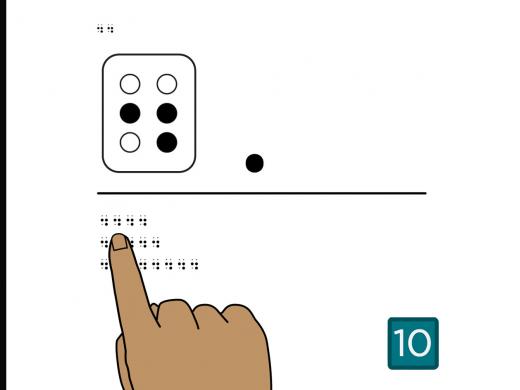
Are you ready to learn some more letters? Feel the braille in the top left corner of the page. This is the letter k, dots 1-3.
The letter k uses the top and bottom dots on the first side of the braille cell.
A hint for k is to think of the k in “skip.” This letter skips right over the dot in the middle.
Below the middle line you’ll find three rows of k’s.
Place your fingers on the letter k at the beginning of the first row. No need to count; just feel each row of k’s from left to right.
Turn the page.
Page 2
Feel the two braille letter k’s, dots 1-3, in the top left corner of the page.
Below the middle line you’ll find three rows of k’s.
Find the letter k at the beginning of the first row.
From left to right, count the number of k’s in the first row.
There are three k’s.
Now, count the number of k’s in the second row.
If you counted seven, you found them all.
And last count the number of k’s in the third row.
There are eight.
Turn the page.
Page 3
Feel the full cell and the letter k in the top left corner of the page.
Let’s practice reading the full braille cell and the letter k.
Below the middle line you’ll find three rows of braille.
Place your fingers on the letter k at the beginning of the first row.
Count only the number of k’s in the first row.
There are two k’s in the first row.
Now count only the full braille cells in the second row.
There are four full cells.
And how many k’s are in the third row?
If you found five k’s, you’re right.
Turn the page.
Page 4
Feel the braille in the top left corner of the page. This is the letter “l,” dots 1-2, and 3.
The letter l uses the three dots on the first side of the braille cell.
L is shaped just like a lowercase print l.
Below the middle line you’ll find three rows of l’s.: Place your fingers on the letter l at the beginning of the first row. No need to count; just feel each row of l’s from left to right.
Turn the page.
Page 5
Feel the two braille letter l’s, dots 1-2-3, in the top left corner of the page.
Below the middle line you’ll find three rows of l’s.
Find the letter l at the beginning of the first row.
From left to right, count the number of l’s in the first row.
If you said five, you’re right!
Now, count the number of l’s in the second row.
There are three.
And last, count the number of l’s in the third row.
There are eight l’s in the third row.
Turn the page.
Page 6
Feel the full cell and the letter l in the top left corner of the page.
Let’s practice reading the full braille cell and the letter l.
Below the middle line you’ll find three rows of braille.
Place your fingers on the letter l at the beginning of the first row.
Count only the number of l’s in the first row.
There are five l’s in the first row.
Now count only the full braille cells in the second row.
There are five full braille cells in the second row.
And how many l’s are in the third row?
If you found four l’s, you’re correct.
Turn the page.
Page 7
Feel the braille in the top left corner of the page. This is the letter “m,” dots 1-3, and 4.
The letter m uses the top and bottom dots on the first side of the braille cell and the top dot on the second side of the braille cell.
M is like a mailbox. There are two dots across the top where the mail goes, and one where the post meets the ground.
Below the middle line you’ll find three rows of m’s.
Place your fingers on the letter m at the beginning of the first row. No need to count; just feel each row of m’s from left to right.
Turn the page.
Page 8
Feel the two braille letter m’s in the top left corner of the page, dots 1-3-4.
Below the middle line you’ll find three rows of m’s.
Find the letter m at the beginning of the first row.
From left to right, count the number of m’s in the first row.
There are three m’s in the first row.
Now, count the number of m’s in the second row.
If you said seven, you found them all.
And last, count the number of m’s in the third row.
There are five.
Turn the page.
Page 9
Feel the full cell and the letter m in the top left corner of the page.
Let’s practice reading the full braille cell and the letter m.
Below the middle line you’ll find three rows of braille.
Place your fingers on the letter m at the beginning of the first row.
Count only the number of m’s in the first row.
There are four m’s in the first row.
Now count only the full braille cells in the second row.
There are three full braille cells in the second row.
And how many m’s are in the third row?
If you found three m’s, you’re right.
Turn the page.
Page 10
Feel the letters k and l in the top left corner of the page.
Below the middle line you’ll find three rows of braille.
In which row are the letters h through m in alphabetical order?
If you chose the last row, you found it: h–i–j–k–l–m.
If you’re wondering about the first row, it has an e instead of an i.
And in the second row, the j and h have switched places.
If you found this tricky, or just want to practice some more before moving on, go ahead and pause or replay the page as many times as you’d like. There’s no rush.
When you’re ready, turn the page.
Page 11
Feel the letters k and m in the top left corner of the page.
Below the middle line you’ll find three rows of braille.
Place your fingers on the letter k at the beginning of the first row.
Count only the number of k’s in the first row.
There are three k’s in the first row.
Now count only the letter l’s in the second row.
There are three l’s in the second row.
And how many m’s are in the third row?
If you found four m’s, you’re right.
Turn the page.
Page 12
Feel the letters k and c in the top left corner of the page.
Now let’s read some braille words!
Below the middle line, you’ll find three rows, each with a word that has the letter k. Take your time reading the words, and notice where you find the letter k in each one.
Which word begins with the letter k?
The last word, “kid,” starts with the letter “k.”
The first word is “check,” and the second word is “hike.”
Were you able to spot the letter “k” in these words?
Turn the page.
Page 13
Feel the letters l and b in the top left corner of the page.
Sometimes it’s helpful to use two letters to label items in your home.
Below the middle line you’ll find three boxes that have letters you could use to label items in your workshop.
Find the box labeled for “lightbulbs.”
The last box has l-b.
Next, find the box labeled for “boat keys.”
If you found the first box with b-k, you got it.
Finally, find the box for “bike lights.”
It’s in the middle, b-l.
Turn the page.
Page 14
Feel the letters m-l, and k in the top left corner of the page.
Below the middle line are three boxes with letters.
Find the box containing the letters you could use to label “cold medicine.”
If you chose the middle box, with the letters c-m, you’re right.
Which could be used to label a “bandage kit?”
The first box has the letters b-k.
How about a bottle of “lavender balm?”
The last box has the letters l-b.
Did you know Hadley has a workshop on labeling medications, where you can learn different ways to mark your medicines?
You can find it among our daily living workshops. Check it out!
When you’re ready, turn the page.
Page 15
Feel the letters m, k, and l in the top left corner of the page.
Then feel the sticker in the top right corner of the page. The sticker reads, “fig cake.”
Below the middle line, you’ll find three boxes from top to bottom, labeled with words describing food items.
Scan to find the box that contains the words “fig cake.”
If you picked the last box, you found it.
You can peel the sticker and place it on this box or keep it to label your own fig cake.
Turn the page.
Page 16
Feel the letters l and m in the top left corner of the page.
Some people make a braille grocery list to take to the store with them.
Below the middle line you’ll find the two rows with words for food.
Which row has the word “milk?” Take your time.
You can use the pause button—or the spacebar—so you’ll have plenty of time to read these words.
Just press the Play button—or use the spacebar again—when you’re ready.
Did you find the word “milk” in the second row?
If not, just replay this page and try reading these words again.
Turn the page.
Page 17
Feel the letters m and l in the top left corner of the page.
Below the middle line are two boxes, each with a list of groceries.
Which box contains the list, “milk, bagel, jam, dill?”
If you said the first box, you’re right.
The second box lists, “milk, bagel, jam, ham.”
Turn the page.
Page 18
Feel the letters k-l, and m in the top left corner of the page.
Below the middle line you’ll find three boxes with words.
Find the box that has the word you could use for labeling your “mailbox key.”
If you chose the last box with the word “mail,” you got it.
The first box has the word “check,” and the middle box says, “hill.”
Turn the page.
Page 19
Feel the letters l-m, and k in the top left corner of the page.
Below the middle line you’ll find a list of three words naming different types of tea.
In which row can you find “iced tea?”
Row two has the word “iced.”
How about “black tea?”
The word “black” is in row one.
What type of tea is named in the last row?
It’s “decaf!”
Turn the page.
Page 20
Here are some extra stickers for the letters k-l, and m that you may want to use to label things around your home.
If you’ve learned how to write braille letters, try labeling your medications using abbreviations.
For example, “cold medicine” can be labeled using the letters “c-m” and “allergy medication” can be labeled “a-m”.
For safety, it’s important to label your medications correctly.
Be sure to use enough letters in your labels so you can identify the medication properly.
We would love to talk to you about learning braille and labeling.
Call Hadley to speak with a braille expert: 847-784-2816. We want to help!
Select Next to complete this workshop.
Completion
Congratulations, you now know letters k through m!
-
Products
Braille/Print Letter Stickers from APH
If you liked the stickers in this workshop and want more, you can order a set from APH.
Braille for Everyday Use: Letters Series
Explore
-
Painting Blind
Audio · 27 minutes
-
I'm having trouble reading
Resource guide
-
Shopping Your Way: Grocery Options When You Have Vision Loss
Article · 3 minutes
-
Book Nook
Discussion
- Explore more
Members also liked
- Workshop

- Workshop
- Workshop

- Video · 6 minutes
Join the Hadley Community
Hadley's resources are always available to you. Create a no-cost Hadley account to go further:
-
Pick up where you left off Everything you start is automatically saved across Hadley.
-
Personalized recommendations We'll suggest resources based on your interests.
-
Join live discussions Live and lively discussions on technology, cooking, and more, all geared toward the community of people living with vision loss.
-
Find peer support Connect with people who understand what you're going through.