
Techniques for Better Reading: Beginner
Knowing how to place your hands and move them across the page smoothly will help you get more comfortable with your braille reading. And with a little practice, you'll begin to read faster and more accurately, which helps you enjoy your reading even more. So, let's jump in and get started.
The first step is to get into a comfortable position. Begin by sitting at a table or using a lap table or tray so you can place your book or paper at about waist level. Set up your reading material at the correct angle with the bottom edge parallel to you. And if you like, use a non-slip mat or a piece of shelf liner to help keep it in place. It also helps to sit up straight and to relax your arms and shoulders as you rest your hands lightly on the page.
Next, it's a good idea to scan each braille page before you read it so you know what's coming up. To scan the page, open both of your hands and place them flat on the paper.
Beginning at the top, slide your hands lightly across and down the page. Notice whether the lines of braille you feel are long or short, and whether there are paragraphs, columns, graphics, or anything else on the page. After you've taken this quick glance, you're ready to start reading.
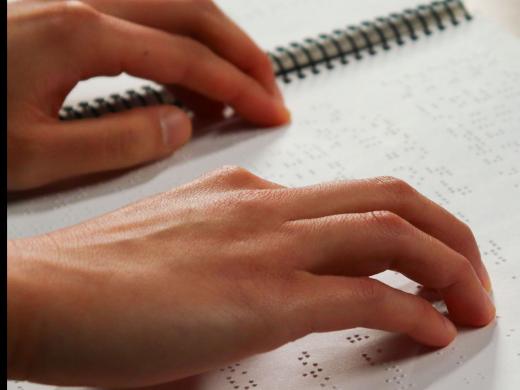
One method that's helpful for beginners is called two-handed tracking. To begin this technique, place your fingers on the page lightly, curving your fingers and keeping your palms, wrists, and arms off the page to let your hands move freely. Using the pads of your middle and index fingers, find the first braille symbol on the top line with your index fingers touching and your hands relaxed.
Keeping your hands together, move them across the line from left to right. You can practice without actually reading the words and characters, just try out the movement. When you reach the end of the line, stop and then move your hands back to the beginning. Still keeping your index fingers together.
As you move to the left, let your fingers lightly feel the braille to make sure you stay on the same line. Then when you reach the beginning, drop your hands down to the next line. Continue this pattern until you reach the end of the page, moving both hands left to right across the line to read it, then moving both hands back to the beginning and dropping down to the next line.
Just like print readers have a dominant eye, you might notice that braille readers have a dominant hand in reading, and it's not always the same hand that's dominant for you in other activities. Still, the most efficient braille readers read with both and multiple fingers on each hand. Using only one finger to read braille is a bit like reading print through a straw, you can only see one letter at a time. Using multiple fingers, you'll begin to feel sets of letters together and learn to read them more quickly.
After you get comfortable with two-handed tracking, you're ready to try the next method, it's called the beginning split hands technique.
Just like you did before, start with both index fingers together on the first braille symbol of the top line and feel the braille with the pads of your fingers. They're more sensitive than your fingertips. Just like before, use both hands to move across the first line left to right.
When you reach the end of the line, this time, you'll keep your right index finger on the last symbol and move only your left hand back to the beginning. When your left hand reaches the beginning, quickly move your right hand back to meet it so your index fingers are touching again. Then drop both hands down to the next line and begin the process once more. You'll read across the line with both hands. Stop at the end of the line while your left hand returns to the beginning, then move your right hand to meet your left hand and drop to the next line.
Both of these techniques are great ways to practice as you build your reading skills. And while you're practicing, check in with your body every now and then. Are you relaxed through your neck, shoulders, wrists, hands, and fingers? If not, stop and do some stretching exercises or take a break.
As you practice these techniques, they'll begin to feel more comfortable and automatic. And when you're ready to build on these skills, check out another workshop in this series to learn even more. If you need more information or you've got your own tips to share, contact a Hadley braille expert. Of course, as with anything new, give yourself time, patience, and practice, and you'll get there.
Techniques for Better Reading Series
- Video · 5 minutes
Explore
-
Gardening and Vision Loss
Audio · 24 minutes
-
It’s hard to ask for help. Now What?
Resource guide
-
"How Do I Tell People About My Vision Loss?"
Article · 7 minutes
-
Recreation Chat
Discussion
- Explore more
Members also liked
- Video · 8 minutes

- Video · 6 minutes
- Workshop

- Video · 9 minutes
Join the Hadley Community
Hadley's resources are always available to you. Create a no-cost Hadley account to go further:
-
Pick up where you left off Everything you start is automatically saved across Hadley.
-
Personalized recommendations We'll suggest resources based on your interests.
-
Join live discussions Live and lively discussions on technology, cooking, and more, all geared toward the community of people living with vision loss.
-
Find peer support Connect with people who understand what you're going through.