
When You Feel Like a Burden
Angela: Hello, my name is Angela Delgado. I worked in the hospital for a long time. I noticed that I started to see floaters in my eyes, and overall, I just realized that my side view was going. And when I went to the doctor, they told me that I have symptoms of glaucoma. They said, eventually you're gonna wind up losing your vision more and more over time.
They gave me the cane. I had the mobility training, the rehab. I ignored it. I was like, I don't want people to know my business. I didn't talk to anybody. I didn't reach out to people. They kept telling me, do you need this? You need that? I said, no, I don't need that. That's not for me. Instead, I was going through all the stages of refusing the help, refusing this, refusing that. And I didn't wanna burden nobody else. I wanted to go and act like I could still see as good, but I wasn't being honest with myself.
My daughter came by to see me and she was like, “Mommy,” she said, she said, “why do you not use your cane?” So we were going to the mall, and I remember the last time we went to the mall, I ran into a pole. And I was afraid of that, but I didn't say anything. I just wanted to make them happy. And she said, “Mommy, why don't you just bring your cane with you?” And when she said that it, it was a light bulb went off in my head.
I thought they was embarrassed of me to go any places with me, 'cause in the mall I was bumping into stuff all the time. And then I started crying because I thought that they didn't wanna be around me. It made me realize that the only person that was embarrassed of my vision loss was me. And they was more worried about me. And I didn't know that.
Everything is changed because I changed the way I think. I changed the way I view life.
Narrator: Angela didn't want to admit to herself, much less anyone else, that her life had changed. She hid her needs from herself and from those closest to her. “I just wanted to make them happy,” is how she put it. She didn't want to bother them. She didn't want to burden them.
Angela's story is so very common. Those feelings and fears that others will find us a burden or a bother can creep in after we've lost some vision, even if we've never felt like this before. So let's take a few minutes and look at what might lay underneath all of this.
Sometimes these fears are built on assumptions, our guesses about how others must be feeling. We think, as Angela did, that our family will find it bothersome to walk alongside someone using a cane. So we leave it behind. We fear that loved ones will worry too much if we share how we're feeling and what we're struggling with. So we pretend that nothing's changed. We put on a happy face, however strained that may be, however false that may feel to everyone.
We expect that a friend will find it inconvenient to give us a ride to go grocery shopping. So we feel guilty for asking for, or even accepting, their offers. And when they do help, we read into any passing comment, looking for confirmation of our fear. “Surely that sigh means they're regretting this trip. I'm wasting their time.”
Fears about how others must be feeling may be shaping our lives in subtle and not-so-subtle ways, and they can be the source of a lot of emotional turmoil. And then there's the fact that losing some vision can challenge how we feel about ourselves, leaving us at times feeling lost and distressed.
This is especially the case if we had typically been the one to take care of others. If we've been that person everyone turns to when the going gets tough, we may think this role is expected of us at all times, and we don't want to let anyone down. So, when the tables are turned and we could use some help ourselves from time to time, we feel uncomfortable, maybe even embarrassed, saying to ourselves something like, “I shouldn't be so needy.”
These are very common feelings, very common fears. So how might we start to work our way through them? Here are some ideas and approaches that others have found useful.
First off, it may help to consider the possibility that guesses and assumptions about how others must be feeling may not be accurate. They simply may not feel the way we think they do. And it may be no trouble at all to pick you up to go grocery shopping. And a passing comment, muttered in frustration, may mean nothing other than that traffic is horrible.
And if asking for or even accepting help goes so much against the grain that you feel like you're letting everyone down by needing it, it may help to consider the possibility that those who have been turning to you for help all these years may be more than happy to return the favor. They may even feel honored that you have trusted them enough to ask. Just taking a moment to consider these possibilities may start to shift things for you.
So the next time you feel yourself hesitating to ask for or accepting a friend's offer of help, because the words running through your head sound something like, “They must find this annoying. I shouldn't need so much help,” you might try quieting that voice and go ahead and accept their help anyhow. You could even try prefacing a request for help with, “It's really hard for me to ask this, but I could use your help with this menu. It's really hard for me to read.” Or, “I hope this isn't too much trouble, but I could really use a hand reviewing these bills.” Or even, “I don't want to inconvenience you, but could we plan to go shopping together sometime? That's really hard for me to do on my own now.”
Sharing not only your need for help with some things that have become more difficult for you, and how hard it is for you to even ask, could be the beginning of a great conversation—one where your friend or family member has the chance to better understand your reality, and you get a chance to hear from them directly.
Angela's daughter got the ball rolling for her mom. She stepped in and encouraged her. Even though Angela was hesitant, her daughter made it clear that she wasn't embarrassed by her mom's use of a cane. In fact, quite the opposite. She encouraged her to do so. She was glad her mom was using all the tools at her disposal.
Giving your friends and family the chance to hear how you feel, what's really going on for you, and the opportunity to help you out on occasion—that may make a world of difference for you, too. Of course, none of this is easy, especially if you're more of a private person. Asking and sharing may feel a little awkward, especially at first. But, as with many things in life, it tends to get a bit easier with time and practice.
And just remember, Hadley is here for you. Because no one should have to face vision loss alone.
The Emotional Impact of Vision Loss
- Video · 8 minutes
- Video · 9 minutes
- Video · 10 minutes
- Video · 9 minutes
Explore
-
Painting Blind
Audio · 27 minutes
-
A family member has vision loss
Resource guide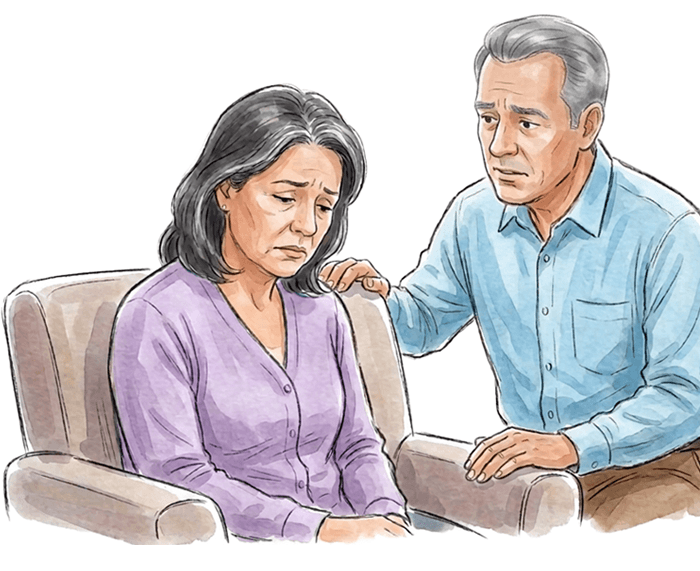
-
Denial and Pretending: Where many vision loss journeys begin
Article · 4 minutes
-
Embracing Braille
Discussion
- Explore more
Members also liked
- Video · 5 minutes
- Video · 4 minutes

- Video · 3 minutes

Join the Hadley Community
Hadley's resources are always available to you. Create a no-cost Hadley account to go further:
-
Pick up where you left off Everything you start is automatically saved across Hadley.
-
Personalized recommendations We'll suggest resources based on your interests.
-
Join live discussions Live and lively discussions on technology, cooking, and more, all geared toward the community of people living with vision loss.
-
Find peer support Connect with people who understand what you're going through.