
Tips for Soup and Salad
When you’re heading out to a dinner party or a meal at a nice restaurant, it’s good to know you can focus on the company and the conversation – and not how to handle certain foods with your eating utensils.
We’ve got a few tips to help you manage your soup and salad with skill, no matter what’s on the menu – and no matter your level of vision. Now, let’s get ready to eat.
We’ll start with the salad. It’s not easy for anyone to manage a large piece of lettuce without making a mess – but here are a few tips on how to cut that problem down to size.
First, it’s easier to cut up a salad before you add the dressing. That way, it isn’t too slippery – and your food stays on the plate while you move your fork and knife around. If you ask for your salad dressing on the side, you can always add it when you’re ready.
When your plate arrives, gently move your hand around and over the plate to find the container of dressing, and move it onto the table – so it won’t be in the way when you start cutting. And for more tips on how to explore your place setting and the items on your plate, check out another workshop in this series – What’s on the Table.
If you ask to have your salad served in a bowl instead of a plate, that can make it easier to cut without spilling.
And if the dish is full, it might be easiest to transfer some of the extra vegetables onto a separate plate and cut them up there.
If anything is difficult to pick up – like cherry tomatoes – use a spoon. Or push it toward your fork with a piece of bread.
When you’re ready to cut up your salad, use your fork to pierce the lettuce and vegetables and hold them in place, and use your knife to make cuts across the back side of the fork. A bowl might start to rock – or roll to the side. But pressing down with your fork helps keep it stable.
One way to make sure your salad is cut into small pieces is to work in criss-cross directions.
Another is to make several cuts in one direction, and then rotate the dish – or rotate your hand position – to cut in another direction. Try it both ways to see what works best for you.
If you’ve moved any items to another plate, you might need to spear them with your fork and cut them individually before moving them back to your salad. Again, it’s helpful to use another utensil – or a piece of bread – to push them into place.
Now that we’ve finished the salad course, let’s move on to soup. Here’s a simple technique to help you get every drop. When you pick up your soup spoon, hold it sideways across the bowl, between the 9 o’clock and 3 o’clock position – or the left and right sides of the bowl.
Then, dip the spoon into the soup – and scoop it away from you.
As you lift it, gently skim the bottom of the spoon across the top – or the 12 o’clock edge – of the bowl. That way you catch any drips before bringing the spoon toward you.
When you do raise the spoon to your mouth, lean forward slightly, so you can keep the spoon – and the soup – over the bowl. If you focus on moving forward, rather than bending down, you can stay facing your companions. You’ll also keep those scarves and neckties out of the way of your dinner.
And when it comes to that last bit of soup in the bowl, the neatest way to get it into your spoon is to tip the bowl away from you, while you scoop the spoon toward the far edge again.
As always, if you need more information or you've got your own tips to share, contact a Hadley learning expert. Of course, as with anything new, give yourself time, patience and practice, and you'll get there.
-
Handouts
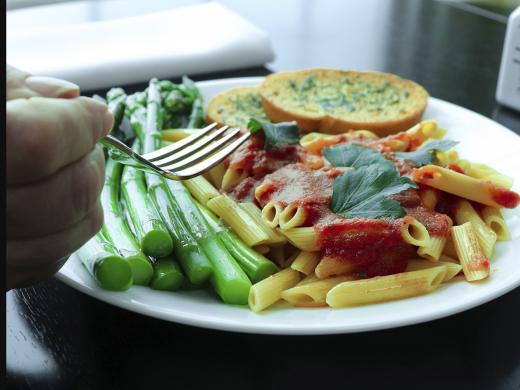
Here are some techniques for handling pasta easily and neatly.
Dining Out Series
- Video · 2 minutes
- Video · 5 minutes
- Video · 5 minutes
- Video · 3 minutes
Explore
-
Vision Loss and Family Dynamics
Audio · 30 minutes
-
I'm having trouble reading
Resource guide
-
7 Helpful Tech Terms When You Have Vision Loss
Article · 4 minutes
-
Recreation Chat
Discussion
- Explore more
Members also liked
- Video · 3 minutes

- Video · 6 minutes
- Video · 4 minutes
- Video · 9 minutes
Join the Hadley Community
Hadley's resources are always available to you. Create a no-cost Hadley account to go further:
-
Pick up where you left off Everything you start is automatically saved across Hadley.
-
Personalized recommendations We'll suggest resources based on your interests.
-
Join live discussions Live and lively discussions on technology, cooking, and more, all geared toward the community of people living with vision loss.
-
Find peer support Connect with people who understand what you're going through.