
Labels: Labels You Touch
We've all said at one time, "I can't believe my eyes," or, "I can't believe my ears." Sometimes it's true, our vision and hearing can fool us, but think about it. We don't say that about our sense of touch, that's because we know that what we can actually feel is real. When we use our sense of touch, we may be using the most accurate sense we have. The world is full of visual information, printed labels, signs, directions, and digital displays. Things in print can tell us a lot, but most of the time we need to know only two things about anything in our house, what it is and how to use it.
Tactile marks, or marks that we can feel, can tell us those two things without any guesswork, especially if we can't count on our vision to do the same job. Let me give you a quick example. You're walking down a long hallway in your apartment building, the doors all look the same and the numbers are hard to read. You want to make sure you find your door, not your neighbors. A rubber band wrapped around your door knob would make this easy. You feel the rubber band and you know for sure you have the right door. Now you pull out your keys, they all look the same, right? If your key has a little bump on it, maybe with a drop of dried glue or a piece of stick on Velcro, you can feel the door key right away. No need to try each and every key until you find the one that works, you already know.
Tactile marks, things you can feel, like the rubber band and the bump on the key, can show you what you need, the right door and the right key in an instant. In that example, tactile marks show us one type of important information, what something is, but we often need to know more, how to use something. Tactile marks make this simple, and I bet everyone has some experience with this already.
Most of us know someone who can flip through TV channels without ever looking at the remote. Maybe we do this ourselves. That's a textbook use of a tactile mark to make something work. In this case, we don't have to add tactile marks because they're already on the device. The arrows on a TV remote tell us how to use it, and we feel these arrows to change the channels up or down. Tactile marks can work for all sorts of items in your home. With tactile marks you can feel where to set your oven, turn on your microwave, adjust your washing machine, sort your clothes, keep your kitchen cupboard organized or even identify medication.
First, let's talk about what you can use to make tactile marks. Most of us have what we need already in the home. Here are some common items used for tactile marks. Tape, if you have bright colored or black tape you might be able to see that mark as well as feel it. Craft Glue, Nail Polish, safety pins, they're great for marking clothing. Rubber bands, stick on Velcro, there's no end to what you can use to make tactile marks, and there's only a few rules to remember.
Make them easy to feel and put marks only where they tell you the two basic things you need to know, what something is or how to use it. Take Ovens, the temperature control of an oven may be in the back, past the burners. It's not safe to lean your head over the range to try to see the little dial marks or digital display to set your oven. If your oven has a dial, put a tactile mark outside the dial at 350 degrees, then put a second mark on the dial itself, right on the mark or arrow that points to the temperature settings. Line the two marks up by feeling them as you turn the dial and your oven is set at 350, now you're reaching over with only your hand and arm, not your whole body.
Some ovens have a flat panel, depending on the model you can put a tactile mark on the on and off buttons, and also on the up or down temperature arrows. When you do this you'll have to remember their locations. Most models default at 350 degrees when you press the on button, so if that's the temperature you want, that's the only button you have to press until you need to turn the oven off. To change the temperature to something other than 350 press the up or down arrows. With most ovens, the temperature changes by five degrees each time you press an arrow, you have to do a bit of math, but you don't have to struggle to read the display or ask someone to read it for you, that's independence.
Most microwaves are also controlled by flat panels, often they're complicated. Many of us just want to heat up leftovers or a cup of coffee, so make things simple, put a tactile mark on the one minute button and a mark on the cancel button. You just need to press the minute button once to heat something for one minute or you can press it a few more times for more minutes, push the cancel button to stop. It's pretty easy, and you don't have to ask anyone for help. And the other settings can be marked as needed.
How about the washer and dryer? Depending on the model, you can mark the washer and dryer controls the same way. Mark the settings on the outside of the dial that you use the most, like normal, or permanent press, then mark the dial itself. Sometimes the dial has an arrow or line on it you can already feel without having to mark it. Just like the TV remote we talked about earlier, many appliances have tactile marks already built in. It's just a matter of locating them and using them.
Marking appliances is using your sense of touch to find out how to use a machine. Let's go back to using our sense of touch so we what something is. Clothing is a fun example. There are so many ways you can mark your clothing so your colors match and your styles go together. Here are some ideas. Dark colors are sometimes hard to tell apart, dark Blues, browns and grays all seem to blend together. Use safety pins to sort them out, one safety pin on blue pants, two on the brown, none on the gray. Now you can pick out the pants you want just by feel. Stick the pins where they won't show or bother you like in an inside pocket or a hem.
You can get creative and choose different locations for a pin to stand for different colors. A pin in the pocket means blue, a pin on the hem means brown, and so on. This is the fun part, you can make your own system as simple or complex as you want. Tactile marks can be used to coordinate clothing and match colors and patterns too, and a lot of clothing can be identified just by texture and style. You can use your sense of touch without even adding an extra mark.
Let's move on to our kitchen cupboard. Boxes, cans and jars sometimes look the same. Wrap rubber bands around cans of vegetables to tell them apart. One rubber band around peas, two around beans, and so on. You can feel which is which. Boxes can be marked the same way. I know someone who keeps a small metal file in his kitchen drawer. He files grooves on his cans and his other containers, by the number and location of grooves he's filed, he feels for the right can of soup or tin of tuna. That's both creative and incredibly simple at the same time.
And that's the point, there's no right or wrong way to use tactile marks to tell you what something is. Now, I mentioned medications, and as you probably have already guessed, you can use some of the same tactile marking methods for your pills and other medicine, but if you're interested and want to learn something more, we have a workshop, just on using marks and labels to keep track of your medicine.
So remember, tactile marks tell you the two most important things you need to know about anything in your house, what something is and how to use it. You don't need to use your eyesight to remain independent, stay safe, or keep tasks convenient. Your sense of touch can do these things for you.
-
Handouts
This handout gives you tactile, visual, and audio marking and labeling tips for rapid identification.
-
Products
Adhesive velcro offers two textures for labeling household items and is available in circles, strips, or in a roll for you to cut pieces of desired length.
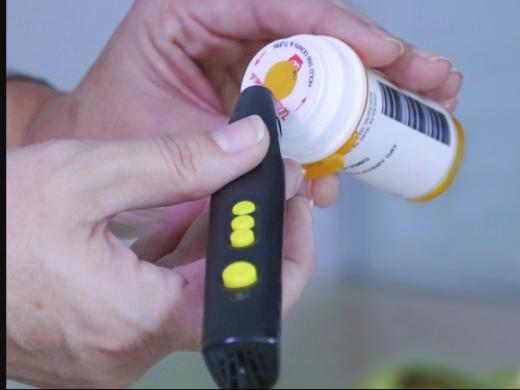
Circular bumps made of plastic with a self-adhesive backing that can be used to mark keys, appliance settings, and other household items.
A three-dimensional fabric paint that expands and puffs up as it dries, allowing you to mark items with raised dots or lines.
Use this three-dimensional, heat resistant paint to create raised dots, lines, or shapes to label everyday items.
Labels for Everyday Use Series
- Video · 6 minutes

- Video · 9 minutes
Explore
-
Gretchen Rubin on Exploring the Five Senses
Audio · 23 minutes
-
A family member or friend is facing vision loss. Now What?
Resource guide
-
Feeling Judgment and Shame: Misunderstandings due to vision loss
Article · 5 minutes
-
Recreation Chat
Discussion
- Explore more
Members also liked
- Video · 3 minutes

- Video · 6 minutes
- Video · 3 minutes
- Video · 4 minutes
Join the Hadley Community
Hadley's resources are always available to you. Create a no-cost Hadley account to go further:
-
Pick up where you left off Everything you start is automatically saved across Hadley.
-
Personalized recommendations We'll suggest resources based on your interests.
-
Join live discussions Live and lively discussions on technology, cooking, and more, all geared toward the community of people living with vision loss.
-
Find peer support Connect with people who understand what you're going through.