
Finding the Right Room
When you’re walking through a building and looking for a doctor’s office or a meeting room, sometimes it can feel like you’re moving through a maze. But a few tips can help you navigate the space – and find the room you need – no matter your level of vision.
One way to get ready ahead of time is to call the office and ask for directions – including directions inside the building. If you let the person on the phone know you’re visually impaired, you can both focus on the details that’ll be helpful to you.
For example, are there any bold or bright colors to look for, like a yellow chair or a blue door? And how many doors will you pass before you get to the right room? With details like these, you won’t have to spend as much time looking for signs and room numbers.
Find out whether you’ll need to use an elevator, or stairs, to get to the room you’re looking for – because sometimes that isn’t obvious, even when you know the room number. For example, Room 200 might be on the second floor – but depending on the building and the door you came in, that might be the floor you walked in on.
If you do need to take an elevator, here’s something to remember: Some buildings have elevators on only one side of the hallway, so it’s easy to know whether to turn right or left when you exit. But some buildings have elevators on both sides of the hallway – so which way you turn depends on which elevator you take.
When you’re getting directions, ask whether you need to turn back toward the front of the building – or in the opposite direction – when you leave the elevator.
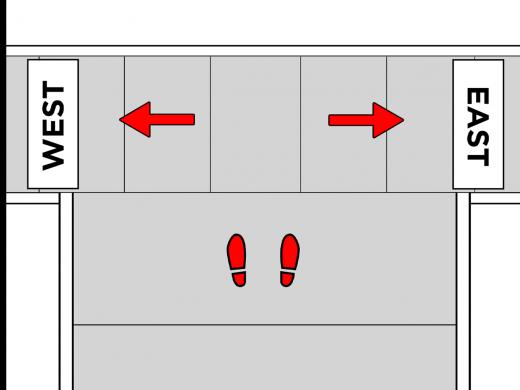
Or – if you’re comfortable with compass directions – ask whether you’ll be heading north, south, east, or west when you walk to the elevator, and what direction you’ll head when you get to the right floor. For more information on using compass directions, check out the workshop on directions, in this series.
When you’re looking for a room number, it’s handy to know how the rooms in the building are numbered. In some buildings, the numbers are even on one side of the hallway and odd on the other – but in others, room 3 might be right next to room 4.
It also helps to know where the signs with room numbers are located. You can usually find them on the door – or they might be on the wall, on the same side as the door handle. If it’s a double door, the sign with the room number is usually on the right. And in most buildings, room signs are posted 4 to 5 feet high.
If it’s helpful for your vision level, bring a monocular with you to read the signs and room numbers. Check out Hadley’s workshop on Monoculars and Telescopes to learn more about these devices.
And knowing the braille alphabet and numbers also comes in handy, so you can reach out to the sign and read the braille.
You may be able to use a lighted magnifier or the light from your cell phone to help make the numbers easier to see. Or take a picture with your phone or tablet and enlarge it with the zoom function. For more on these techniques, check out the Technology series on Low Vision Features for iPhones, iPads or Android devices.
Some places, like hotels and conference centers, have meeting rooms with names instead of numbers – and the signs that point you in the right direction aren’t always easy to find. Ask a staff member whether a map is available, and have them mark the path you need with a bold or bright marker.
And speaking of maps, you might be able to find a map of the building online – or ask for one in email – before you go. You can enlarge it and print it, and even work with a friend or family member to add tactile highlights with yarn, straws or other household items. This can be helpful to study ahead of time, or to bring with you. Keep the highlights simple, and include only key areas, like entrances, connecting hallways, elevators, and the room you need.
It can also be helpful to have a friend or family member make a recording to walk you through your route. They can describe the path you’ll take by looking at the map – or they can explain the route if they’ve been there before. Have them create a recording that helps you find the room, and another one that gets you back to your starting point.
Another way to get voice directions is to use a service like AIRA, to get assistance from a trained professional through your smart phone – or an app like Be My Eyes, for help from volunteers. The person on the other end of the phone can help guide you by reading the room numbers or hallway signs, telling you where to turn, or spotting other landmarks and clues. See the Resources section for information on these handy tools.
As always, contact a learning expert if you have questions or your own tips to share. Of course, as with anything new, give yourself time, patience, and practice and you'll get there.
-
Smartphone Apps
Voice recorder app
A free service that uses volunteers to assist people with visual impairments in completing tasks through video calls.
A subscription based service that has trained agents to assist people with visual impairments in completing tasks through video calls.
-
Websites
Navigating Unfamiliar Places and Spaces Series
- Video · 6 minutes
- Video · 4 minutes
- Video · 4 minutes
- Video · 5 minutes

Explore
-
Vision Loss and Justice
Audio · 29 minutes
-
I'm feeling overwhelmed
Resource guide
-
"Phantom Vision": Understanding Charles Bonnet Syndrome
Article · 5 minutes
-
Embracing Braille
Discussion
- Explore more
Members also liked
- Video · 3 minutes
- Video · 4 minutes

- Video · 3 minutes

- Video · 2 minutes

Join the Hadley Community
Hadley's resources are always available to you. Create a no-cost Hadley account to go further:
-
Pick up where you left off Everything you start is automatically saved across Hadley.
-
Personalized recommendations We'll suggest resources based on your interests.
-
Join live discussions Live and lively discussions on technology, cooking, and more, all geared toward the community of people living with vision loss.
-
Find peer support Connect with people who understand what you're going through.