
Tips for Cutting Meat
Mealtime is the perfect time to relax and enjoy your family, friends, and favorite foods. But if you’re worried about what’s being served – and whether your knife and fork skills are up to the challenge – we’re here to set you up for mealtime success.
With a few tips and tricks, you’ll be able to handle main dishes like steak, chicken – and even ribs – no matter your level of vision.
A good way to begin is to practice with easier cuts of meat – without bones – like slices of ham or turkey, boneless chicken or steak, or even hamburger patties. That way, you can perfect your knife-and-fork technique before you try something more complicated. And practicing on food without sauce or gravy helps you stay neat.
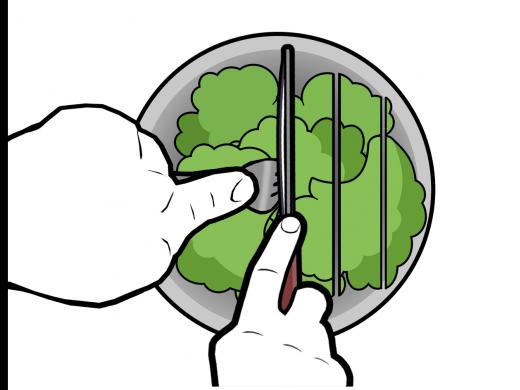
When you’re ready, hold your knife in your dominant hand, and hold your fork in the other hand.
Next, turn your hands palms-down, and slide your pointer fingers up the back of the knife and onto the rounded part of the fork. This helps you control them both like extensions of your pointer fingers. It also lets you apply a little pressure to just the right place.
Use both utensils to help locate the edge of the meat, starting with the side that’s closest to your hand with the fork. Then press the fork into the meat, about one bite-sized piece away from the edge. Place the blade of the knife along the back of the fork tines, and gently move the tip of the knife from one edge of the meat to the other. That helps you see how long the cut should be.
Finally, start cutting. Then use your knife to feel around the edge of the piece you’ve cut off and decide whether it needs to be cut into smaller pieces.
Some people put their knife down after cutting, and then switch their fork to the other hand to eat. But you might find it more convenient to hold the knife and fork in the same position you use for cutting, while you’re eating. Then it’s easier to keep track of both utensils throughout the meal.
And if you have dexterity issues or pain in your arms or hands, there’s no need to be shy about asking for assistance – or asking to have your meat cut before it’s brought to the table.
If your meal includes meat with bones – like a T-bone steak or a pork chop – here’s a simple way to adjust the cutting technique. Holding your knife and fork the same way, gently spear the meat with your fork, and probe with the point of the knife to locate the bone. When you find it, move the fork closer to the bone to keep your food steady, and insert the knife alongside the bone to cut the meat away. Keep going until you’ve cut away all the bones – and then you’re ready to cut and eat the meat as you normally would.
It might be helpful to ask for an extra dish to hold the bones once you’ve cut them away. This way, you won’t keep finding the bones as you go for your next bite.
Let’s say you’re headed to a restaurant that’s famous for its ribs – but maybe you don’t want barbecue sauce … well … everywhere. You can use the same knife-and-fork technique here, too.
If you have a rack of ribs that are connected, use your fork and knife to locate the rib on one end – and insert the tines of your fork into the meat between that bone and the next one. Insert your knife between the meat and the bone and cut it away. Then move your fork to the other side of the bone and cut the meat away there, too.
The same technique works if your ribs are separate. But if you can’t find enough meat in one place to pierce it with your fork, just use the fork to hold the bone steady on your plate. Then cut around it with your knife.
If you’re having chicken, you might find a bone just about anywhere you cut – so it can be easier to remove the meat with two forks, instead of a knife.
It’s easier and much neater to do this if the skin is crispy – or if it’s completely removed. To see whether the skin is crisp, lightly scrape the tines of your fork across the top. If it feels and sounds crunchy, it usually won’t be a problem.
But if the skin isn’t crisp – or if you just want to remove it – here’s a simple technique. Use a fork in your non-dominant hand to pierce the chicken at one end and hold it still. Use a second fork in your other hand to pull the skin away from the meat with a raking motion.
To get the meat off the bones, pierce it with both forks close to each other, and use a twisting and pulling motion with one of the forks. Fully cooked chicken should pull away from the bone easily.
And once again, a separate dish for the bones helps you simplify what’s on your plate.
As always, if you need more information or you've got your own tips to share, contact a Hadley learning expert. Of course, as with anything new, give yourself time, patience and practice, and you'll get there.
-
Handouts
Eating Shellfish with Ease (PDF)
Helpful tips on eating shellfish served in the shell.
Dining Out Series
- Video · 4 minutes
- Video · 2 minutes
- Video · 5 minutes
- Video · 5 minutes
Explore
-
Questions about Glaucoma
Audio · 28 minutes
-
I'm feeling overwhelmed
Resource guide
-
"Phantom Vision": Understanding Charles Bonnet Syndrome
Article · 5 minutes
-
What's Cooking?
Discussion
- Explore more
Members also liked
- Video · 3 minutes

- Video · 9 minutes
- Video · 6 minutes
- Video · 4 minutes
Join the Hadley Community
Hadley's resources are always available to you. Create a no-cost Hadley account to go further:
-
Pick up where you left off Everything you start is automatically saved across Hadley.
-
Personalized recommendations We'll suggest resources based on your interests.
-
Join live discussions Live and lively discussions on technology, cooking, and more, all geared toward the community of people living with vision loss.
-
Find peer support Connect with people who understand what you're going through.