
At the Store
When you’re heading out to the grocery store, it’s always great to feel confident that you’ll find what you need and check out smoothly, without spending more time than you’ve planned. And with a little know-how, you can do just that, no matter your level of vision. Let’s look at a few tips that can help.
One way to make your grocery shopping easier is to shop with an assistant, whether it’s someone you know or a store employee.
If you’ve called ahead to work with an employee, they’ll let you know where to meet them—usually in front of the store or at the customer service desk.
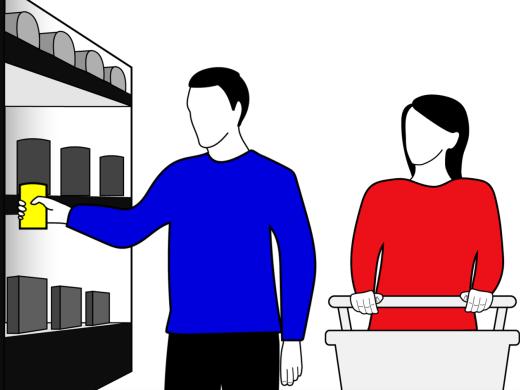
When you do shop with an assistant, it’s handy to use a grocery cart, even if you’re picking up just a few items. Your assistant can hold the side of the cart, navigating through the store and letting you know when to expect a turn or a stop. And you can walk behind the cart, holding the handle. If you have a guide dog, you can continue to hold their harness with one hand.
Be sure to give your assistant a copy of your grocery list to help them find what you need. And let them know if you’d like to check over the items before they go in your cart.
It’s a great idea to see and feel the products yourself, to be sure you’ve got the right thing. Be sure to ask any questions you like, such as the brand, the ingredients, and the price. For example, spaghetti noodles come in several different packages and sizes, and you might not remember whether one pound is exactly what you’re looking for. But when you hold the box in your hands, you’ll know if that’s the right size. You can also check if the package is damaged.
Whether you’re shopping with someone else or on your own, it’s a good idea to follow the same general path through the store, each time you go. Getting used to the same route makes it easier to stay organized and stay oriented, and to remember what’s next on your list.
When you shop at different stores that are part of the same chain, they might follow the same layout. But if you find yourself in a store that’s not familiar, you’ll want to notice the layout as you begin shopping, to make it easier to get back to the checkout lanes.
The refrigerated items, produce, and baked goods are usually around the outer edges of the store. And you can often use your senses to recognize the different areas, too. Your sense of smell might tell you you’re in the bakery or in the coffee aisle. The hum of the freezers might tell you that this is the frozen food section, or the cool air from refrigerated shelves might tell you that you’re in the dairy aisle.
Grocery stores generally have signs overhead that tell you what’s in each aisle. If you have low vision, you may want to bring along a monocular telescope to make it easier to spot and read these signs. A handheld magnifier can be helpful, too, when you want to read product labels and price tags. For more information on both monocular telescopes and magnifiers, check out the workshops in our Magnification Series.
If you like to keep a running total of what you’re spending at the store, a talking calculator can help. Then you’ll know how much money you’ll need at checkout, and you can be ready.
And if you’re shopping on your own, here are a few tips that come in handy when you’re ready to check out. Grocery stores often have lighted signs that tell you which checkout lanes are open, or you can listen for clues, like people talking, or scanner beeps, to know whether a lane is in use. In self-checkout lanes, some systems – but not all – have a computer voice that guides shoppers through the process.
When you’re standing in the checkout line, if you’re unable to see the people ahead of you moving forward, you can always ask someone to let you know when the line is moving.
Grocery shopping may be a good time to carry a white cane, even if you are just using it to identify that you have a visual impairment. You can also use the white cane to gently reach forward on the ground to check whether someone is in front of you. You may be worried about your cane hitting someone, but it’s perfectly acceptable if your cane taps someone's feet when you’re checking if the line is moving.
If you’d like to use a checkout divider, and can’t locate it, ask the cashier, or another shopper, to hand you one.
While the cashier is scanning your groceries, don’t be shy about asking them to announce each item as they scan it. That helps you make sure nothing got mixed in with your items by mistake.
Once everything is scanned and put into bags, the last step is to pay. If you’re using a debit or credit card with the store’s card reader, feel for the chip or the magnetic stripe so you know which way to insert the card. And most grocery stores make it convenient to use contactless payments, too, with a card or a smartphone. With either method, you can listen for the audio cues that let you know when to remove your card, or when your payment is complete. For more tips on using a credit or debit card, paper money, and other methods of payment, check out our workshop on money organization, in the series on dining out.
As always, if you need more information or you've got your own tips to share, contact a Hadley learning expert. Of course, as with anything new, give yourself time, patience, and practice, and you'll get there.
-
Smartphone Apps
Explore
-
"You tap into other things when you lose some vision"
Audio · 4 minutes
-
It's hard to ask for help
Resource guide
-
Denial and Pretending: Where many vision loss journeys begin
Article · 4 minutes
-
Book Nook
Discussion
- Explore more
Members also liked
- Video · 3 minutes

- Video · 6 minutes
- Video · 3 minutes
- Video · 4 minutes
Join the Hadley Community
Hadley's resources are always available to you. Create a no-cost Hadley account to go further:
-
Pick up where you left off Everything you start is automatically saved across Hadley.
-
Personalized recommendations We'll suggest resources based on your interests.
-
Join live discussions Live and lively discussions on technology, cooking, and more, all geared toward the community of people living with vision loss.
-
Find peer support Connect with people who understand what you're going through.