
Windows Narrator: Getting Started
Ricky: Hello, my name is Ricky Enger and today we'll get a quick intro to Windows Narrator. What is it? What is it do? And how do we get started with it? Before we dive into Narrator let's talk about a few keys that we'll be using today and throughout the rest of the series. Will be using the Control key, the Windows key and the Alt key just to name a few.
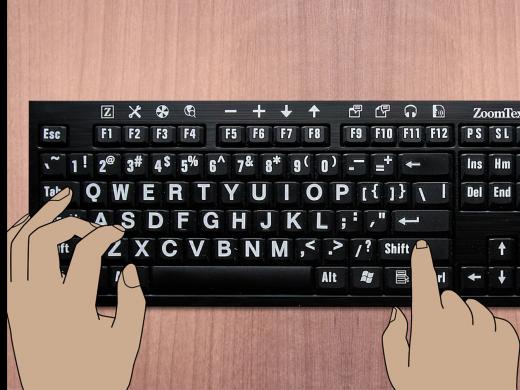
Now keyboards are pretty standard, but there can be differences. Let's talk about the left hand side of our keyboard. In general will find that the Alt key is just to the left of the spacebar, then the Windows key is just to the left of the Alt key, and the Control key is to the left of the Windows key. This may not always be the case though. Some keyboards have an Fn key. Or there might be another key besides Alt, Control and Windows. So just take a little time before getting started and make sure you're familiar with these keys as well as the rest of the keyboard.
Okay, so let's talk about Windows Narrator. First, what is it? It's a screen reader, which means that instead of reading the information on our screen visually, Narrator is actually going to read it aloud. That's pretty much what narrators do right? They speak information aloud and tell us what's going on. So yeah, now that the name makes sense, how do we get started with this screen reader?
The awesome thing here is that Narrator is built right into Windows. So we don't have to go searching for something on the internet and figure out how to install it or anything like that. We can just press one little keystroke. Once we've turned our computer on, and Narrator will start narrating. This is going to work whether we're on our login screen or if we've already logged into Windows.
So let's go ahead and start Narrator. We'll press and hold the Control and Windows keys. And then we'll press and release our Enter key. When we press that.
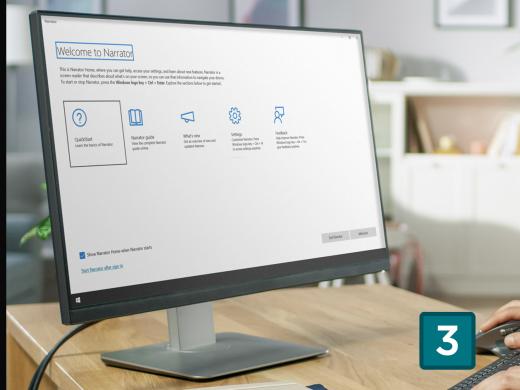
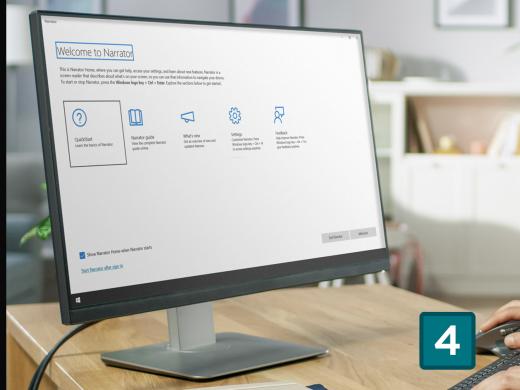
Narrator: Starting Narrator, Narrator heading level one. Welcome to Narrator this is Narrator Home.
Ricky: And Narrator just keeps reading here. It has a lot to say apparently, but we're not quite ready to hear all of it. So to tell the Narrator to shush, we can just press the Control key. Now the first time you run Narrator, you might get a message giving a heads up about some Narrator changes. So you'll want to close that message and keep it from showing again. To do that, press the Tab key until you hear Narrator say, don't show this message again, checkbox, press the spacebar to check the box. And finally, press Enter and you'll be all set to dive into this series.
Okay now, we've started Narrator so let's take some time and go through what's here. We're in a Window called Narrator Home, which always comes up when we start Narrator unless we tell it not to. So to find out what's in this Window, let's just start pressing our down arrow key,
Narrator: Quick Start button, Alt+Q.
Ricky: Will press our down arrow one more time.
Narrator: Learn the basics of Narrator.
Ricky: So we've got a Quick Start button. And our description is that we can use this button to learn the basics of Narrator. Going through this Quick Start Guide is actually a great way to learn and practice some Narrator concept. So whenever we want to do that, we can just press our spacebar on this Quick Start button to activate it. When we were focused on the Quick Start button, we also heard Narrator say Alt+Q. What that means is that we can press ALT+Q, no matter where we are in this Window, and that will open our Quick Start Guide.
Now the rest of our options, which we can also call Controls are going to follow the same format. Will have an option and we'll hear the shortcut key for it if there is one. And then when we press our down arrow again, will get its description. We can also move through options with our TAB key. This is a nice way to get through these options quickly, will miss the descriptions of what things are though.
So when we're first going through this Window, or any new Window for that matter, we don't want to just use our TAB key because we'll miss a lot of stuff. But as we come to know Narrator Home a little better, we may choose to use our TAB key to get through things faster. So let's do that now. We'll use our TAB key to see what else Narrator Home has to offer.
Narrator: Narrator guide button, Alt+ G.
Ricky: This is the Narrator User Guide which is full of really great detailed information on how to use Narrator.
Narrator: What's new button, Alt+W.
Ricky: Here's where we'll find out what has changed since the last version of Narrator.
Narrator: Settings button, Alt+S.
Ricky: Now this one is definitely a useful button because when we open settings, we can really customize how Narrator works for us. It's so cool in fact that we have a whole workshop dedicated to exploring Narrator settings. Let's press Tab again to see what's next.
Narrator: Feedback button, Alt+F
Ricky: Will use this button if we have feedback on Narrator that we'd like to share with Microsoft and will Tab again.
Narrator: Show Narrator Home when Narrator starts checkbox checked.
Ricky: With this Control, which is on right now since our checkbox is checked. We can tell Narrator to show this Window we're in now Narrator Home. Or if we turn it off Narrator will just run without showing Narrator Home. Let's press our spacebar and see what happens.
Narrator: Unchecked.
Ricky: So two things happen there we heard Narrator say, unchecked. And we also heard a little sound to let us know we change the status of this Control. Will press spacebar again.
Narrator: Checked.
Ricky: And we heard Narrator telling us the status of this checkbox. Plus we got the little sound again, it's nice to have both those bits of auditory feedback. Okay, we're ready to press Tab again.
Narrator: Link, Start Narrator after Sign-in.
Ricky: Now this option is really helpful because we can tell Narrator when to start, we can tell it to start automatically when we sign into our account. Then we don't even have to press our Control plus Windows plus Enter shortcut to get our computer talking. And let's Tab again.
Narrator: Exit Narrator button, Alt+X
Ricky: We pretty much know what that one does. So we would press our spacebar on this button to close Narrator. Our Control plus Windows plus Enter shortcut key will do this as well. We press it to turn on Narrator and we can press it again to turn it off. Okay, let's Tab.
Narrator: Minimize button, Alt+M
Ricky: This last button is basically used to move Narrator Home out of the way, even though it's still running. So how do we know that this is the last button? Well, let's press Tab one more time.
Narrator: Quick Start button, Alt+Q.
Ricky: So once we move through all our options and Narrator Home, we jump right back to the beginning again and there you have it. We turn Narrator on and off with Control plus Windows plus Enter. And we now know that Narrator Home is a really useful place to be. I'm Ricky Enger and I'm glad you could spend a little time with me today. Learning to start and stop Narrator and exploring Narrator Home.
-
Handouts
Narrator Keyboard Shortcuts (PDF)
Getting Started with Narrator Quick-Start Guide (PDF)
This quick-start guide helps you get started with Narrator to hear your documents or web page read aloud.
-
Websites
Microsoft Disability Answer desk
Receive assistance by phone or chat for using assistive technology with Microsoft products.
Windows Narrator Series
- Video · 7 minutes
- Video · 8 minutes
- Video · 10 minutes
- Video · 10 minutes

Explore
-
"You can't do this alone"
Audio · 3 minutes
-
I'm having trouble reading
Resource guide
-
10 Tips for Knitting with Vision Loss
Article · 5 minutes
-
Resource Roundtable
Discussion
- Explore more
Members also liked
- Video · 5 minutes

- Video · 3 minutes
- Video · 5 minutes
- Video · 12 minutes
Join the Hadley Community
Hadley's resources are always available to you. Create a no-cost Hadley account to go further:
-
Pick up where you left off Everything you start is automatically saved across Hadley.
-
Personalized recommendations We'll suggest resources based on your interests.
-
Join live discussions Live and lively discussions on technology, cooking, and more, all geared toward the community of people living with vision loss.
-
Find peer support Connect with people who understand what you're going through.