Braille Special Symbols 3 - Measurement and Money
Hadley
Braille Special Symbols Workshop 3
Measurement and Money
Opening
Hadley presents Braille Special Symbols, Workshop 3, Measurement and Money.
Page 1
First, make sure you have your braille workbook with you.
If you don't already have one, call Hadley at 847-784-2816, and we'll mail one right out to you.
Now, Let’s learn a few more special symbols.
Feel the braille in the top left corner of the page.
These are the prime ('), double prime ("), degree (°), and percent (%) symbols.
Prime and double prime are used to show feet and inches.
Above the middle line are four rows of braille.
In the first row is the '.
The next row has the " symbol.
The third row shows the ° symbol.
And the last row has the % symbol.
Below the middle line are four rows of braille. Let’s read them together.
The first row says: 3'.
The next row says: 3".
Now, the third row.
This one reads: 3%.
And finally, the last row says: 3°.
Turn the page.
Page 2
Feel the braille in the top left corner of the page.
This is the prime symbol for feet, dots 2-3-5-6.
In print, this symbol looks like a single quotation mark.
Above the middle line, you’ll find four rows of braille.
As you read the braille and work through the activities on these pages, use the Pause button or spacebar for as long as you need to.
Then, select the Play button, or press the spacebar again, to hear the feedback for that item.
Read these four rows and find which row shows the prime symbol for feet.
Did you say the third row? That’s it!
Below the middle line are three sentences.
What does the first sentence say?
If you read, “Cal’s boat is 16' long,” you’re right!
Now, read the next sentence.
This one says, “Can you get the 12' ladder?”
Finally, read the last sentence.
The last sentence reads, “The golden eagle has a 7' wingspan.”
Move to the next page.
Page 3
Feel the braille in the top left corner of the page.
This is the " symbol for inches; a two-cell symbol with dots 2-3-5-6, dots 2-3-5-6.
In print, this symbol looks like two apostrophes or closing quotation marks.
Above the middle line, you’ll find four rows of braille.
Read these four rows and find which one shows the double prime symbol for inches.
If you said it’s the last row, you’re right!
Below the middle line are four sentences.
What does the first sentence say?
The first sentence reads, “The water heater left a 2" flood in my garage.”
Now, read the next sentence.
If you read, “Hilary asked for a 16" cheese pizza,” you got it!
How about the third sentence?
The third sentence reads: The average rainfall in Miami for the last two years was 81.6" and 61.3".
Finally, read the last sentence.
This one says, “Did you buy the 72" TV or the 82" one?”
Turn the page.
Page 4
Feel the ' and " symbols in the top left corner of the page.
Above the middle line are three rows of braille.
Read these three rows and find which one says: 8'2".
If you said the middle row, you’re right!
And which row says: 6'3"?
It’s the last row.
Below the middle line are four sentences.
Once again, use the Pause button or the spacebar to stop the audio for as long as you need to complete an activity.
Then, select the Play button, or press the spacebar again, to hear the feedback.
Go ahead and read the first sentence.
The first one says, “Grandpa said to measure twice and cut once for the 2'6" board.”
Now, read the next sentence.
If you read, “I need 3'4" of fabric to finish the quilt,” you got it!
Next, read the third sentence.
The third one says, “Anna’s cathedral wedding veil was 9'8" long.”
Finally, read the last sentence.
The last sentence reads: The women’s long jump world record is 24'8".
Did you notice that the measurements for feet and inches can be written with or without a space between them? It’s the same as in print.
Go to the next page.
Page 5
Feel the braille in the top left corner of the page.
This is the °, a two-cell symbol that uses dots 4-5, dots 2-4-5.
The ° is used to tell temperature, directional coordinates, and angles.
Above the middle line are four rows of braille.
Go ahead and read these four rows.
Which row reads, “45° angle?”
If you said the first row you’re right!
And which row reads, “180° change?”
It’s the second row.
Which row reads, “78° Fahrenheit?”
This time, it’s the last row.
Below the middle line, you’ll find four sentences.
What does the first sentence say?
The first one says, “Cook the chicken to 165° F.”
How about the second one?
If you read, “That corner is not a 90° angle,” you got it!
Now, read the third sentence.
This one reads, “Water freezes at 32° F or 0° C.”
Finally, read the last sentence.
This one says, “The lighthouse balcony has a 360° view of St. Augustine.”
Turn the page.
Page 6
Feel the % in the top left corner of the page.
The % is a two-cell symbol that uses dots 4-6, dots 3-5-6.
Above the middle line are three rows of braille.
What does the first row say?
The first row says, “100%.”
Now, read the middle row.
If you read, “20%,” you’re right!
Finally, read the last row.
The last row says, “33%.”
Below the middle line, you’ll find four sentences.
Go ahead and read the first sentence.
The first sentence reads, “I got 95% on my test!”
Now, read the second sentence.
If you read, “The sign says 25% off pizza today and 15% off tomorrow,” you got it!
What about the third sentence?
This one says, “Did you know that between 33% and 40% of adults have a fear of flying?”
Finally, what does the last sentence say?
The last one says, “54% of Americans eat healthier now than 20 years ago.”
Move to the next page.
Page 7
Feel the ° and % symbols in the top left corner of the page.
Above the middle line are four rows of braille.
Which row says, “45%?”
It’s the second row.
And which row says, “63%?”
This time it’s the first row.
Now, which sentence reads, “45°?”
The last row says, “45°.”
And finally, which row reads, “63°?”
Did you say the third row? You got it!
Below the middle line, you’ll find four sentences.
Read the first two sentences and find which one has the correct braille for, “The baby's fever is 104°?”
If you said it’s the first sentence, you’re right!
Now, read the last two sentences and find which one has the correct braille for, “Apple pie with no toppings is preferred by 38%, 37% prefer whipped cream, and 25% prefer ice cream.”
The last sentence is correct.
Turn the page.
Page 8
Feel the braille in the top left corner of the page.
These are four special symbols for currency: the pound sterling sign (£), the euro sign (€), the dollar sign ($) and the cent sign (¢).
You've learned about the $, which is a two-cell symbol that uses dot 4-s.
Like the $, all special symbols for currency begin with dot 4 followed by a letter that resembles the print symbol.
Above the middle line are four rows of braille. Let’s read them together.
The first row is the £.
The next row is the €.
The third row shows the $.
And the last row is the ¢.
Like the $, the € and £ come before the numeric indicator.
But the ¢ comes after the number, just like in print.
Below the middle line are four more rows of braille.
What does the first row say?
The first row says, “£7.”
Now, read the second row.
If you read, “€7,” you’re right!
What about the next row?
The third row says, “$7.”
Finally, read the last row.
This one reads, “7¢.”
Go to the next page.
Page 9
Feel the braille in the top left corner of the page.
This is the symbol for £, dot 4-l.
Above the middle line are four rows of braille.
Which row shows the £?
If you said the third row, you’re right!
Below the middle line are four sentences.
Go ahead and read the first sentence.
If you read, “A tube of toothpaste costs about £1 in London,” you got it!
Next, read the second sentence.
This one says, “Lois paid £8 for bangers and mash at a corner pub.”
How about the third sentence?
The third sentence reads, “I love the £10 note with Jane Austen on the back, because she is my favorite author.”
Finally, what does the last sentence say?
This one says, “Should we book the train to Edinburgh for £27 standard or £68 first class each way?”
Turn the page.
Page 10
Feel the braille in the top left corner of the page.
This is the €, dot 4-e.
Above the middle line are four rows of braille.
Which row shows the €?
If you said the last row, you got it!
Below the middle line are four sentences.
What does the first sentence say?
It says, “Amelie was thrilled to get a ticket for the Vienna State Opera for only €8.”
Now, read the second sentence.
If you read, “Jessica paid €17 at the Louvre Museum, but I got in free as a teacher,” That’s it!
And what does the third sentence say?
This one says, “My family found a farmhouse to rent in Tuscany for €762 a week.”
Finally, read the last sentence.
The last sentence reads, “We plan to spend €50 a day in Germany, and our hotel will be about €350 for 4 days.”
Move to the next page.
Page 11
Feel the braille in the top left corner of the page.
This is the ¢, dot 4-c.
Above the middle line are four rows of braille.
Which row shows the ¢?
If you said the second row, That’s it!
Now, which row shows the £?
The £ is in the last row.
And which row shows the €?
Row one shows the €.
Below the middle line, you’ll find four sentences.
Read the first sentence.
The first sentence says, “Mateo bought an espresso and got 93¢ change from his $5 bill.”
Now, read the second sentence.
This one says, “Can you loan me 75¢ for a muffin?”
And what does the third sentence say?
The third sentence reads, “I found 86¢ in the washing machine.”
Finally, read the last sentence.
If you read, “Donna, put her 38¢ with Danette’s 55¢ and Jessica’s 94¢ for a total of $1.87,” you’re right!
Just like in print, when writing dollars and cents together, as in $1.87, the decimal already indicates cents, so the ¢ is not needed.
Turn the page.
Page 12
Feel the £, the €, the $, and the ¢ in the top left corner of the page.
Above the middle line are four rows of braille.
Each row has two choices to write an amount of currency.
Read the first row and find which choice is correct for €209.
If you said the first choice is correct, you got it!
Now, read the next row and find the correct braille for £45.
This time, it’s the second choice.
In the third row, which is the correct braille for $2.99?
The first choice is correct.
Finally, read the last row and find the correct braille for 68¢.
It’s the second choice.
Below the middle line, you’ll find four sentences.
Go ahead and read the first sentence.
The first sentence reads, “Jake saved $459 this year by paying 43¢ less per cup of coffee.”
Now, read the second sentence.
This one says, “Did Emma have $1,210 for her car repairs?”
How about the third sentence?
The third one says, “Henry got £2,000 for his birthday from his grandfather.”
And finally, what does the last sentence say?
If you read, “Carla spent €325 on a pair of shoes,” you got it!
Go to the next page.
Page 13
In the top left corner of the page, read the words, “Redecorating Notes."
On this page is a list of items for decorating.
Go ahead and read the list, and when you’re done, we'll look at a few questions.
Now that you've read the list, Let’s look at some of the details.
Which item is 50" by 84" and costs $429.32?
If you said, “curtain fabric,” you’re right!
How much is the discount for paint, and what's the sale price?
It’s 20% off and it’s $52.45 a gallon.
What size is the antique rug and how much does it cost?
The antique rug is 8' 6" by 5' 6" for £375.
And how much is the wall mural from Paris?
It’s €419.
That was some great reading!
Now you can make your own list with measurements, prices, and more.
And you can always call a braille expert for help with any of the special symbols in this workshop.
When you’re ready to complete this workshop, select Next.
Completion
Congratulations! You've learned some special symbols for measurement and money.
If you have any questions about using these symbols, reach out to a Hadley braille expert at 847-784-2816. We are happy to help!
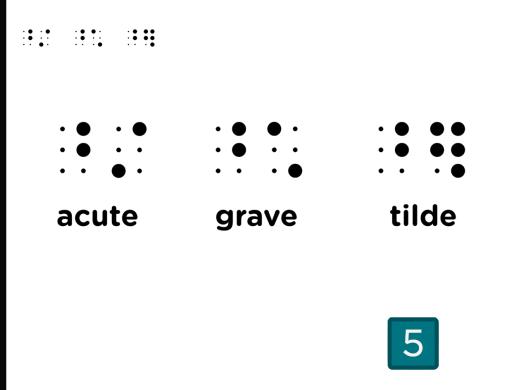
Braille Special Symbols Series
Explore
-
Services You Should Know When New to Vision Loss
Audio · 30 minutes
-
I can’t drive anymore
Resource guide
-
Paying for Eye Treatment: Where to Find Help
Article · 7 minutes
-
Embracing Braille
Discussion
- Explore more
Join the Hadley Community
Hadley's resources are always available to you. Create a no-cost Hadley account to go further:
-
Pick up where you left off Everything you start is automatically saved across Hadley.
-
Personalized recommendations We'll suggest resources based on your interests.
-
Join live discussions Live and lively discussions on technology, cooking, and more, all geared toward the community of people living with vision loss.
-
Find peer support Connect with people who understand what you're going through.