
Workshop 3: Final Alphabetic Wordsigns
Hadley
Contracted Braille
Workshop 3: Final Alphabetic Wordsigns
Opening
Hadley presents Contracted Braille Workshop 3: Final Alphabetic Wordsigns.
Page 1
First, make sure you have your braille workbook with you.
If you don’t already have one, call Hadley at 847-784-2816 and we’ll mail one right out to you.
Let’s learn the last two sets of the alphabetic wordsigns.
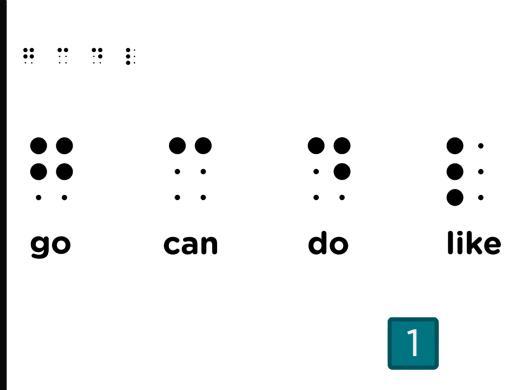
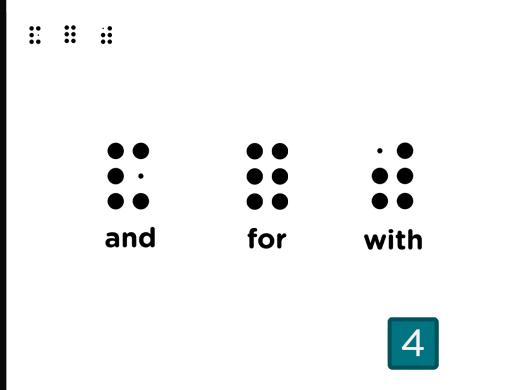
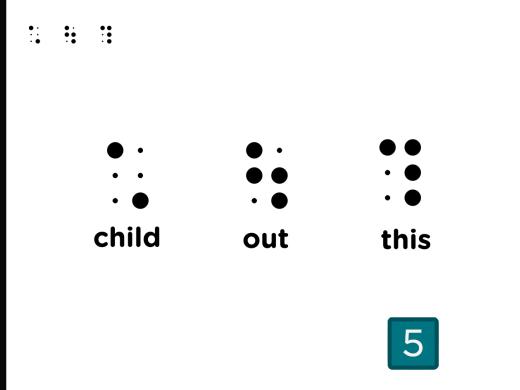
Feel the letters “u,” “f,” “x,” “z” in the top left corner of the page.
Use the Pause button or spacebar for as long as you need to complete an activity item.
Then, select the Play button or press the spacebar again to hear the feedback for that item.
Above the middle line, you’ll find four boxes.
In the first box is u.
When u is by itself, it’s read as the word “us.”
Now, check out the second box.
The letter f is the wordsign “from.”
The next two boxes have something a little different. Read what’s in the third box.
The x by itself is the word “it,” and in that last box the z by itself is the word “as.”
The words “it” and “as” are the only two alphabetic wordsigns that do not begin with the first letter of the word.
Below the middle line, you’ll find a row of words.
Let’s read these words together: “from,” “us,” “it,” “as.”
Feel free to replay this page if you’d like to review these words again.
When you’re ready, turn the page.
Page 2
Feel the braille in the top-left corner of the page. You now know that f stands for the word “from.”
Above the middle line, you’ll find four boxes containing words.
Which box contains the alphabetic wordsign “from?”
If you picked the last box, you found the word “from.”
Below the middle line, you’ll find four rows of braille words.
Place your fingers at the beginning of the first row.
Now, read these four words and find which word is “from.”
If you picked the second word, you got it!
Find the word “from” in the next row.
It’s the first word. Next, find the word “from” in the third row.
This time, the word “from” is the third word.
Finally, find the word “from” in the last row.
In this row, it’s the last word.
Turn the page.
Page 3
Feel the braille in the top left corner of the page.
You now know that u stands for the word “us.”
Above the middle line, find the four boxes containing words.
Which box contains the alphabetic wordsign “us?”
If you picked the second box, you found “us.”
Below the middle line, you’ll find four rows of words.
Place your fingers at the beginning of the first row.
Go ahead and read the four words. Which word is “us?”
The first word is “us.” Now find “us” in the next row.
If you picked the last word, well done!
Next, find the word “us” in the third row.
This time, “us” is the second word.
Finally, find the word “us” in the last row.
It’s the third word.
Turn the page.
Page 4
Feel the braille in the top-left corner of the page.
You now know that x stands for the word “it.”
Above the middle line, find the four boxes containing wordsigns.
Which box contains the alphabetic wordsign “it?”
If you picked the second box, you found it!
Below the middle line, you’ll find four rows of braille words.
Place your fingers at the beginning of the first row.
Read the four words and find which word is “it.”
If you picked the last word, that’s right.
Now, find “it” in the next row.
In this row, “it” is the second word.
Next, find the word “it” in the third row.
This time, “it” is the first word.
Finally, find the word “it” in the last row.
It’s the third word.
Turn the page.
Page 5
Feel the braille in the top left corner of the page.
You now know that z stands for the word “as.”
Above the middle line, find the four boxes containing words.
Which box contains the alphabetic wordsign “as?”
If you picked the last box, you found it!
Below the middle line, you’ll find four rows of words.
Place your fingers at the beginning of the first row.
Go ahead and read the four words. Which word is “as?”
If you picked the third word, that’s right!
Now, find “as” in the next row.
It’s the first word.
Next, find the word “as” in the third row.
This time “as” is the last word.
Finally, find “as” in the last row.
The word “as” is the second word.
Turn the page.
Page 6
Feel the braille in the top left corner of the page: “us,” “from,” “it,” “as.”
This workshop will not give long pauses for each activity item.
Instead, use the Pause button or the spacebar to stop the audio for as long as you need to complete an activity item.
Then, select the Play button or press the spacebar again to hear the feedback for that item.
Above the middle line are three rows of braille.
Which row has the words “it,” “from,” “us,” “as” in that order?
If you chose the last row, great job!
Below the middle line are three sentences.
Read the first sentence.
If you read, “It is as big as you!” great job!
Now read the second sentence.
It says, “He got it from us.”
Finally, what does the third sentence say?
This sentence reads, “But you will not get it from me.”
Turn the page.
Page 7
Feel the word “it” in the top left corner of the page.
Above the middle line, you’ll find three rows of braille.
In the first row, find the word “it’s” brailled correctly, like in the sentence, “It’s cold.”
If you said the first word, you got it.
Notice you can use the apostrophe with alphabetic wordsigns.
Now in the second row, which way shows the word “it’ll,” like “It’ll be fine,” brailled correctly.
The second way is correct.
Finally in row three, which way shows the word “sit” brailled correctly?
The first one is right. Because alphabetic wordsigns stand alone, the word “sit” needs to be spelled out.
Below the middle line, you’ll find a short children’s story using these words with apostrophes: “it’s,” “it’ll,” and “it’d.”
Go ahead and read the first sentence, and feel free to pause anytime it’s helpful.
This says, “It’s a pet pig, so it’s as big as it will get!”
How about the next sentence?
This one says, “Can you toss a toy from you to it?”
Next, what does the third sentence say?
The third sentence says, “It’d like to play, but not sleep.”
Finally, read the last sentence.
If you read, “It’ll have fun as you play, but you will, too,” you did it!
Don’t forget, if you’re having trouble identifying any of the symbols, you can call a braille expert for help.
Turn the page.
Page 8
Feel the abbreviations “US” and “IT” in the top-left corner of the page.
The alphabetic wordsigns for “us” and “it” are not used for abbreviations like “US” for “United States” or “IT” for “information technology” because the abbreviations are not read like words.
The abbreviation uses a capital word indicator and the letters U and S or I and T spelled out.
Above the middle line, you’ll find two sentences.
Let’s read these sentences together.
The first sentence says, “A US flag produces a response.”
Now let’s read the second sentence together.
It says, “An IT director runs a company.”
Notice that abbreviations for US and IT should use a capital word indicator and the letters U and S or I and T spelled out.
If you like, you can pause here to look at these two sentences again and see how US and IT are brailled.
Below the middle line are four rows of braille.
Read the first two rows.
Which row shows the correct way to write the sentence, “Can a US crew get us more help?”
If you chose the second sentence, you are right!
Now read the last two rows.
Which row shows the correct way to write the sentence, “IT improves from week to week?”
The first one is correct. The second sentence says, “It improves from week to week.”
Turn the page.
Page 9
Feel the braille words “us,” “from,” “it,” “as” in the top left corner of the page.
Above the middle line are four numbered rows of braille. These are a little tricky.
In the first row, find “us.”
If you chose the first word, you got it!
Now in the second row, which word is “it?”
It is the second word. For the third row, find “from.”
In this row, “from” is the last word.
Can you find “as” in the fourth row?
It’s the third word.
Below the middle line are four sentences.
Read the first sentence and if you’d like some extra time, pause the audio.
The first sentence says, “It’s as big as it can get.”
What about the second sentence?
If you read, “I have to go from my job to my home,” you got it!
Next, read the third sentence.
It says, “Give a gift from us to you!”
Finally, what does the last sentence say?
This one says: Did he say, “I hope he likes us all?”
Turn the page.
Page 10
Feel the words “us,” “from,” “it,” and “as” in the top left corner of the page.
Above the middle line, you’ll find three rows of braille. Read the first row.
This row says, “Dr. Frome.”
Notice that the alphabetic wordsign cannot be used in the name “Frome” because alphabetic wordsigns cannot touch any other letters. And here it would touch the e.
In the second row, which word has the word “bus” brailled correctly?
The third word is correct.
How about the third row? Which word for “has” is brailled correctly?
If you picked the middle choice, you got it!
The alphabetic wordsign for “as” cannot be used as part of a word.
And the h by itself is the alphabetic wordsign for “have.”
Below the middle line is a list of numbered sentences.
Read sentences one and two and decide which sentence has the correct braille.
As always, use the Pause-Play button for enough time to read.
The second sentence is correct. “Don’t go to/from my home.”
“Don’t” must be spelled out because “do” isn’t standing alone.
And the alphabetic wordsign “from” cannot touch the forward slash.
Now, read sentences three and four. Which one is brailled correctly?
If you chose sentence three, you got it!
“Can’t you get it–it’s not too big?”
The alphabetic wordsign should be used in the word “can’t” because it’s standing alone next to the apostrophe.
Also, the alphabetic wordsign for “it” in the word “it’s” can be used next to the dash.
Turn the page.
Page 11
Feel the letters “t,” “q,” “v,” “j” in the top left corner of the page.
These are four more alphabetic wordsigns.
Above the middle line, you’ll find four boxes.
In the first box, you’ll find t.
When t is by itself, it’s read as the word “that.”
Now check out the second box.
The letter q is the word “quite.”
In the third box, v by itself is the word “very.”
And in that last box, j is the word “just.”
Below the middle line, you’ll find a row of words.
Go ahead and read these words: “that,” “quite,” “very,” “just.”
Turn the page.
Page 12
Feel the braille in the top left corner of the page.
You now know that t stands for the word “that.”
Above the middle line, you’ll find four boxes containing words.
Which box contains the alphabetic wordsign “that?”
If you picked the third box, you’ve found the word “that.”
Below the middle line, you’ll find four rows of braille words.
Place your fingers at the beginning of the first row.
Now, read these four words. Which one is “that?”
If you picked the third wordsign, you got it!
Find the word “that” in the next row.
It’s the second word.
Next, find the word “that” in the third row.
This time, the word “that” is the first word.
Finally, find the word “that” in the last row.
In this row, “that” is the last word.
Turn the page.
Page 13
Feel the braille in the top left corner of the page.
You now know that q stands for the word “quite.”
Above the middle line, you’ll find four boxes containing words.
Which box contains the alphabetic wordsign “quite?”
If you picked the fourth box, you got it right!
This is “quite.”
Below the middle line, you’ll find four rows of words.
Place your fingers at the beginning of the first row.
Go ahead and read the four words.
Find the word “quite” in the first row.
It’s the second word.
Now, find “quite” in the next row.
If you picked the first word, well done!
Next, find the word “quite” in the third row.
This time, “quite” is the last word.
Finally, find the word “quite” in the last row.
In the last row, “quite” is the third word.
Turn the page.
Page 14
Feel the braille in the top left corner of the page.
This is v for the wordsign “very.”
Above the middle line, find the four boxes containing words.
Which box contains the alphabetic wordsign “very?”
If you picked the second box, you got it. This is “very.”
Below the middle line, you’ll find four rows of words.
Place your fingers on the first row. Find “very.”
It’s the first word in this row.
Which word is “very” in the second row?
This time, “very” is the last word.
And where is “very” in the third row?
If you said the third word, you got it!
Finally, find the word “very” in the last row.
The last word is “very.”
Turn the page.
Page 15
Feel the braille in the top-left corner of the page.
The letter j on its own stands for the word “just.”
Above the middle line, you’ll find four boxes containing words.
Which box contains the alphabetic wordsign “just?”
If you picked the first box, you found “just.”
Below the middle line, you’ll find four rows of words.
Place your fingers at the beginning of the first row. Which word is “just?”
The first word is “just.” Now, find “just” in the next row.
If you picked the second word, you found it!
Next, find “just” in the third row.
This time, “just” is the last word.
Finally, find “just” in the last row.
It’s the last word again.
Turn the page.
Page 16
Feel the braille words “that,” “quite,” “very,” and “just” in the top left corner of the page.
Above the middle line are three rows of braille.
Which row has the words “just,” “very,” “quite,” “that” in that order?
Select Pause while you read. Then select Play when you’re ready for the feedback.
If you chose the last row, great job!
Below the line are three sentences.
Now, read the first sentence.
The first sentence says, “That is not quite complete yet.”
Now read the next sentence.
This one says, “That’s a very big gift from you!”
Did you notice the alphabetic wordsign was used in the word “that’s?”
Finally, read the last sentence.
Did you read, “Will Rose just do more next week?” You got it!
If you need to pause to read these sentences again or replay this page, go ahead.
When you’re ready, turn the page.
Page 17
Feel the braille words “very,” “just,” “that,” “quite” in the top left corner of the page.
Above the middle line, you’ll find four rows of braille.
Go ahead and read the words on the first row to find the correct braille for “that’s,” as in, “That’s great!”
Again, for each word, select Pause to find it and then Play to get the feedback.
If you picked the first word, you found it!
Now check out the words on the second row to find “quite.”
It’s the second word.
Next, read the third row to find the word “just.”
The second word is “just.”
Finally, read the words in the last row to find the word “very.”
The word “very” is brailled correctly in the first word.
Below the middle line, you’ll find four fill-in-the-blank sentences.
Read the first sentence. Then pause the audio to use one of the words from the four rows above the line to fill in the blank.
For sentence one, did you choose the word “that’s,” “t’s,” to make the sentence, “That’s it?”
Now fill in the blank for sentence two.
Did you choose the “q” for “quite” to make the sentence, “A million is quite a lot.”
Now try the third sentence.
Sentence three should read, “I will have just two more.”
The letter j works here for “just.”
Finally choose a word for sentence four.
Did you choose v for “very?”
The last sentence should read, “It is so very pretty!”
Turn the page.
Page 18
Feel the braille words “quite,” “very,” “just,” “that” in the top left corner of the page.
Above the middle line are four numbered rows of braille.
In the first row, find “that.”
If you chose the third word, you got it!
Now in the second row, find “quite.”
It’s the last word. For the third row, find “just.”
The first word is” just.”
Can you find “very” in the last row?
It’s the last word.
Below the middle line are four sentences.
Read the first sentence.
This sentence reads, “It is quite likely we will go on 6/28.”
Now read the second sentence.
This one says, “That’s okay, but not at 2:30 a.m.”
How about the third sentence?
It says, “Will you just go to Miami, or Tampa as well?”
Now the last sentence.
This one says, “You will want a jacket; just not THAT jacket.”
If this seemed tricky or you have any questions at all, you can always call a braille expert.
Turn the page.
Page 19
Feel the braille words “but,” “as” in the top left corner of the page.
Let’s read a few more sentences using all of our wordsigns.
Above the middle line are three sentences.
Read the first sentence and use the Pause-Play button or spacebar to give yourself time to read.
The first sentence says, “We have quite a cold front that is very breezy!”
Now read the middle sentence.
If you read, “I am very sore from that run, but I will not quit,” great job!
Finally, let’s try the last sentence above the line.
This one says, “I sew just as well as you (so we will do it!).”
Below the middle line, you’ll find four more sentences.
Read the first two sentences to find the one that’s brailled correctly.
If you chose the first sentence, that’s right!
This one says, in quotation marks, “That’s very like you, but you’ve not quite got it.”
Now read the last two sentences. Which of these is brailled correctly?
The last sentence is right. It says, “It’s just-not-quite 3:15 yet.”
The correct sentences both use the alphabetic wordsigns with punctuation.
Turn the page.
Page 20
Feel the braille in the top-left corner of the page. These are the words “as” and “but.”
Above the middle line is one sentence using many alphabetic wordsigns.
Read it and notice how much space is saved using those contractions.
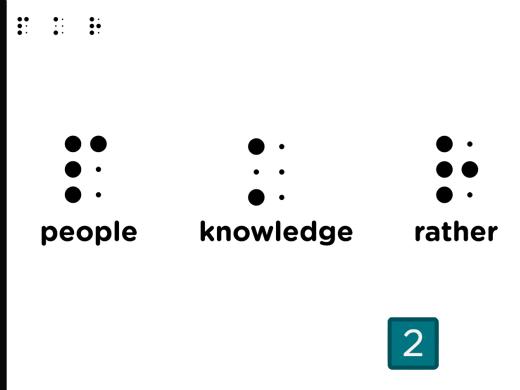
This sentence says, “People rather like knowledge from books but do not do more to prove it.”
Below the middle line are four sentences. Read the first sentence.
This one says, “To have knowledge is rather important.”
How about the next sentence?
The second sentence says, “If you’d like, you can get every piece you want.”
What does the third sentence say?
The third sentence reads, “A horde can have people, animals, or bugs.”
Finally, read the last sentence.
If you read, “People like us do more fun activities,” you got it!
Turn the page.
Page 21
Feel the word “it” in the top-left corner of this page.
Above the line, you will find four rows of braille.
Sometimes, it’s handy to jot down notes to discuss when we visit the doctor.
Read the first sentence above the line.
If you read, “Doctor Visit Notes,” you got it!
Now read the second sentence.
This is the question, “Will it help us to walk as soon as we wake?”
How about the third sentence?
The third sentence says, “Do I take that pill more or less if I eat?”
Now read the last sentence.
This one reads, “Will I get a call from a Dr. at 2:30?”
Below the middle line, you’ll find five more sentences.
Read the first one. In this sentence, what is important to tell the doctor?
If you said, “every detail,” that’s it!
Now, read the second sentence below the line.
What should you have less of?
It says, “less salt, not more.”
What does the third sentence say to get more of?
It says, “more fruit or more vegetables.”
Next, read the fourth sentence to find what it tells you about liquids.
This one says, “It will help us to just have more liquids!”
Finally, what does the last sentence tell you to do?
If you said, “use more vigor as I walk every week,” that’s it!
Now you can write your own notes to discuss with your doctor or someone else.
When you’re ready, select Next to complete this workshop.
Completion
Congratulations, you’ve learned eight new alphabetic wordsigns!
You’ve learned all the alphabetic wordsigns. If you’d like to talk to a braille expert or order the next set of workbooks, call 847-784-2816. We’re happy to help out!
Contracted Braille Series
- Workshop
Explore
-
Artificial Intelligence (AI) and Vision Loss: Tools You Should Know
Audio · 37 minutes
-
I was just diagnosed
Resource guide
-
5 Ways to Make Technology for Vision Loss More Affordable
Article · 4 minutes
-
Book Nook
Discussion
- Explore more
Members also liked
- Workshop

- Video · 6 minutes
- Workshop
Join the Hadley Community
Hadley's resources are always available to you. Create a no-cost Hadley account to go further:
-
Pick up where you left off Everything you start is automatically saved across Hadley.
-
Personalized recommendations We'll suggest resources based on your interests.
-
Join live discussions Live and lively discussions on technology, cooking, and more, all geared toward the community of people living with vision loss.
-
Find peer support Connect with people who understand what you're going through.