
Workshop 5: Strong Wordsigns child, out, this, shall, still, which
Hadley
Contracted Braille
Workshop 5: Strong Wordsigns: child, out, this, shall, still, which
Opening
Hadley presents Contracted Braille, Workshop 5, Strong Wordsigns: child, out, this, shall, still, which.
Page 1
To begin, make sure you have your braille workbook with you.
If you don’t already have one call Hadley at 847-784-2816 and we’ll mail one right out to you.
Feel the braille in the top left corner of the page.
These new symbols are called strong wordsigns.
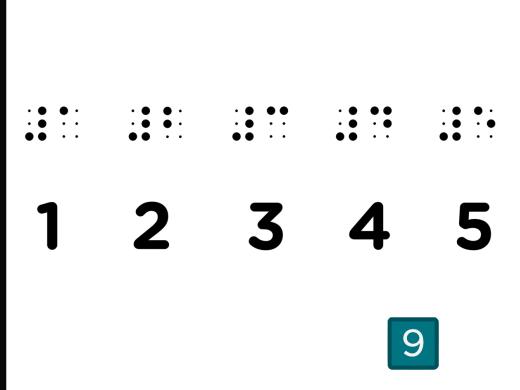
These three strong wordsigns stand for the whole words, “child,” “out,” and “this.”
Like other strong contractions, strong wordsigns use dots in the top and bottom and the first and second sides of the braille cell.
Above the middle line, you’ll find three rows of braille.
Feel the first row. This is the word “child.”
Now feel the second row. This is the word “out.”
And now, the last row. It’s the word “this.”
Below the middle line, you’ll find a row of words.
Let’s read these words together: “child, out, this.”
Turn the page.
Page 2
Feel the braille in the top left corner of the page.
This is the strong wordsign “child,” dots 1-6.
Child uses the top dot on the first side and the bottom dot on the second side of the cell.
Above the middle line, you’ll find three rows of braille.
Just use the Pause button or spacebar for as long as you need to complete an activity item.
Then, select the Play button or press the spacebar again to hear the feedback for that item.
Which row has the wordsign “child?”
If you said the second row, you’re right!
Below the middle line, you’ll find three more rows of braille.
Read the first row. Which word is “child?”
“Child” is the last word. And which word is “child” in the second row?
If you said the first one, you got it!
Finally, read the last row to find the word “child.”
In this row, it’s the last word.
Turn the page.
Page 3
Feel the braille in the top left corner of the page.
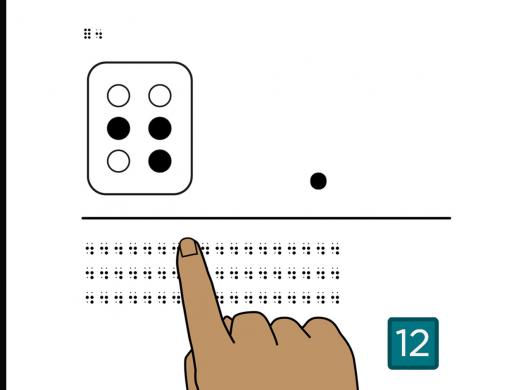
This is the strong wordsign “out,” dots 1-2-5-6.
It uses the top and middle dots on the first side and the middle and bottom dots on the second side of the cell.
Above the middle line, you’ll find three rows of braille.
Which row has the wordsign “out?”
If you said the last row, you found “out.”
Below the middle line, you’ll find three rows of braille.
Read the first row of braille. Which word is “out?”
“Out” is the last word. Now, which word is “out” in the second row?
If you said the middle word, you got it!
Finally, let’s read the last row to find the word “out.”
This time, it’s the first word.
Turn the page.
Page 4
Feel the braille in the top left corner of the page.
This is the strong wordsign “this,” dots 1-4-5-6.
It uses the top dot on the first side of the cell and the top, middle, and bottom dots on the second side.
Above the middle line, you’ll find three rows of braille.
Read the three rows. Which row has the word “this?”
Did you find “this” in the second row? That’s correct!
Below the middle line, you’ll find three more rows of braille.
Read the first row and find the word “this.”
“This” is the middle word. Now, in the second row, which word is “this?”
In the second row, “this” is the last word.
Finally, read the last row to find the word “this.”
If you said the first word, great!
Turn the page.
Page 5
Feel the braille words, “child,” “out,” and “this” in the top left corner of the page.
Above the middle line, you’ll find three rows of braille.
Which row has the wordsigns “child,” “this,” and “out,” in that order?
If you said the last row, you got it!
Below the middle line, you’ll find three braille sentences.
Read the first sentence.
Use the Pause button or spacebar for as long as you need to complete an activity item.
Then select the Play button or press the spacebar again when you’re ready to keep going.
This says, “Did you see that dog jump out of the truck?”
Now read the second sentence.
It says, “Try this cake to see if you like it.”
And finally, what does the last sentence say?
If you read, “My child ran a 2-mile race this week,” you got it!
Turn the page.
Page 6
Feel the words, “out,” “this,” and “child” in the top left corner of the page.
Above the middle line, you’ll find three rows of braille with these wordsigns.
These words will be used to fill in the blanks to complete the sentences below the line.
Read the three rows.
Below the middle line, you’ll find five sentences. Each one has a blank.
You can use the words above the middle line to complete each of the sentences.
Read the first sentence and choose a word to fill the blank.
If you chose the first word above the middle line, “child,” that’s the right one!
The sentence should say, “My child loves to play games.”
Now read the second sentence, and choose a word to fill the blank.
This time, the right word is the second word above the middle line, “out.”
The sentence reads, “Can we go out for a walk on 8/26?”
What about the third sentence?
The third word above the middle line, “this,” fits here.
It says, “I like it cool; more-so this fall.”
Now read the fourth sentence, and choose which word should fill in the blank.
The second word above the middle line, “out,” works here.
This one says, “Can you go out to grill food for us at 6:30?”
Finally, read the last sentence. The blank is the first word of the sentence this time.
The third word above the middle line, “this,” fits here.
The sentence reads, “This black cat will make a very nice pet for us.”
If you’d like to practice this page again, select Replay.
Turn the page.
Page 7
Feel the braille in the top left corner of the page.
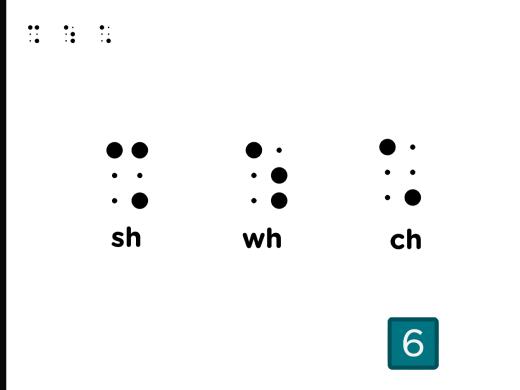
These are three more strong wordsigns.
These strong wordsigns stand for the words, “shall,” “still,” and “which.”
Above the middle line, you’ll find three rows of braille.
The first row is the word “shall.”
The second row contains the word “still.”
And in the last row, you’ll find the word “which.”
Below the middle line, you’ll find a row of words.
Let’s read these words together: “shall, still, which.”
Turn the page.
Page 8
Feel the braille in the top left corner of the page.
This is the strong wordsign “shall,” dots 1-4-6.
“Shall” uses the top dot on the first side and the top and bottom dots on the second side of the cell.
Above the middle line, you’ll find three rows of braille.
Read these three rows. Which row has the wordsign “shall?”
If you said the middle row that’s right!
Below the middle line, you’ll find four rows of braille.
Read the words on the first row. Which word is “shall?”
“Shall” is the first word. Now which word is “shall” in the second row?
If you said the last word, you got it!
Where is “shall” in the third row?
“Shall” is the middle word.
Finally read the last row and find the word “shall.”
It’s the last word.
Turn the page.
Page 9
Feel the braille in the top left corner of the page.
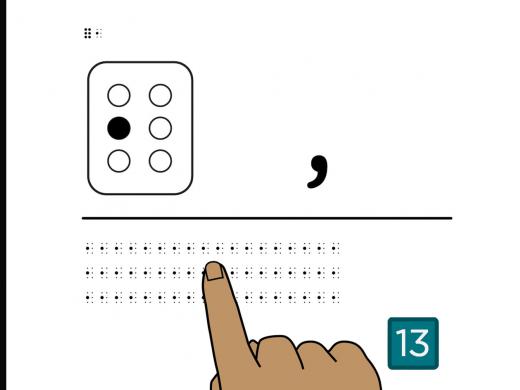
This is the strong wordsign “still,” dots 3 and 4.
“Still” uses the bottom dot on the first side of the cell and the top dot on the second side.
Above the middle line, you’ll find three rows of braille.
Read these three rows. Which row has the wordsign “still?”
If you said the first row, you’re right!
Below the middle line, you’ll find four rows of braille.
Read the first row. Which word is “still?”
If you said the last word, you found it!
Now, which word is “still” in the second row?
“Still” is the first word.
What about the third row? Which is “still?”
This time, it’s the middle word.
Finally, read the last row and find the word “still.”
This time, “still” is the last word.
Turn the page.
Page 10
Feel the braille in the top left corner of the page.
This is the strong wordsign “which,” dots 1-5-6.
“Which,” uses the top dot on the first side and the middle and bottom dots on the right side of the cell.
Above the middle line, you’ll find three rows of braille.
Which row has the wordsign “which?”
If you said the last row, you got it!
Below the middle line, you’ll find four rows of braille.
Read the first row and find the wordsign “which.”
“Which” is the last word. Now find “which” in the second row.
If you said the middle word, that’s correct!
How about the third row, where is “which?”
“Which” is the last word this time.
Finally, read the last row to find the word “which.”
This time, “which” is the first word.
Turn the page.
Page 11
Feel the words, “shall,” “still,” and “which” in the top left corner of the page.
Let’s read a few sentences using these wordsigns.
Above the middle line, you’ll find three sentences.
Select Pause to read a sentence, then Play to check your reading.
If you read, “I shall make cupcakes,” you got it!
Now, read the second sentence.
This one says, “Do you still like to walk laps?”
And what does the last sentence say?
The last sentence reads, “Which cat ran up the tree?”
Below the middle line are six more sentences.
Read sentences one and two and find which one is correctly brailled to say, “Which child still sleeps?”
Sentence two is right! It correctly uses the strong wordsigns “child” and “still.”
Sentence one reads, “Which still child sleeps?” That was a tricky one.
Now, let’s look at sentences three and four to find the one that’s correctly brailled for, “Which movie shall we go see?”
If you chose sentence three, you got it! Sentence three correctly uses “which.”
In sentences five and six, which one uses “shall” correctly?
If you said sentence five, that’s it!
Sentence five says, “Pam shall help this child.”
Turn the page.
Page 12
Feel the words “child,” “still,” “out,” “this,” “which,” and “shall” in the top left corner of the page.
These strong wordsigns can touch punctuation, except for the forward slash.
Above the middle line, you’ll find three rows of braille.
Read the first row.
If you read, “still-life,” you’re right!
Notice the wordsign “still” can be used with the hyphen.
Next, read the second row of braille.
It reads, “child’s.” Again, the wordsign can be used here, next to the apostrophe.
Now, read the third row.
The third row says, “this/that.” “This” and “that” must each be spelled out beside the forward slash.
Below the middle line, you’ll find four sentences.
Read the first sentence and count the number of wordsigns.
The first sentence reads: The child sang “Out, out, out!”
There are five wordsigns in this sentence. “The,” “child,” “out,” “out,” and “out” are all wordsigns.
Notice that the strong wordsign “out” is touching the opening and closing quotation marks, commas, and exclamation point.
Now, let’s read the second sentence.
If you read, “Which item, THIS?” you got it!
The wordsign “this” can be used with a capital word indicator and a question mark.
What about the third sentence?
This one says, “A child/baby will get in free.”
You’ve learned that “child” must be spelled out beside the forward slash.
Finally, read the last sentence.
The last sentence is, “This is a still-relevant law.”
The wordsign “still” can be used with the hyphen.
If you found this tricky or you have any questions, reach out to a braille expert for help at
847-784-2816.
Turn the page.
Page 13
Feel the words, “shall,” “child,” “out,” “this,” “still,” and “which” in the top left corner of the page.
Above the middle line, you’ll find three sentences.
Pause the audio to read all three sentences. Then play the audio when you’re ready for the questions.
Which sentence says, “Which child is STILL out?” with the word “still” in all capitals?
If you said the second sentence, that’s right!
Now, let’s take another look at those sentences.
Which one says, “Which child is (still) out?” with parentheses around the word “still?”
The last sentence uses parentheses.
Finally, which sentence says: Which child is “still” out? with quotation marks around “still?”
The first sentence has quotation marks around the wordsign “still.”
Below the middle line, you’ll find four fill-in-the-blank sentences.
And below each sentence, you’ll find two choices to fill in the blank.
Read sentence one and choose which word completes it.
For this sentence, the first word below it, “out,” is the right choice.
The sentence should read, “I shall go out to take pictures of nature.”
Now read sentence two and select the word that best completes it.
If you chose the second word below it, “child,” you got it!
“The mom and child look lovely by that bridge.” How about sentence three?
The second word below it, “shall,” fits here.
This sentence should read, “I shall come at 5:30.”
And finally, choose the word that fills in the blank for sentence four.
The first answer below it is right.
This one reads, “I will buy this book for my wife.”
If this page was a little tricky and you’d like to try it again, just select Replay.
When you’re ready, turn the page.
Page 14
Feel the braille words, “child,” “out,” “this,” “which,” “shall,” and “still” in the top left corner of the page.
Above the middle line, you’ll find two columns of words.
Which column correctly shows the words, “which,” “shall,” “this,” “out” in that order?
If you said the second column, you got it!
Below the middle line, you’ll find a set of notes about setting up for a rummage sale.
Read the notes, and when you’re done, we’ll look at a few questions about the rummage sale.
One of the sentences tells us when someone is coming to the sale.
What time are they coming?
They’re planning to come at 7:15 AM. That’s in the second sentence.
Now, which item still has tags on it?
It’s the coat, according to the fourth sentence.
Can you find where the sign needs to go?
It goes out on the deck. That’s in the third sentence.
And finally, there are two things at the sale for a child. What are those two things?
If you said, “books” and “toys,” that’s great!
The first and last sentences tell us about items a child would like.
Select Next to complete this workshop.
Completion
Congratulations! You’ve learned six strong wordsigns.
Now you’re ready to use them in your own notes, to-do lists, and more.
If you’d like to speak with a braille expert, call 847-784-2816, and they’ll be happy to help you out.
Contracted Braille Series
- Workshop
Explore
-
The Impact of Vision Loss on a Marriage
Audio · 22 minutes
-
I'm having trouble reading
Resource guide
-
Feeling Judgment and Shame: Misunderstandings due to vision loss
Article · 5 minutes
-
Writers' Circle
Discussion
- Explore more
Members also liked
- Video · 6 minutes
- Workshop
Join the Hadley Community
Hadley's resources are always available to you. Create a no-cost Hadley account to go further:
-
Pick up where you left off Everything you start is automatically saved across Hadley.
-
Personalized recommendations We'll suggest resources based on your interests.
-
Join live discussions Live and lively discussions on technology, cooking, and more, all geared toward the community of people living with vision loss.
-
Find peer support Connect with people who understand what you're going through.