Workshop 4: Strong Contractions and, for, with, the, of
Hadley
Contracted Braille, Strong Contractions: and, for, with, the, of
Opening
Hadley presents Contracted Braille, Workshop 4, Strong Contractions: and, for, with, the, of.
Page 1
To begin, make sure you have your braille workbook with you.
If you don’t already have one, call Hadley at 847-784-2816 and we’ll mail one right out to you.
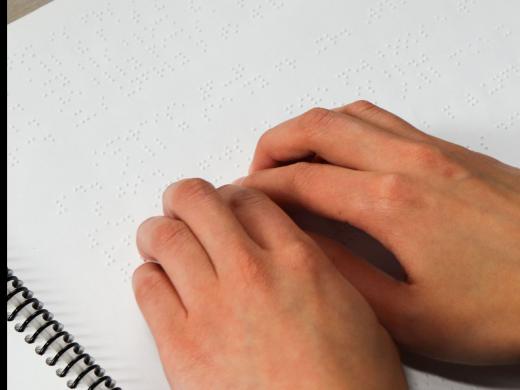
Feel the braille in the top left corner of the page.
These new symbols are called strong contractions.
These strong contractions stand for the whole words “and,” “for,” and “with.”
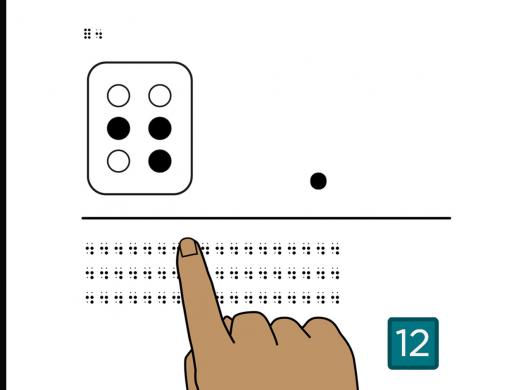
Strong contractions use dots in the top and bottom and in the first and second sides of the braille cell.
Let’s try something a little different.
Above the middle line, you’ll find three rows of braille.
Notice that there are no spaces between the rows of braille.
Single spacing is how most braille is written.
Place your fingers on the first row of braille above the middle line.
This is the word “and,” a-n-d. Now, feel the second row.
This is the word “for,” f-o-r. And feel the last row.
This is the word “with,” w-i-t-h.
Below the middle line, you’ll find a row of words.
Let’s read these words together: “and, for, with.”
Turn the page.
Page 2
Feel the braille in the top-left corner of the page.
This is the word “and,” dots 1-2-3-4-6.
The word “and” uses all three dots on the first side of the cell and the top and bottom dots on the second of the cell.
Above the middle line, you’ll find three rows of braille.
Just use the Pause button or spacebar for as long as you need to complete an activity item.
Then, select the Play button or press the spacebar again to hear the feedback for that item.
Find the row that contains word “and.”
Did you find “and” in the first row? That’s right!
Below the middle line, you’ll find four more rows of braille words.
Read the three words in the first row. Which word is “and?”
If you picked the third word, you found “and.”
Now, find the word “and” in the second row.
In this row, “and” is the first word.
Next, find the word “and” in the third row.
This time, “and” is the middle word.
Finally, find “and” in the last row.
In this row, “and” is the last word.
Turn the page.
Page 3
Feel the full cell in the top left corner of the page. In contracted braille, this is the word “for,” f-o-r.
It’s the full cell, or all six dots.
The word “for” uses all three dots on the first side, and all three dots on the second side.
Above the middle line, you’ll find three rows of braille.
Read the three rows, and find which row contains the word “for.”
“For” is in the last row.
Below the middle line, you’ll find four rows of braille.
Read the words in the first row. Which word is “for?”
It’s the first word. Now, find the word “for” in the second row.
This time “for” is the last word.
Next, find the word “for” in the third row.
If you said it’s the last word again, you’re right!
Finally, where is “for” in the last row?
“For” is the middle word.
Turn the page.
Page 4
Feel the braille in the top left corner of the page.
This is the word “with,” dots 2-3-4-5-6.
The word “with” uses the middle and bottom dots on the first side and all three dots on the second side.
Above the middle line, find the three rows of braille.
Which row contains the word “with?”
Did you find “with” in the middle row? You got it!
Below the middle line are four rows of braille words.
Read the words in the first row and find which word is “with.”
It’s the middle word.
Now find “with” in the second row.
This time “with” is the last word.
Next find “with” in the third row.
Did you say it’s the first word? That’s right!
Finally, where is “with” in the last row?
“With” is the first word again!
Turn the page.
Page 5
Feel the braille words “for,” “with,” and “and” in the top left corner of the page.
Use the Pause button or spacebar for as long as you need to complete an activity item.
Then select the Play button, or press the spacebar again when you’re ready to keep going.
Above the middle line are three rows of braille.
Read the three rows. Which row has the words “with,” “and,” “for” in that order?
If you chose the second row, great job! This says “with,” “and,” “for.”
Below the middle line are four sentences.
Read the first sentence.
This sentence says, “That is not for you.”
Now read the second sentence.
The second sentence reads, “He is with Sylvia.”
How about the third sentence?
This one says, “I like to pay with crisp bills.”
And the last sentence?
If you said, “Will James and Ella go too?” you’re right!
If you found this tricky, or you just want to practice some more before moving on, go ahead and replay the page as many times as you like.
Turn the page.
Page 6
Feel the braille in the top left corner of the page.
These new symbols are two more strong contractions.
These strong contractions stand for the words “of,” o-f and “the,” t-h-e.
Read the braille in the first row above the middle line.
This is “of.” Now, read the second row.
This is the word “the.”
Below the middle line, you’ll find a row of words.
Let’s read these words together: “of the of the of the.”
Turn the page.
Page 7
Feel the braille in the top-left corner of the page.
This is the word “of,” dots 1-2-3-5-6.
The word “of” is all three dots on the first side of the cell and the middle and bottom dots on the second side of the cell.
Above the middle line, you’ll find two rows of braille.
Which row contains the word “of?”
Did you find it in the second row? That’s correct!
Below the middle line, you’ll find four rows of braille words.
Read the three words in the first row. Which word is “of?”
If you picked the first word, you got it!
Now, find the word “of” in the second row.
In this row, “of” is the last word.
Next, find the word “of” in the third row.
This time, the word “of” is the middle word.
Finally, find the word “of” in the last row.
It’s the first word.
Turn the page.
Page 8
Feel the braille in the top left corner of the page.
This is the word “the,” dots 2-3-4-6.
The word “the” uses the middle and bottom dots on the first side and the top and bottom dots on the second side.
Above the middle line, you’ll find two rows of braille.
Which row contains the word “the?”
Did you find it on the first row? You got it!
Below the middle line, you’ll find four rows of braille words.
Read the three words in the first row.
Which word is “the?”
The word “the” is the middle word.
Now find the word “the” in the second row.
If you picked the first word that’s right!
Next find the word “the” in the third row.
This time, the word “the” is the last word.
Finally, find the word “the” in the last row.
In this row, “the” is the last word again.
Turn the page.
Page 9
Feel the braille words, “the” and “of” in the top left corner of the page.
Let’s do something a little different.
Above the middle line, you’ll find two vertical columns of words.
Scan to find the two columns.
When you’re reading words in columns, you generally read one column at a time from top to bottom.
Read the words in each column and find which column has the words “and,” “for,” “of,” “the,” “with” in that order.
Pause the audio to read the columns.
Then play the audio after you find the column that reads, “and,” “for,” “of,” “the,” “with.”
If you said the second column, you’re right!
The second column reads, “and,” “for,” “of,” “the,” “with” from top to bottom.
Below the middle line are three sentences.
What does the first sentence say?
The first sentence reads, “Sam plays the trumpet.”
Now read the second sentence.
This one says, “A lot of people like jam on biscuits.”
How about the third sentence?
The third sentence reads, “We saw the movie George of the Jungle.”
Finally, read the last sentence.
If you said, “Is the date of the play 4/15?” you are right!
If you’d like to practice this page again, use the replay button.
When you’re ready, turn the page.
Page 10
Feel the braille words “and,” “for,” “of,” “the,” and “with” in the top left corner of the page.
These strong contractions can be used with indicators and with punctuation, including the forward slash.
Above the middle line are three phrases.
Read the first phrase.
Which strong contraction is touching punctuation?
If you said the word “with,” that’s right!
“With” in the phrase, (with nuts) is touching the opening parenthesis.
Which strong contraction is touching punctuation in the second phrase?
In this phrase, “Ricky–the boss,” the word “the” is touching the dash.
How about the third phrase? Which strong contraction is touching punctuation here?
This phrase says, “and/or.” The word “and” is touching the forward slash.
Below the middle line are six rows of braille. They’re grouped together in three pairs.
Read rows one and two.
Which row is correctly brailled to say, “employee-of-the-week?”
Row two correctly uses the strong contractions “of” and “the.” They’re used right next to hyphens.
Now, read rows three and four.
Which of these is correct to use for a “For Sale” sign?
If you said row three, that’s correct!
You can use a strong contraction with the capital indicator.
How about rows five and six? Which one is correct?
This phrase says, “(with lime and ice)” in parentheses.
Row six correctly uses the strong contraction “with” next to the parenthesis.
If you have questions about using contractions with indicators and punctuation or anything else call a Hadley braille expert at 847-784-2816.
Turn the page.
Page 11
Feel the braille in the top left corner of the page.
These are the words “and” and “hand.”
There are two different uses for strong contractions.
As you’ve learned, strong contractions are used as whole words.
But these contractions can also be used as group signs or part of a word.
Above the middle line, you’ll find five rows of braille that use strong contractions as group signs.
Let’s look at the first row.
This is the word “fort.”
Notice that it uses the group sign f-o-r.
Now read the second row.
This is the word “soft,” using the group sign o-f.
What’s the word in the third row?
If you read, “sand,” you got it!
Sand uses the a-n-d contraction.
How about the fourth row?
This one says, “theme.”
Notice the t-h-e contraction.
Now read the last row.
This is the word “withhold.” It uses the w-i-t-h contraction.
Notice that these strong group signs can be used at the beginning, middle, or end of a word.
Below the middle line, you’ll find five rows of braille.
On the first row, which word says, “demand?”
In the first row, the last word is “demand.”
Now, read the words on the second row. Which word says “fortune?”
The middle word is “fortune.”
How about the third row? Which word is “hoof?”
If you found “hoof,” the last word, that’s right!
Now on the fourth row, find “withdrew.”
“Withdrew” is the middle word.
Finally, on the last row, find the word “theft.”
“Theft” is the first word.
When you’re ready, turn the page.
Page 12
Feel the words “for” and “fort” in the top left corner of the page.
Above the middle line, you’ll find a list of seven words.
Read the list of words.
Which three words are strong contractions used as whole words?
The three strong contractions used as whole words are, “of” in the second row, “with” in the fifth row, and “the” in the last row.
Now, find the four words in which strong contractions are used as group signs.
If you read, “handy,” “off,” “reform,” and “Matthew” you found them all!
Below the middle line, you’ll find six sentences.
In the first sentence, which words contain strong contractions?
Did you find them in “candy,” “with,” “coffee,” and “for?”
The sentence says, “Do you like candy with a cup of coffee for a snack?”
Which words contain strong contractions in the second sentence?
The strong contractions in the second sentence are in, “Amanda,” “soft,” “with,” and “coffee.”
It says, “Amanda likes soft rolls with tea, not coffee.”
Where are the strong contractions in the third sentence?
They’re in the words “with” and “foreign.”
The sentence says, “You can pay with a swipe, but not foreign bills!”
How about the fourth sentence?
The words “withdrawal” and “the” in the question, “Will you have to make a withdrawal from the bank?” use strong contractions.
Can you find four strong contractions in the fifth sentence?
If you found them in the words “the,” “of,” “coffee,” and “profit” you got it!
The sentence says, “Does the sale of coffee make a profit?”
And finally, where are the strong contractions in the last sentence?
They’re in the words “afford” and “fortune.”
It reads, “I can only afford a fortune cookie.”
Were these sentences tricky?
You can replay this page and try it as many times as you’d like or call a braille expert for help.
When you’re ready, turn the page.
Page 13
Feel the words “and,” “for,” “of,” “the,” and “with” in the top left corner of the page.
Above the middle line, you’ll find two columns of words.
Which column has “theft,” “softly,” “forgo,” and “sand” brailled correctly?
If you said the second column, that’s right!
The second column correctly uses these strong contractions as group signs.
Below the middle line, you’ll find six rows of braille.
Let’s try something new here.
Read the first row, marked number one, and notice the blank at the end of the sentence.
Now read the two words in the second row.
Which of these two words would you put in the blank to complete the sentence?
If you said the second word, “off,” that’s correct!
It contains the group sign o-f and then includes another f.
The sentence should say, “The bandage got wet and fell off.”
Now, read sentence number two and find the blank.
In the next row, choose the word that correctly completes the sentence.
The first word, “proof,” is correct.
This makes the sentence, “The clue is proof of the crime.”
The second word doesn’t work because it only has one o.
How about sentence number three? Which word below this sentence completes this one?
The second word is right.
Now the sentence reads, “The dog is dirty, so I will bathe it.”
The first word has the letter z instead of the t-h-e group sign.
Turn the page.
Page 14
Feel the words “for,” “the,” “of,” “with,” “and,” in the top left corner of the page.
Above the middle line, you’ll find five rows of braille.
There’s a title and four sentences.
Read the braille above the middle line.
This says, “Notes for my Bank.”
“You can withdraw funds as you want to.”
“That way will make more profit.”
“They withheld the taxes from the bill.”
“Go to www.forbes.net for advice.”
Now read the six sentences below the middle line.
These six sentences read:
“We can’t afford the fees just yet.”
“The withdrawal is more from the other bank.”
“Use the drive-up for deposits and more.”
“My economics professor uses a coffee can.”
“It’s a grand plan for Mike and for us!”
“I’m not sure the bank agrees.”
Did you read the contractions and wordsigns correctly? That’s great!
Turn the page.
Page 15
Completion
Congratulations! you’ve learned five strong contractions.
And you’ve learned to read many new phrases, including words you might find on a bank statement.
Did you know that you can request your bank statements in braille?
To find out more about this or to answer any braille questions, Contact Hadley at 847-784-2816 to speak with a braille expert.
Contracted Braille Series
- Workshop
Explore
-
National Library Service and Free Talking Books
Audio · 27 minutes
-
I'm feeling overwhelmed
Resource guide
-
Holiday Gift Ideas for Vision Loss
Article · 4 minutes
-
Book Nook
Discussion
- Explore more
Members also liked
- Video · 6 minutes
- Workshop

- Workshop
Join the Hadley Community
Hadley's resources are always available to you. Create a no-cost Hadley account to go further:
-
Pick up where you left off Everything you start is automatically saved across Hadley.
-
Personalized recommendations We'll suggest resources based on your interests.
-
Join live discussions Live and lively discussions on technology, cooking, and more, all geared toward the community of people living with vision loss.
-
Find peer support Connect with people who understand what you're going through.