
Everyday Braille Writing, Punctuation: Colon, Semicolon, Forward Slash
Hadley
Everyday Braille Writing, Punctuation
Workshop 15: Colon, Semicolon, Forward Slash
Opening
Hadley presents Everyday Braille Writing, Punctuation, Workshop 15: Colon, Semicolon, Forward Slash
Workbook page 10, Colon Practice
Now that you brailled a story with dialogue, let's work with a colon, semicolon, and forward slash. We recommend completing Braille for Everyday Use, Punctuation, Workshop 15: Colon, Semicolon, Forward Slash if you have not already. Go ahead and load your writing device with paper. Let's practice writing the colon.
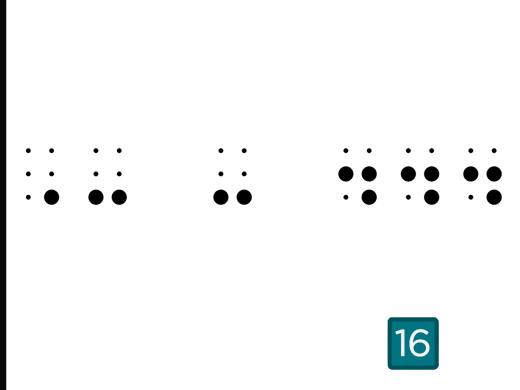
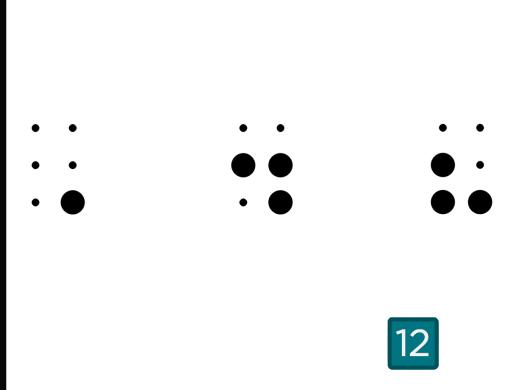
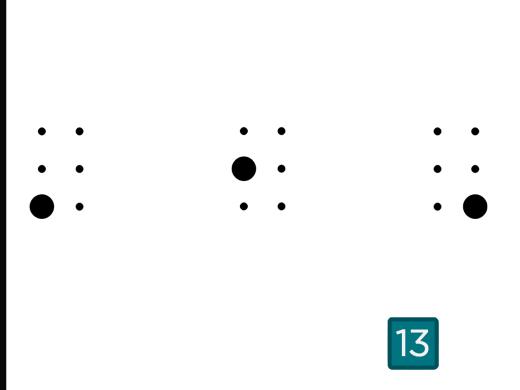
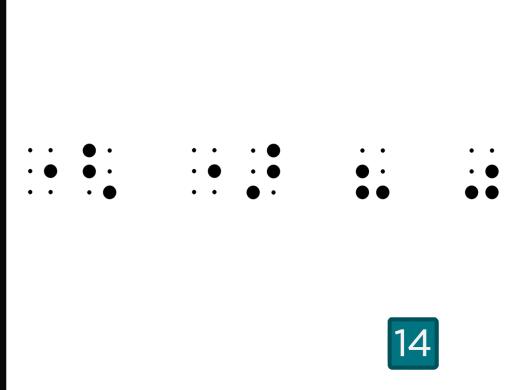
The colon is dots 2-5 and uses the middle dot on the first side and the middle dot on the second side.
Now move to the next line in your writing device to write phrases in a to-do list. First, you'll hear the whole phrase. Then you'll hear it again with all the punctuation. And when writing times, use the numeric indicator and numbers.
To give yourself time to braille, select Pause to write, then select Play to get to the next item to write.
Write:
Monday: invite guests
Monday, colon, invite guests
Now try:
Tuesday: buy cheese, crackers, and wine at 2:30.
Tuesday, colon, buy cheese, comma, crackers, comma, and wine at 2 colon 30
Next, write:
Thursday: make cookies and cake at 9:15.
Thursday, colon, make cookies and cake at 9 colon 15, period
This time, write:
Saturday: vacuum, dust, and mop floor at 8:45.
Saturday, colon, vacuum, comma, dust, comma, and mop floor at 8 colon 45, period
Finally, write:
Sunday: enjoy party at 7:00.
Sunday, colon, enjoy party at 7 colon zero, zero
When you're ready to check your braille, select Next.
Workbook Page 10, Check Colon Practice
Now, look over what you have written and compare it to the phrases on page 10 in the workbook.
Feel the colon at the top left corner of the page. You'll find phrases like the ones you just brailled. Compare your writing to these.
Check to make sure you are using dots 2 and 5 to make the colon. It will be in the middle of the cell.
When you're ready for more, turn to page 11 in your workbook and select Next.
Workbook Page 11: Semicolon Practice
Let's write the semicolon now.
The semicolon is dots 2-3, and uses the middle and bottom dots on the first side of the cell.
Move to the next line on your writing device to write sentences about winter weather advice.
Write:
Winter is frigid; wear lots of layers.
Winter is frigid, semicolon, wear lots of layers, period
Now, write:
Sidewalks are icy; wear treaded shoes to prevent slipping.
Sidewalks are icy, semicolon, wear treaded shoes to prevent slipping, period
Next, write:
Keep pedestrians safe; shovel the walk.
Keep pedestrians safe, semicolon, shovel the walk, period
Try this one:
Wind is bitter; button your coat.
Wind is bitter, semicolon, button your coat, period
Finally, write:
Hats and snow make it hard to hear; listen carefully.
Hats and snow make it hard to hear, semicolon, listen carefully, period
When you're ready to check your braille, select Next.
Workbook Page 11: Check Semicolon Practice
These sentences can be found on page 11 in the workbook. Feel the semicolon at the top left corner of the page.
You will find phrases like the ones you just brailled. Compare your writing to these.
Sometimes writers confuse the colon and semicolon. Just make sure you used dots 2-3 for the semicolon in each phrase.
Continue down the page and compare each of your phrases to the ones in your workbook.
When you're ready for more, turn to page 12 in your workbook and select Next.
Workbook Page 12: Forward Slash Practice
Here, we will practice using the forward slash. The forward slash is a two-cell symbol. The first cell is dots 4-5-6, and uses the top, middle, and bottom dots on the second side. The second cell is dots 3-4. It uses the bottom dot on the first side and the top dot on the second side.
Move to the next line on your writing device to write phrases with the forward slash. Since these are phrases, the words are not capitalized. As in print spacing, there is no space before or after the forward slash.
Write: pots and/or pans
pots and, forward slash, or pans
Now write: run/walk
run, forward slash, walk
Try this: candy/gum
candy, forward slash, gum
Dates also use the forward slash. When using a forward slash with numbers, you need a numeric indicator after each forward slash.
Write: 6/3/1984
numeric indicator, 6, forward slash, numeric indicator, 3, forward slash, numeric indicator, 1984
Next, try: 9/28/1857
9, forward slash, 28, forward slash, 1857
Did you remember to use the numeric indicator after each forward slash when writing these dates?
Last, write: 10/16/2021
10, forward slash, 16, forward slash, 2021
When you're ready to check your braille, select Next.
Workbook Page 12: Check Forward Slash Practice
Now, compare what you have written to the phrases on page 12 in the workbook. Feel the forward slash at the top left corner of the page.
On this page, you will find phrases like the ones you just brailed. Compare your writing to these.
Did you use dots 4-5-6 in the first cell of the two-cell forward slash? Many people mistakenly write dots 1-2-3.
And recall that there are no spaces before and after the forward slash.
Last, did you repeat the numeric indicator after each forward slash when writing dates?
This is done because the forward slash stops numeric mode, and you want to make sure your numbers will be read as numbers.
Compare each phrase and date you wrote to those found in your workbook.
When you're ready for more, turn to page 13 in your workbook and select Next.
Workbook Page 13: Sentence Practice 1
Let's practice writing the forward slash, semicolon, and colon in some sentences.
On a new line, indent two spaces, and write this sentence. Be sure to use capitalization and punctuation as you would in print:
Shop at Book Bound: a bookstore.
Shop at Book Bound, colon, a bookstore, period
Next braille:
Inside the bookstore is a coffee/tea bar.
Inside the bookstore is a coffee, forward slash, tea bar, period
Try writing:
Order coffee: caffeinated/decaf.
Order coffee, colon, caffeinated, forward slash, decaf, period
Now braille the sentence:
You can shop for gifts; buy novels, encyclopedias, and magazines.
You can shop for gifts, semicolon, buy novels, comma, encyclopedias, comma, and magazines, period
Finally write:
Sit for a bit; preview some books.
Sit for a bit, semicolon, preview some books, period
When you're ready to check your braille, select Next.
Workbook Page 13: Check Sentence Practice 1
You can check your braille on page 13 of the workbook.
Feel the forward slash, semicolon, and colon in the top left corner of the page.
Compare your writing to the sentences on this page.
Did you use the punctuation correctly in each sentence?
When you're ready for more, turn to page 14 in your workbook and select Next.
Workbook Page 14: Sentence Practice 2
Now try writing a longer sentence.
The bookstore has various genres of writing including comic books/graphic novels.
The bookstore has various genres of writing including comic books, forward slash, graphic novels, period
Next, write the sentence:
The fantasy genre encompasses a wide range of topics: magic, mythology, and legendary creatures.
The fantasy genre encompasses a wide range of topics, colon, magic, comma, mythology, comma, and legendary creatures, period
When you're ready to check your braille, select Next.
Workbook Page 14: Check Sentence Practice 2
You can check your work on page 14 of the workbook.
Feel the forward slash, semicolon, and colon in the top left corner of the page.
Compare your sentences with the sentences written here.
When you're ready for more, turn to page 15 in your workbook and select Next.
Workbook Page 15: Sentence Practice 3
Let's continue with writing the next sentence:
A classic is a book widely accepted as noteworthy; it stands the test of time.
A classic is a book widely accepted as noteworthy, semicolon, it stands the test of time, period
Finally, write this sentence:
Popular classic novels: To Kill a Mockingbird, Little Women, and A Tale of Two Cities.
Popular classic novels, colon, To Kill a Mockingbird, comma, Little Women, comma, and A Tale of Two Cities, period
When you're ready to check your braille, select next.
Workbook Page 15: Check Sentence Practice 3
These sentences can be found on page 15 of the workbook to check your writing.
Feel the forward slash, semicolon, and colon in the top left corner of the page.
Select Next to complete this workshop.
Completion
Congratulations. You have completed Everyday Braille Writing, Punctuation: Colon, Semicolon, Forward Slash.
If you have any questions about the punctuation that you just learned, just call a Hadley braille expert. We are happy to help.
Everyday Braille Writing: Punctuation Series
Explore
-
Vision Loss and Marriage
Audio · 28 minutes
-
It's hard to ask for help
Resource guide
-
Diabetic Retinopathy? First Steps Forward
Article · 5 minutes
-
Book Nook
Discussion
- Explore more
Members also liked
- Workshop
- Workshop
- Workshop
- Workshop
Join the Hadley Community
Hadley's resources are always available to you. Create a no-cost Hadley account to go further:
-
Pick up where you left off Everything you start is automatically saved across Hadley.
-
Personalized recommendations We'll suggest resources based on your interests.
-
Join live discussions Live and lively discussions on technology, cooking, and more, all geared toward the community of people living with vision loss.
-
Find peer support Connect with people who understand what you're going through.