
Everyday Braille Writing, Punctuation: Comma, Apostrophe, More Caps
Hadley
Everyday Braille Writing, Punctuation
Workshop 13: Comma, Apostrophe, More Caps.
Opening
Hadley presents Everyday Braille Writing, Punctuation Workshop 13, Comma, Apostrophe, More Caps.
Workbook Page 3: Apostrophe Practice
You've learned the capital letter indicator and some final punctuation marks. Now let's learn the apostrophe and comma as well as how to capitalize a whole word.
We recommend completing Braille for Everyday Use, Punctuation, Workshop 13: Comma, Apostrophe, More Caps if you have not already.
Go ahead and load your writing device with paper.
Let's practice writing the apostrophe. It's dot 3 or the bottom dot on the first side of the cell.
Starting on the next line on your writing device, you will write four phrases that use the apostrophe. Each phrase is said twice. To give yourself time to braille, select Pause to write, then select Play to get the next item to write.
Write: Bob's car
Capital B-o-b, apostrophe s, space, c-a-r
Now braille: Andre's computer
Capital A-n-d-r-e, apostrophe s, space, computer
Braille: Chicago's teams
Capital Chicago's, teams
Finally write: New York's pizza
Capital New, capital York's, pizza
When you're ready to check your work, turn to page 3 in your workbook and select Next.
Workbook Page 3: Checking Apostrophe Practice
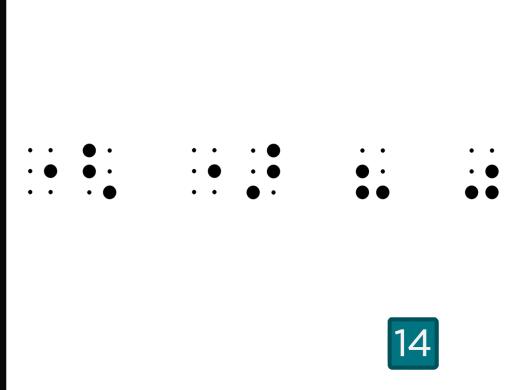
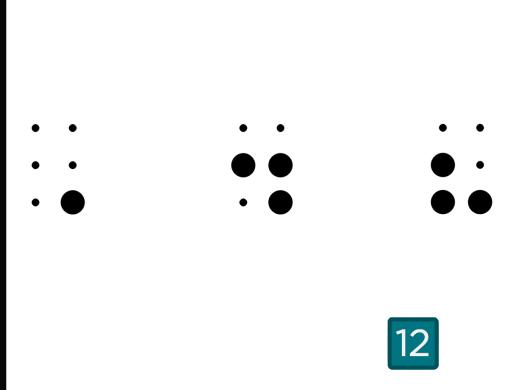
Feel the apostrophe, comma, and capital word indicator in the top left corner of page 3 in your workbook.
Now, look over what you have written and compare it to the phrases above the middle line on page three.
The apostrophe is commonly misbrailled with dot 6 or sometimes with dot 2. To make sure you are making it correctly, feel how the apostrophe is closer to the letters that come before it than to the letter or letters after it. Also, it is sitting at the bottom of the cell.
And if you have questions or you'd like some help, reach out to a braille expert at Hadley.
Select Next to continue.
Workbook Page 3: Comma Practice
Move to the next line of your writing device to begin using the comma. The comma is dot 2. It uses the middle dot on the first side of the cell.
You may have learned this symbol previously when writing with numbers, but now we will practice using it in a series of words. It is the same symbol whether written with numbers or words. Each phrase is said twice.
First braille: red, white, and blue
red, comma, white, comma, and blue
Now write: snow, sleet, and ice
snow, comma, sleet, comma, and ice
Next, try: fruit, vegetables, or dessert
fruit, comma, vegetables, comma, or dessert.
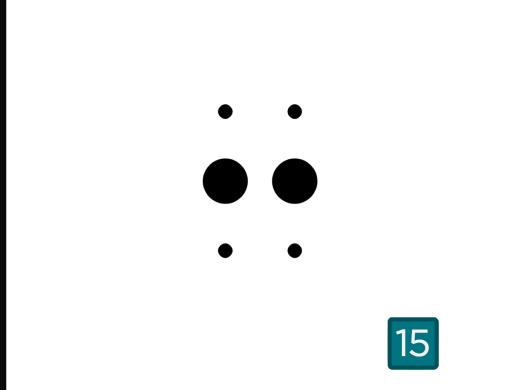
The next two phrases include the capital word indicator. Recall that this indicator capitalizes every letter in the word that follows. It is dot 6, dot 6. It uses the bottom dot on the second side two times in a row.
Write: not ONE but TWO
not, capital word indicator, ONE, comma, but, capital word indicator, TWO
Finally braille: Well, YES, you can
Capital Well, comma, capital word indicator, YES, you can
When you're ready to check your braille, select Next.
Workbook Page 3: Check Comma Practice
On page 3 of the workbook, you can check your braille with the phrases below the middle line.
Because the comma is only on the first side of the cell, the empty second side of the cell is often confused with a space. Be sure there is a completely blank cell after the comma for the space between words.
When you're ready for more, turn to page 4 in your workbook and select next.
Workbook Page 4: Practice Sentences
Let's write some sentences using all of the punctuation you have learned so far.
Each sentence is said twice. To give yourself time to braille, select Pause to write, then select Play to get the next item to write.
On a new line of your writing device, indent two spaces and braille the sentence:
Movies made from books can be fun, too!
Capital Movies, made from books can be fun, comma, too, exclamation point
Now recall that the capitalized word mode is ended by any punctuation. So in a word that has an apostrophe and a capital S, you must also use a capital letter indicator before the S.
Now write:
We like ROOTS and SCHINDLER'S LIST.
Capital We, like, capitalized word ROOTS, and capitalized word SCHINDLER'S, capitalized word LIST, period
The next sentence to write is
A classic movie adaptation is LITTLE WOMEN.
Capital A, classic movie adaptation is, capitalized word LITTLE, capitalized word WOMEN, period
Now try writing this sentence:
Have you viewed that one?
Capital Have, you viewed that one, question mark
Finally, braille this sentence:
Katherine Hepburn's portrayal of Jo is fantastic.
Capital K-a-t-h-e-r-i-n-e, capital H-e-p-b-u-r-n, apostrophe S, portrayal of, capital J-o, is fantastic, exclamation point
When you're ready to check your braille, select Next.
Workbook Page 4: Checking Practice Sentences
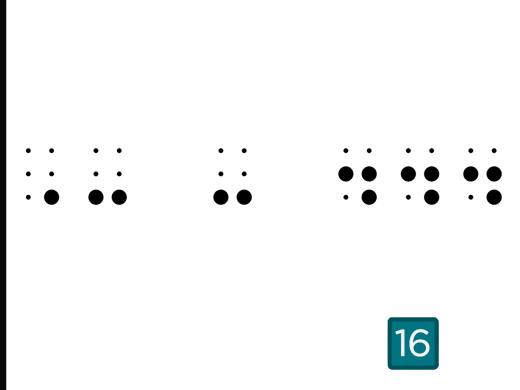
Feel the word “sentences” in the top left corner of page 4.
Scan the page and notice how each new sentence is indented to the third cell and the runovers begin in the first cell.
Notice how this makes finding each new sentence easy as you're scanning down the page. Read the first sentence you wrote on your paper, and then read the same sentence above the middle line in the workbook. Do you notice any differences?
Now, do this for the second sentence. Read what you have written and then compare it to the second sentence in the workbook.
Did you include spaces between each word you wrote? Did you use two dot 6s to make the titles of the movies fully capitalized? Be sure you included the capital letter indicator before the final S in “SCHINDLER'S”. If you have any questions, just reach out to a braille expert.
When you're ready for more, turn to page 5 in your workbook and select Next.
Workbook Page 5: Even More Practice Sentences
Now move down to the next line in your writing device to braille some more sentences.
Indent two spaces to begin. The first sentence is a question:
Will you go see the new one?
Capital Will, you go see the new one, question mark
Now write:
Those actors do well, too.
Capital Those, actors do well, comma, too, period
Next, braille:
It's hard to beat the eBook though.
Capital It, apostrophe s, hard to beat the e, capital Book, comma, though, period
How about this one?
Tom Clancy's JACK RYAN books are great action movies!
Capital Tom, capital Clancy, apostrophe s, capital word JACK, capital word RYAN, books are great action movies, exclamation point
Then write:
JACK RYAN'S script will keep you on the edge of your seat.
Capitalized word JACK, capitalized word RYAN's with apostrophe s, script will keep you on the edge of your seat, period
Finally, write:
Hold onto your popcorn!
Capital Hold, onto your popcorn, exclamation point
Select Next to check your braille.
Workbook Page 5: Checking Final Practice Sentences
Go to page 5 in the workbook to check your writing, feel the word “sentences” in the top left corner of the page.
Especially notice any unusual words like “eBook” in the third sentence above the middle line to check the capital letter indicator, and the word “RYAN'S” in the second sentence below the middle line to make sure you used both the capital word indicator and the capital letter indicator.
Select Next to complete this workshop.
Completion
Congratulations, you have completed the Everyday Braille Writing, Punctuation: Comma, Apostrophe, More Caps workshop. If you have any questions about the punctuation that you just learned, call a braille expert. We are happy to help.
Everyday Braille Writing: Punctuation Series
Explore
-
Keeping Your Job After Vision Loss
Audio · 25 minutes
-
I can’t drive anymore
Resource guide
-
5 Free Apps to Help After Vision Loss
Article · 5 minutes
-
Recreation Chat
Discussion
- Explore more
Members also liked
- Workshop
- Workshop
- Workshop
- Workshop
Join the Hadley Community
Hadley's resources are always available to you. Create a no-cost Hadley account to go further:
-
Pick up where you left off Everything you start is automatically saved across Hadley.
-
Personalized recommendations We'll suggest resources based on your interests.
-
Join live discussions Live and lively discussions on technology, cooking, and more, all geared toward the community of people living with vision loss.
-
Find peer support Connect with people who understand what you're going through.