
BARD Low Vision: Settings and Preferences
Hi, I'm Vikki Vaughan and in today's workshop, we'll have a look at various settings for making BARD Express easier to use.
This series is intended for individuals with low vision. We'll use a combination of mouse clicks and keyboard shortcuts. If you use a screen reader, be sure to check out the screen reading version of this series on Hadley's website.
Now it's important to note that we must have an active BARD account to use BARD Express. If you'd like to learn more, have a look at the first workshop in the series to learn how to set up your own free account.
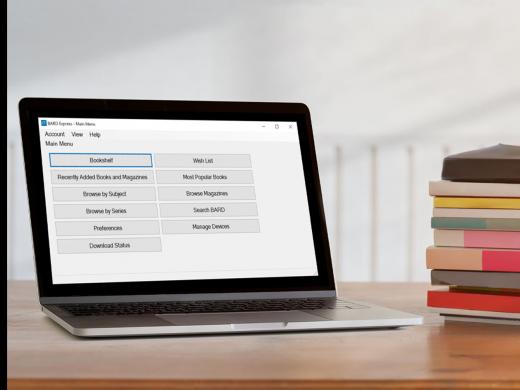
Let's check out the BARD Express menu bar. It contains several helpful little nuggets for those of us with low vision. Let's start from our bookshelf. We see all of our books and magazines organized by type.
Now we'll jump into our view menu with the keyboard shortcut Alt+V for view. We can also open our view menu with our mouse pointer. Near the bottom of the menu, we find a couple of tools that let us change the size of our font. When we press the F key, we make the font order. When we press F again, our font gets smaller. Let's try it out.
We'll hold down the alt key and press V for view. This opens our view menu. Now let's press F for font, followed by the enter key. We see the font size in bookshelf is bigger. Each time we go through this process, we increase the size of the font. Let's try it one more time. Alt+V, F, then enter. If the font is a little too big, we can make it smaller by using the keyboard shortcut Alt+V and then pressing F twice. We can also use our mouse pointer to select font size smaller from our dropdown menu. No matter which technique you choose, it's nice to know we can customize our font size to meet our needs.
Help Context Sensitive Help is the next tool in the menu bar. Context Sensitive means the help is specific to the task we're currently doing. Let's have a deeper look into this fantastic partner. Imagine we're in our bookshelf and we're a little confused about the difference between the bookshelf and the wishlist.
Let's press our keyboard shortcut F1, open our context sensitive helper. A new window opens with loads of information about the bookshelf. For those of us who prefer to use our mouse, we open the help menu by selecting help from the menu bar. Whenever we're unsure about a button or a menu in BARD Express, F1 is there to quickly answer our questions. Our context sensitive helper can be opened in any part of BARD Express. When we finished with our help menu, we close it by selecting the red X in the top right corner. For shortcut fans like me, alt+F4 will do the job.
Let's check out another useful tool in the help menu. We'll press Alt+H to open our dropdown menu, then press K for keyboard shortcuts. We've opened a new window with a handy list of many of the BARD Express keyboard shortcuts. This is super helpful for those times when we forgotten that one shortcut we need, to complete a task. Check out the resource section below for a full list of the keyboard shortcuts in BARD Express.
The final tool we'll look at today is in our main menu. The preferences button gives us several options to customize BARD Express. Let's use our keyboard shortcut Ctrl+P to open this window. Here we find our first option is a dropdown box labeled format.
We have three different format options, audio and braille, only audio and only braille. We can use our arrow keys to move through the three choices. If we prefer to use our mouse pointer, a simple click will open the dropdown menu and another click chooses our format option.
Our next three options are radio buttons. We can use either our arrow keys or mouse pointer to move to our selections. Next, we have cartridge copy mode. With this control, we choose whether we want to limit the number of books on a cartridge or allow multiple books.
Tabbing to our next option, we find the display mode. Here, we choose between standard mode and advanced mode. If you'd like more information about the difference between these display options, have a look at the recently added and most popular books workshop in this series.
Our next option is the status sound. With this control, we can set the status sound on or off. When it's turned on, we hear a status tone when large items take more than 10 seconds to load. The next option is results message display time. This control allows us to set how long a message is displayed when we search for books.
We tab to the slider bar and then press the arrow keys to increase or decrease the length of time we have to read informational messages. We can also use our mouse pointer to click and drag the slider bar to our preferred time.
Our last preference option is the bookshelf directory location. By default, BARD Express will place the bookshelf in our documents folder. If we want to change the location, we tab to the button labeled, view directory location in Windows Explorer. We then tell BARD where we'd like to store our bookshelf.
In today's workshop, we learned about various settings and preferences in BARD Express. I'm Vikki Vaughan and I thank you for joining me.
-
Handouts
BARD Express for Low Vision: Settings and Preferences Quick-Start Guide (PDF)
This quick-start guide shows you how to make viewing easier, find help, find keyboard shortcuts, and set some general preferences.
BARD Individual Application (PDF)
Subscribe/Unsubscribe to Book Series or Magazines (PDF)
-
Websites
BARD Express Frequently Asked Questions
Contact BARD Support at [email protected]
BARD Low Vision: Searching the BARD Collection (YouTube Playlist)
Using the BARD Website with Low Vision (YouTube Playlist)
Learn how to access and download books and magazines right from the Braille and Audio Reading Download (BARD) website.
BARD Express Low Vision Series
- Video · 7 minutes
- Video · 7 minutes
- Video · 6 minutes
- Video · 7 minutes
Explore
-
"That really changed my life"
Audio · 3 minutes
-
It's hard to ask for help
Resource guide
-
The Crochet Life: 7 Tips for Crocheting After Vision Loss
Article · 4 minutes
-
Book Nook
Discussion
- Explore more
Members also liked
- Video · 3 minutes

- Video · 3 minutes
- Video · 3 minutes

- Video · 9 minutes
Join the Hadley Community
Hadley's resources are always available to you. Create a no-cost Hadley account to go further:
-
Pick up where you left off Everything you start is automatically saved across Hadley.
-
Personalized recommendations We'll suggest resources based on your interests.
-
Join live discussions Live and lively discussions on technology, cooking, and more, all geared toward the community of people living with vision loss.
-
Find peer support Connect with people who understand what you're going through.