
Punctuation: Colon, Semicolon, Forward Slash
Hadley
Braille for Everyday Use,
Punctuation: Colon, Semicolon and Forward Slash
Note: If using a screen reader, it may be helpful to reread through the activity sentences character by character to check for punctuation.
Opening
Hadley presents Braille for Everyday Use, Punctuation, Workshop 15: Colon, Semicolon, Forward Slash.
Page 1
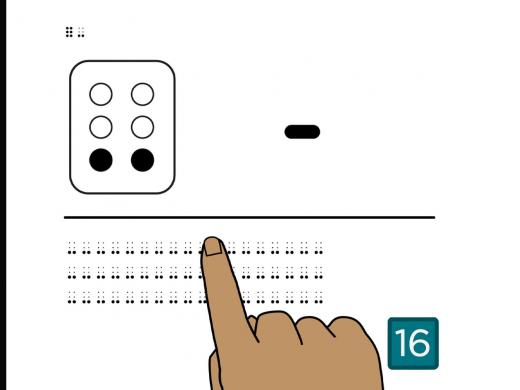
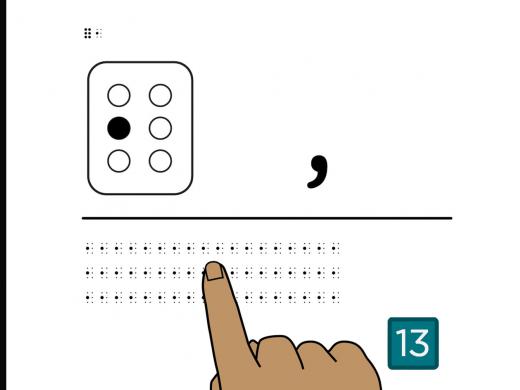
Feel the braille in the top left corner of the page.
This is a full cell followed by a colon.
The colon is dots 2-5.
The middle dot on the first side of the cell and the middle dot on the second side of the cell.
It’s easy to confuse the braille colon for a hyphen.
It might help to try thinking of the braille colon as a print colon gone sideways.
Below the middle line, you’ll find three rows of colons.
Place your fingers on the first row of braille.
No need to count. Just let your fingers feel each row of colons from left to right.
Turn the page.
Page 2
Feel the braille in the top left corner of the page.
This is a full cell followed by a colon, dots 2-5.
Below the middle line, you’ll find three rows of colons.
Place your fingers on the first row of braille and beginning with the first colon, count the number of colons on this line.
If you said six, you got it!
Now, count the number of colons in the second row.
There are five.
Finally, count the number of colons in the third row.
There are nine colons in this row.
Turn the page.
Page 3
Feel the full cell and the colon in the top left corner of the page.
The colon is similar to the letter “c,” except the colon is in the middle of the cell.
Below the middle line are two rows of braille, one with full cells and colons and one with full cells
and c’s.
Read both rows and find the row that has full cells and colons.
If you picked the second row, you’re right!
This row has colons.
Turn the page.
Page 4
Feel the full cell and the colon in the top left corner of the page.
Below the middle line are two rows of braille.
Read both rows and find the one that ends with the colon.
If you picked the first row, you found it.
This row says, “date:”
The second row is the word, “date,” followed by a letter c.
The colon and c are very similar.
Turn the page.
Page 5
Feel the full cell and the colon in the top left corner of the page.
Below the middle line are two rows of braille.
Read both rows and find the one that contains a colon.
If you picked row one, you’re right!
It has a colon after the word, “colors.”
The second row has a comma instead.
Turn the page.
Page 6
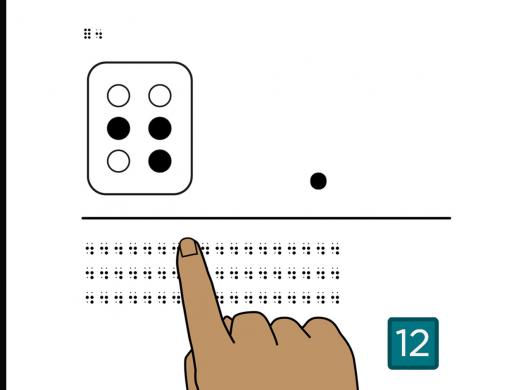
Feel the braille in the top-left corner of the page.
This is a full cell followed by a semicolon.
The semicolon is dots 2-3, the middle and bottom dots on the first side of the cell.
It is similar to the letter “b,” but the semicolon is in the bottom of the cell.
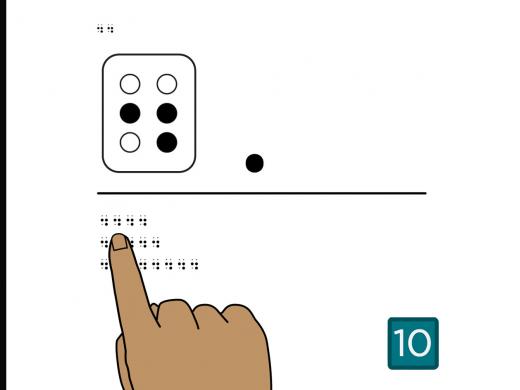
Below the middle line you’ll find three rows of semicolons.
Place your fingers on the first row of braille.
No need to count. Just let your fingers feel each row of semicolons from left to right.
Turn the page.
Page 7
Feel the braille in the top-left corner of the page.
This is a full cell followed by a semicolon.
The semicolon is dots 2-3.
Below the middle line, you’ll find three rows of semicolons.
Place your fingers on the first row.
Beginning with the first semicolon, count the number of semicolons on this line.
There are three semicolons on this line.
Now count the number of semicolons in the second row.
If you counted seven, you’re right!
Finally, count the number of semicolons in the third row.
There are 10.
Turn the page.
Page 8
Feel the full cell and semicolon in the top left corner of the page.
The semicolon is dots 2-3.
Again, it is like the braille b, but in the lower part of the cell.
Below the middle line are two rows of braille: one with full cells and semicolons, and one with full cells and b’s.
Read both rows and find the one that has the full cells and semicolons.
If you picked the second row, you’re right! This row has semicolons.
Turn the page.
Page 9
Feel the full cell and semicolon in the top left corner of the page.
Below the middle line are two rows of braille.
Read both rows and find the one that ends with a semicolon.
If you picked row one, you got it!
This row says, “both;”
The semicolon is similar to the colon, but the semicolon is dots 2-3.
Turn the page.
Page 10
Feel the full cell and semicolon in the top left corner of the page.
Below the middle line are two rows of braille.
Read both rows and find the one that ends with a semicolon.
Pay close attention to the spacing.
If you picked row one, you are correct.
It says, “Come;”
In the second row, notice there’s some extra space between the letter “e” and the next symbol.
Turn the page.
Page 11
Feel the full cell and the semicolon in the top left corner of the page.
Below the middle line are three rows of braille.
Read each row and find the one that uses semicolons throughout.
While you’re reading, think about spacing and dot locations.
If you picked the last row, you found it.
It says, “Eye; ear; nose;”
Turn the page.
Page 12
Feel the braille in the top left corner of the page.
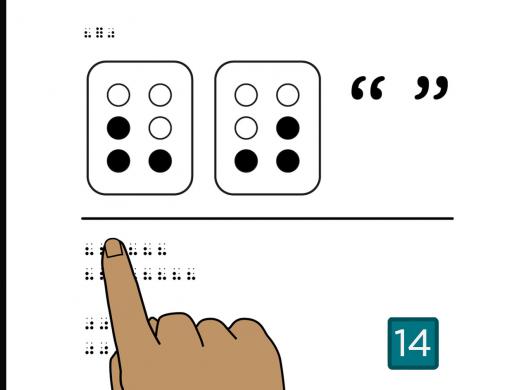
This is a forward slash.
The forward slash takes two cells to make.
The first cell uses dots 4-5-6, and the second cell uses dots 3-4.
In the first cell, it’s all three dots on the second side.
And in the second cell, it’s the bottom dot on the first side and the top dot on the second side.
Below the middle line you’ll find three rows of forward slashes.
Place your fingers on the first row of braille.
No need to count. Just let your fingers feel each row of forward slashes from left to right.
Turn the page.
Page 13
Feel the forward slash in the top left corner of the page.
The forward slash is dots 4-5-6 in the first cell and dots 3-4 in the second cell.
Below the middle line, you’ll find three rows of forward slashes.
Place your fingers on the first row of braille.
Beginning with the forward slash, count the number of forward slashes on this line.
Be sure to count both cells, dots 4-5-6 and
dots 3-4, as one forward slash.
If you said five, you got it!
Now, count the number of forward slashes in the second row.
There are two.
Finally, count the number of forward slashes in the third row.
There are four in this row.
Turn the page.
Page 14
Feel the forward slash in the top left corner of the page.
The forward slash is similar to the letters, “l” and “k,” but their spacing is different.
Below the middle line are two rows of braille: one with full cells and forward slashes and one with full cells, l’s, and k’s.
Read both rows and find the one that has the full cells and forward slashes.
If you picked the last row, you’re right!
This row has forward slashes.
Turn the page.
Page 15
Feel the forward slash in the top left corner of the page.
Below the middle line are three rows of braille.
Read all three rows.
Which row says, “up/down?”
If you chose the last row, you got it!
Turn the page.
Page 16
Feel the forward slash in the top left corner of the page.
Below the middle line are three rows of braille.
Read all three rows.
Which row is brailled correctly?
If you chose the last row, “open/closed,” you got it!
Turn the page.
Page 17
Feel the forward slash in the top-left corner of the page.
Below the middle line are four rows of braille.
Each row has two phrases.
Place your fingers on the first row of braille and read both phrases.
Which phrase says, “Do it now:”?
If you said the second phrase, you got it!
Now read the two phrases in row two.
Which one says, “Do it now;”?
The first phrase has a semicolon.
Next, read the two phrases in the third row.
Which phrase says, “Do it now/later?”
It’s the first phrase.
Finally, read the two phrases on the last row of braille. Which one says, “Do it now.”
The period is in the second phrase.
Turn the page.
Page 18
Feel the braille in the top left corner of the page.
This is a two-cell forward slash, followed by a fraction line.
These two symbols look the same in print, but in braille the fraction line is used only with fractions.
For everything else, use the forward slash.
Below the middle line are three rows of braille.
Each row uses either a forward slash or a fraction line.
Notice that the numeric indicator is repeated following each forward slash, but it’s not repeated after the fraction line.
Place your fingers on the first row of braille and read the date.
It says, “6/24/19.”
This is June 24th, 2019. Now read row two.
This is the fraction, 7/8.
Now let’s read row three together.
This one should say, “12/18/23.”
Can you find the error on this line?
If you said the second numeric indicator is missing, you got it!
This was a challenging activity. If you want to talk it over with a braille expert, just give us a call.
Turn the page.
Page 19
Feel the full cell, colon, full cell, semicolon, and forward slash in the top left corner of the page.
Below the middle line are four braille sentences containing all the punctuation you’ve learned so far.
Read the first sentence.
You can pause the audio whenever you need more time.
If you read: Bo said, “Get a job by 4/8.” great!
Now read the second sentence.
It says: “Do we leave (for work) by 7:15?”
Try the third sentence.
This one says, “Best trips: Aspen, CO; Maui, HI.”
Finally, read the last sentence.
It’s a bit tricky.
If you read, “MOM’S S’MORES: 3/4 cup candies!” you got it!
When you’re ready, turn the page.
Page 20
Now that you know the colon and the forward slash, you can more easily update your calendar or make a list of appointments.
If you want to learn more about this, or if you’d like more practice with these new symbols, call a Braille expert.
Select Next to complete this workshop.
Completion
Congratulations, you’ve learned the colon, semicolon, and slash. Very useful punctuation!
Braille for Everyday Use: Punctuation Series
- Workshop
- Workshop
Explore
-
Back in the Kitchen After Vision Loss
Audio · 41 minutes
-
I can’t drive anymore. Now What?
Resource guide
-
Diabetic Retinopathy? First Steps Forward
Article · 5 minutes
-
Book Nook
Discussion
- Explore more
Members also liked
- Workshop

- Workshop
- Workshop

- Workshop
Join the Hadley Community
Hadley's resources are always available to you. Create a no-cost Hadley account to go further:
-
Pick up where you left off Everything you start is automatically saved across Hadley.
-
Personalized recommendations We'll suggest resources based on your interests.
-
Join live discussions Live and lively discussions on technology, cooking, and more, all geared toward the community of people living with vision loss.
-
Find peer support Connect with people who understand what you're going through.