
Punctuation: Quotes and Parentheses
Hadley
Braille for Everyday Use
Punctuation: Quotes and Parentheses
Note: If using a screen reader, it may be helpful to reread through the activity sentences character by character to check for punctuation.
Opening
Hadley presents Braille for Everyday Use, Punctuation, Workshop 14: Quotes and Parentheses.
Page 1
Let’s learn some more punctuation.
Feel the braille in the top left corner of the page.
This is the opening quotation mark, the full cell, and the closing quotation mark.
The opening and closing quotation marks are opposites. In fact, they mirror each other.
They’re shown here with the full cell between them because quotation marks always have letters, words, numbers, or other symbols between them.
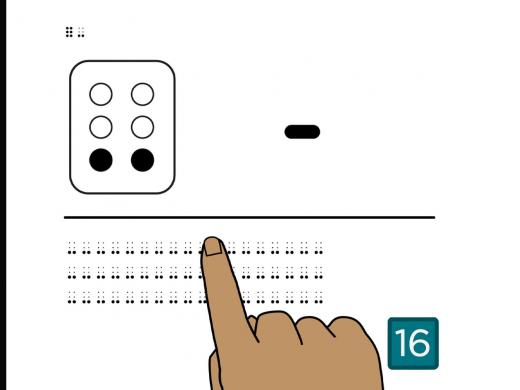
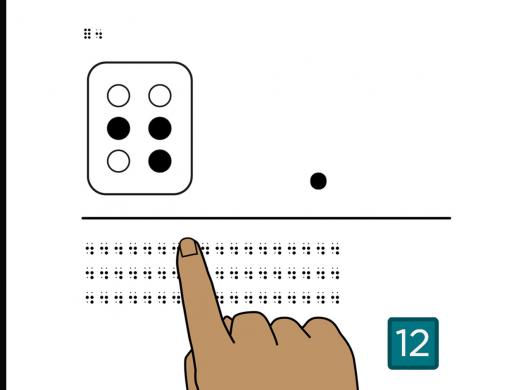
The opening quotation mark is dots 2-3-6, the middle and bottom dots on the first side, and the bottom dot on the second side.
The closing quotation mark is dots 3-5-6, the bottom dot on the first side, and the middle and bottom dots on the second side.
A hint to remember the quotation marks is that they look like the bottom left and right corners of a box.
Think of them as “boxing in” a quote.
Below the middle line, you’ll find three rows of quotation marks with the full cell.
Place your fingers on the opening quotation mark at the beginning of the first row.
No need to count. Just feel each row of quotation marks with full cells from left to right.
Turn the page.
Page 2
Feel the quotation marks, with the full cell, in the top left corner of the page.
The quotation marks are dots 2-3-6, and 3-5-6.
Below the middle line, you’ll find four rows of quotation marks.
Find the opening quotation mark at the beginning of the first row.
From left to right, count the number of opening quotation marks.
There are six in this row.
Now, count the opening quotation marks in the second row.
If you said, “eight,” you’re right!
Next, find the closing quotation mark at the beginning of the third row.
Count the closing quotation marks in that row.
Did you find seven?
And finally, count the closing quotation marks in the last row.
There are five.
Turn the page.
Page 3
Feel the quotation marks around the full cell in the top left corner of the page.
Below the middle line are two rows of braille.
The quotation marks are similar in shape to the letters “h” and “j,” but quotation marks are lower in the cell.
Read the two rows of braille. Which row contains the word, “hello,” with quotation marks?
The first row uses the quotation marks.
In the second row, the letters h and j are used instead of the quotation marks.
Turn the page.
Page 4
Feel the quotation marks and the full cell in the top left corner of the page.
To remember which direction the opening and closing quotation marks face, think about “boxing in” a quote.
Below the middle line, you’ll find three rows of braille.
In which row are the quotation marks around the word, “Stop” brailled correctly?
The quotation marks are brailled correctly in the last row.
The first row has them reversed and the second row uses two opening quotation marks.
Turn the page.
Page 5
Feel the two opening quotation marks in the top-left corner of the page.
Below the middle line, you’ll find two rows of braille.
Which row shows a word in quotation marks?
If you found the quotation marks in the second row, that’s right.
What does the first row say?
It says, “When?” with a question mark.
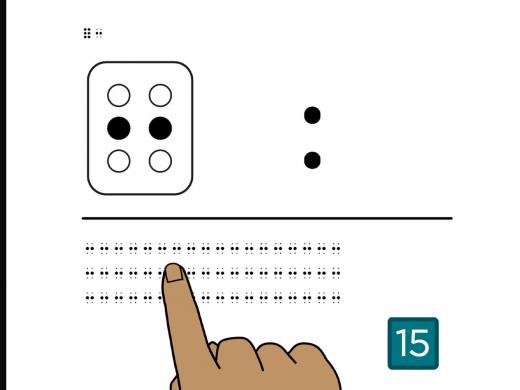
Have you discovered that the opening quotation mark and the question mark use the same dots?
You can tell them apart by remembering the question mark is used only at the end of a word, and the opening quotation mark always comes before a word.
Turn the page.
Page 6
Feel the quotation marks and the full cell in the top left corner of the page.
Below the middle line are three braille sentences using quotation marks.
In these examples, notice that the ending sentence punctuation, like the period, comes before the closing quotation mark.
It follows the same rules in braille as it does in print.
Read the first sentence.
The first sentence says: Will said, “It’s hot!”
Now try the second sentence.
If you read: “Here is a fan.” that’s correct.
What punctuation is used at the end of the sentence?
There’s a period followed by a closing quotation mark.
How about the last sentence?
It asks: “Can I get some water?”
If you’d like, you can select replay at the end of the page to try again.
And if you’d like some help, just give us a call.
When you’re ready, turn the page.
Page 7
Feel the braille in the top left corner of the page.
This is the opening parenthesis, the full cell, and the closing parenthesis.
The opening and closing parentheses are two cell symbols.
That is, they each take two cells to make.
They’re used here with the full cell between them to show that something is always between the parentheses.
To help you remember the shape of the parentheses, think of cupped hands surrounding the words.
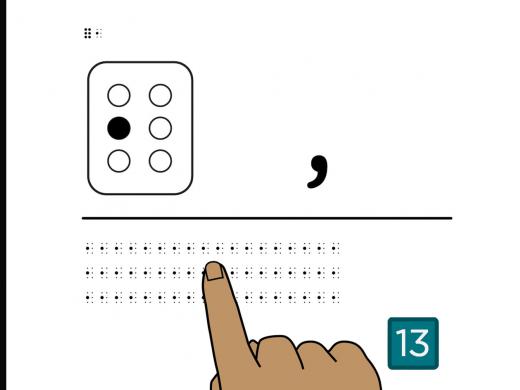
The opening parenthesis is dot 5 in the first cell, and dots 1-2-6 in the second cell.
In the first cell, it’s the middle dot on the second side.
In the second cell, it’s the top and middle dots on the first side, and the bottom dot on the second side.
The closing parenthesis is dot 5 in the first cell, and dots 3-4-5 in the second cell.
In the first cell, it’s the middle dot on the second side.
In the second cell, it’s the bottom dot on the first side, and the top and middle dots on the second side.
Below the middle line, you’ll find three rows of parentheses with the full cell.
Place your fingers on the opening parenthesis at the beginning of the first row.
No need to count. Just feel each row of parentheses from left to right.
Turn the page.
Page 8
Feel the parentheses with the full cell in the top left corner of the page.
The parentheses are dot 5, dots 1-2-6 for open, and dot 5, dots 3-4-5 for close.
Below the middle line you’ll find four rows of parentheses.
Find the opening parenthesis at the beginning of the first row.
From left to right, count the number of opening parentheses.
There are five in this row.
Now count the opening parentheses in the second row.
If you said, “eight,” you’re right!
Now find the closing parenthesis at the beginning of third row.
Count the closing parentheses in that row.
There are seven.
And count the closing parentheses in the last row.
There are four.
Turn the page.
Page 9
Feel the parentheses around the full cell in the top left corner of the page.
The opening and closing parentheses each start with dot 5.
Below the middle line, you’ll find four rows of braille.
Which row has opening parentheses?
The third row has open parentheses brailled correctly.
Which row has closing parentheses?
If you said the closing parentheses are in the first row, you’re right!
Turn the page.
Page 10
Feel the parentheses and the full cell in the top left corner of the page.
Below the middle line, you’ll find three rows of braille words in parentheses.
Let’s read the first word.
The first row says, “(bee)” in parentheses.
Now try the second row.
It says, “(red)” in parentheses.
How about the last row?
If you read the word, “(age)” in parentheses, you got it!
Turn the page.
Page 11
Feel the parentheses and the word, “oh,” in the top-left corner of the page.
Below the middle line are two rows of braille. Find the braille that says, “(Oh boy!)” in parentheses.
The first row says, “(Oh boy!)” in parentheses.
What punctuation is used around the phrase in the second row?
Did you say, “quotation marks?” That’s right!
Turn the page.
Page 12
Feel the parentheses and the full cell in the top-left corner of the page.
Below the middle line, you’ll find a list of party supplies with some words in parentheses.
Read the whole list to answer these questions.
How many games are planned?
Just one, for now, per the third row.
What color balloons are needed?
The answer, in the second row, is “pink and purple.”
Do they want chocolate cake?
No. The first row says they want, “vanilla.”
Which drink would you choose?
The last row says the choices are, “punch and root beer.”
Turn the page.
Page 13
Feel the quotation marks and parentheses in the top left corner of the page.
Below the middle line, you’ll find four sentences.
Read the first two sentences and feel free to pause the audio if you need extra time.
Which sentence uses the quotation marks correctly?
If you chose sentence one, you’re right!
The quotation marks here use the correct dots.
The sentence reads: Jose shouted, “Let’s go!”
Now, read the last two sentences.
Which one is brailled correctly?
The last sentence is correct.
Sentence three is missing dot 5 as the first cell of each parenthesis.
Sentence four says, “BLUE,” in all capitals, “(my favorite color).”
Turn the page.
Page 14
Feel the quotation marks and parentheses in the top left corner of the page.
Below the middle line is an invitation with four sentences.
Take a minute or so to read the invitation and notice the punctuation in each row.
The invitation says:
“Come to Johnny’s party!”
When?
(Aug. 10, at 4:00)
Where?
(Johnny’s house)
“It’ll be fun!”
When you’re ready, turn the page.
Page 15
Now that you know quotation marks and parentheses, you can read and write dialogue.
Try creating your own story.
Reach out to a braille expert if you’d like to share your story.
Select Next to complete this workshop.
Completion
Congratulations. You’ve learned quotation marks and parentheses in braille.
Braille for Everyday Use: Punctuation Series
- Workshop
Explore
-
"Knock the t off can't"
Audio · 4 minutes
-
A family member or friend is facing vision loss. Now What?
Resource guide
-
Diagnosed with Vision Loss? Find Help Here
Article · 5 minutes
-
Book Nook
Discussion
- Explore more
Members also liked
- Workshop

- Workshop
- Workshop

- Workshop
Join the Hadley Community
Hadley's resources are always available to you. Create a no-cost Hadley account to go further:
-
Pick up where you left off Everything you start is automatically saved across Hadley.
-
Personalized recommendations We'll suggest resources based on your interests.
-
Join live discussions Live and lively discussions on technology, cooking, and more, all geared toward the community of people living with vision loss.
-
Find peer support Connect with people who understand what you're going through.