
Punctuation: Hyphen, Dash, Ellipses
Hadley
Braille for Everyday Use,
Punctuation: Hyphen, Dash, and Ellipses
Note: If using a screen reader, it may be helpful to reread through the activity sentences character by character to check for punctuation.
Opening
Hadley presents, Braille for Everyday Use, Punctuation, Workshop 16: Hyphen, Dash, Ellipses.
Page 1
Let’s learn some more punctuation that we can use when writing.
Feel the braille in the top left corner of the page.
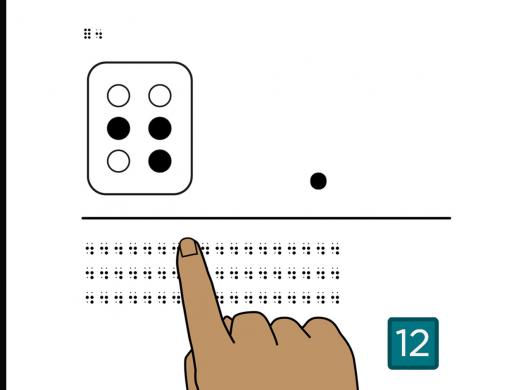
First is the full braille cell then the hyphen,
dots 3-6.
The hyphen uses the bottom dot on the first side and the bottom dot on the second side of the braille cell.
The braille hyphen is similar to the print hyphen.
The tricky thing to remember is that it’s at the bottom of the cell, not the middle.
Below the middle line you’ll find three rows of hyphens.
Place your fingers on the hyphen at the beginning of the first row. No need to count. Just feel each row of hyphens from left to right.
Turn the page.
Page 2
Feel the full cell and the hyphen in the top left corner of the page.
You’ve learned the hyphen in an earlier workshop on numbers.
The hyphen is dots 3-6.
Below the middle line, you’ll find three rows of hyphens.
Find the hyphen at the beginning of the first row.
From left to right, count the number of hyphens in the first row.
There are four.
Now, count the number of hyphens in the second row.
If you counted six, you’re right!
And last, count the hyphens in the third row.
There are five in this row.
Turn the page.
Page 3
Feel the hyphen and the letter “c” in the top-left corner of the page.
The hyphen is similar to the letter c, but the hyphen is in the bottom of the cell.
Let’s practice reading the letter c and the hyphen.
Below the middle line are two rows of braille.
One with full cells and hyphens and one with full cells and c’s.
Which row has the full cells and hyphens?
If you said the second row, you found it.
The first row has c’s.
Turn the page.
Page 4
Feel the letter “b,” hyphen, and letter “g” in the top left corner of the page.
Below the middle line you’ll find a list of three words.
Which row has, “blue-green?”
If you said the last row, you found the right one!
The first row reads, “red-green,” and the second row uses the letter c instead of a hyphen.
Turn the page.
Page 5
Feel the letter “d” and the hyphen in the top left corner of the page.
Let’s practice reading the hyphen.
Below the middle line are three phrases.
Read the first phrase.
It says, “mother-in-law.”
Now try the second phrase.
It reads, “sixty-year-old.”
Finally read the last phrase.
If you read, “RED-HOT,” in all capitals, you got it!
Notice that each word touching a hyphen is considered to be standing alone.
So, capital indicators will need to be used before each word.
Turn the page.
Page 6
Feel the braille in the top left corner of the page.
This is the full cell and the dash.
The dash uses two braille cells. The first cell is dot 6, and the second cell is dots 3-6.
The first cell uses the bottom dot on the second side of the cell, and the second cell uses the bottom dot on the first side and the bottom dot on the second side.
Below the middle line you’ll find three rows of dashes.
Place your fingers on the dash at the beginning of the first row.
No need to count. Just feel each row of dashes from left to right.
Turn the page.
Page 7
Feel the full cell and the dash in the top left corner of the page.
The dash is dot 6, dots 3-6.
In print, the dash is longer than the hyphen.
Below the middle line you’ll find three rows of dashes.
Find the dash at the beginning of the first row.
From left to right, count the number of dashes in the first row.
If you said four, you got it!
Now count the number of dashes in the second row.
There are five in the second row.
And last, count the number of dashes in the third row.
There are seven.
Turn the page.
Page 8
Feel the full cell and the dash in the top left corner of the page.
Let’s practice reading the full cell and the dash.
Below the middle line are two rows of braille, one row of full cells and dashes and one row of full cells and hyphens.
Scan the two rows of braille.
Which row has full cells and dashes?
Did you say the second row?
If so, you are correct.
If you didn’t get it the first time, that’s okay. It takes practice.
If you’d like, replay the page at the end and take as much time as you need.
When you’re ready, turn the page.
Page 9
Feel the dash in the top left corner of the page.
Let’s practice reading the dash with a word.
Below the middle line are three rows of braille.
Which row has the word, “wait,” followed by a dash?
If you said the second row, you got it!
The first row uses the hyphen, and the last row uses an exclamation point.
Turn the page.
Page 10
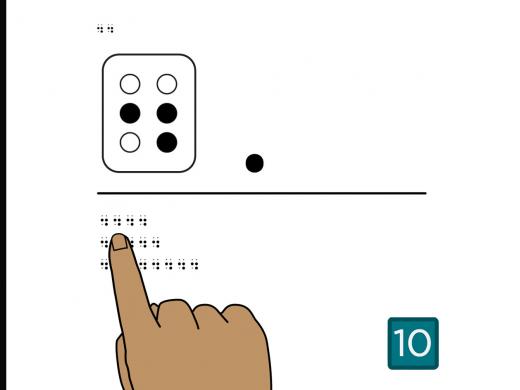
Feel the braille in the top left corner of the page.
This is the full braille cell followed by the ellipsis, dots 2-5-6, dots 2-5-6, dots 2-5-6.
All three cells use the middle dot on the first side of the cell, and the middle and bottom dots on the second side of the cell.
The ellipsis uses the same dots as the period.
And just as in print, the braille ellipsis is three periods in a row.
Below the middle line, you’ll find three rows of ellipses.
Place your fingers on the ellipsis at the beginning of the first row.
No need to count. Just feel each row of ellipses from left to right.
Turn the page.
Page 11
Feel the full cell and the ellipsis in the top left corner of the page.
The ellipsis is dots 2-5-6, dots 2-5-6, dots 2-5-6.
Below the middle line, you’ll find three rows of ellipses.
Find the ellipsis at the beginning of the first row.
From left to right, count the number of ellipses in the first row.
There are five ellipses in this row.
Now count the number of ellipses in the second row.
There are three.
And last, count the number of ellipses in the third row.
If you counted four, you found them all.
Turn the page.
Page 12
Feel the full cell and the ellipsis in the top left corner of the page.
Let’s practice reading the full cell and the ellipsis.
Below the middle line are two rows of braille, one with full cells and ellipses and one with full cells and letter d’s.
Which row has the full cells and ellipses?
Right! The first row has the full cells and ellipsis.
Turn the page.
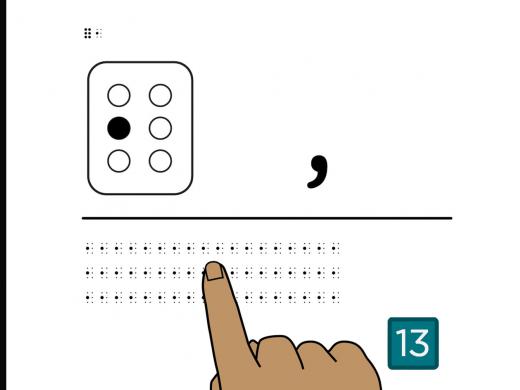
Page 13
Feel the ellipsis in the top-left corner of the page.
Let’s practice reading the ellipsis—or dot-dot-dot—in a phrase.
Below the middle line are three rows of braille.
Which row has the phrase, “…happily ever after…”?
If you said the first row, you’re right!
The second row has a period at the end, and the last row has each cell in the ellipsis reversed.
Turn the page.
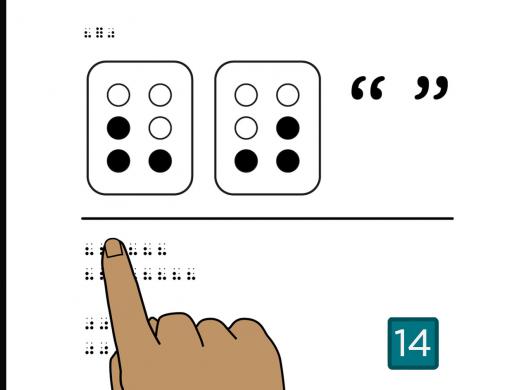
Page 14
Feel the ellipsis and period in the top left corner of the page.
Dots 2-5-6 are used as the period, dot in a web address, or decimal, and in the ellipsis.
Let’s practice reading the period dot in a web address, computer dot, decimal, and ellipsis.
Below the middle line are four rows of braille.
Find the row with the decimal.
This row uses a dollar amount.
How much money does it say?
If you said, “$2.50,” that’s correct.
What is the web address using the computer dot?
It’s Hadley’s own web address, “Hadley.edu.”
Now find the phrase with a period at the end.
Where in a book would you find this phrase?
That’s right, at “The end.”
And last, find the phrase with the ellipsis.
What does it say?
It says, “well…um.”
Turn the page.
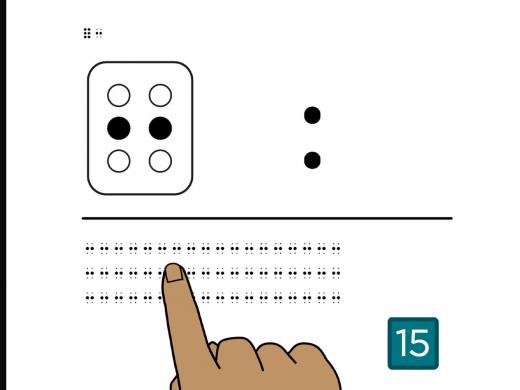
Page 15
Feel the hyphen and dash in the top left corner of the page.
Let’s practice reading the hyphen and the dash.
Below the middle line are two sentences.
Read the first sentence.
Did you read, “I do all the work−you have the fun.”
If so, you got it! Now read the second sentence.
It says, “The well-known author has a new book.”
If you’d like another try on this page, just replay this page at the end and give yourself time and patience. You’ll get there.
When you’re ready, turn the page.
Page 16
Feel the ellipsis in the top left corner of the page.
Below the middle line are three braille sentences.
Read the three sentences to answer each of the following questions.
What color is the cat?
“The cat is yellow-orange.”
Who likes tea?
Did you say, “Sue?”
That’s correct.
And who likes coffee?
“Jim likes coffee.”
The last sentence is open-ended, it uses the ellipsis.
“I can’t believe…”
How would you finish the last sentence?
Turn the page.
Page 17
Feel the dash in the top left corner of the page.
Read the passage below the middle line.
You can pause, if you’d like, while you read.
The passage says:
The lady−who’s sad−waved goodbye.
She misses her best friend/sister!
They’ll have another get-together.
But…not for a year (or so).
Turn the page.
Page 18
You have learned a lot of punctuation: quotation marks, parentheses, colon, semi-colon, forward slash, hyphen, dash, and ellipsis.
If you like to read books, these are all very useful to know.
Do you want to learn even more?
Call a braille expert at Hadley, and we can tell you about what’s next in Contracted Braille!
Select Next to complete this workshop.
Completion
Congratulations! You’ve learned many punctuation marks and completed the series Braille for Everyday Use.
If you haven’t already, check out Hadley’s braille writing series, or ask a braille expert about contracted braille.
Braille for Everyday Use: Punctuation Series
- Workshop
Explore
-
The Beauty of Dusk: On Vision Lost and Found
Audio · 22 minutes
-
I can’t drive anymore. Now What?
Resource guide
-
After the Eye Doctor: Practical Help for Vision Loss
Article · 6 minutes
-
Recreation Chat
Discussion
- Explore more
Members also liked
- Workshop
- Workshop

- Workshop

- Workshop
Join the Hadley Community
Hadley's resources are always available to you. Create a no-cost Hadley account to go further:
-
Pick up where you left off Everything you start is automatically saved across Hadley.
-
Personalized recommendations We'll suggest resources based on your interests.
-
Join live discussions Live and lively discussions on technology, cooking, and more, all geared toward the community of people living with vision loss.
-
Find peer support Connect with people who understand what you're going through.