
Braille Special Symbols 6 - Capital Passage
Hadley
Braille Special Symbols 6 – Capital Passage
Opening
Hadley presents Braille Special Symbols, Workshop 6: Capital Passage.
Page 1
First, make sure you have your braille workbook with you. If you don’t already have one, call Hadley at 847-784-2816, and we’ll mail one right out to you.
Now let's learn about capitalized passages.
You previously learned the capital letter indicator and the capital word indicator.
In this workshop, we’ll look at the capitalized passage indicator and the capitals terminator.
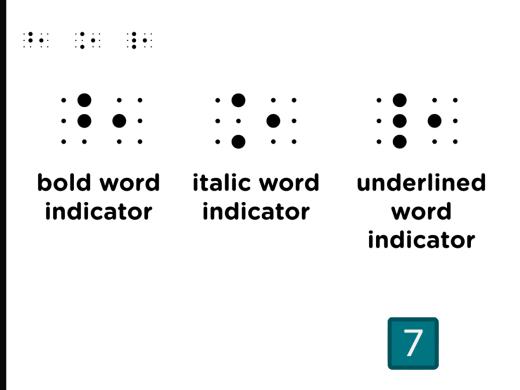
Feel the braille in the top left corner of the page.
These are the capitalized passage indicator and the capitals terminator.
The capitalized passage indicator is used when three or more fully capitalized words are used, one after the other.
A capitalized passage ends with the capitals terminator.
A capitals terminator must always be used if a capitalized passage indicator is used.
Above the middle line, you’ll find a row of braille.
Let’s read it together.
It says: HAPPY NEW YEAR!
. . . in all capitals.
Notice the capitalized passage indicator at the beginning and the capitals terminator at the end.
Below the middle line are 4 more rows of braille.
Let’s read these 4 rows.
The first row is the capital letter indicator.
The next row is the capital word indicator.
The third row shows the capitalized passage indicator.
And the last row shows the capitals terminator.
Turn the page.
Page 2
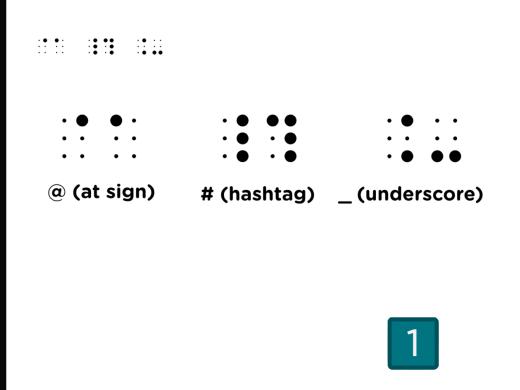
Feel the capitalized passage indicator in the top left corner of the page.
The capitalized passage indicator is made with three cells: dot 6, dot 6, dot 6.
Above the middle line are three rows of braille.
As you read the braille and work through the activities on these pages, use the Pause button, or spacebar, for as long as you need to.
Then select the Play button, or press the spacebar again, to hear the feedback for that item.
Go ahead and read the three rows above the middle line, and find which row shows the capital letter indicator.
The last row shows the capital letter indicator.
And which row shows the capital word indicator?
If you said the middle row, you got it!
Finally, which row shows the capitalized passage indicator?
The capitalized passage indicator is in the first row.
Below the middle line are three more rows of braille.
Read all three rows and notice the spacing in each row.
Which row has the capitalized passage indicator?
Did you say the second row? That’s it!
Which row has the capital word indicator?
It’s the last row.
And which row has a dash?
The first row has a dash.
Move to the next page.
Page 3
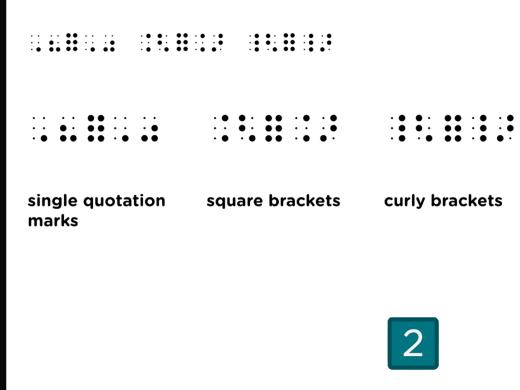
Feel the capitals terminator in the top left corner of the page.
The capitals terminator is a two-cell symbol made with dot 6, dot 3, and it’s used to end a capitalized passage.
A capitals terminator must always be used when a capitalized passage indicator is used.
Above the middle line are four rows of braille.
Read all four rows and find which row contains the capitalized passage indicator.
The capitalized passage indicator is in the second row.
And which row contains the capitals terminator?
Did you find it in the third row? That’s it!
Notice the spacing of the dot 6, dot 3, and compare this with the spacing of the capital word indicator, dot 6, dot 6, on the last row; and the hyphen, dots 3, 6 on the first row.
Below the middle line you’ll find 2 rows of braille.
On the first row, read the two words.
This says: SHOUT OUT!
Each word in “SHOUT OUT!” uses a capital word indicator, because there are two capitalized words in this phrase.
Now read the last row.
This row says: SHOUT IT OUT!
This phrase has three words, so it must begin with a capitalized passage indicator and end with a capitals terminator.
Turn the page.
Page 4
Feel the capitalized passage indicator and capitals terminator in the top left corner of the page.
Above the middle line are three fully capitalized phrases that use the capitalized passage indicator and the capitals terminator.
What does the first phrase say?
If you read: LIFE FOUND ON MARS
. . . you got it!
Now read the second row.
This row says: MIX AND MATCH
And now the last row.
The last row says: GREEN EGGS AND HAM
Below the middle line you’ll find three more rows of braille.
Go ahead and read all three rows.
Which row uses the capital word indicator?
The capital word indicator is used in the last row: WELCOME HOME
Which row uses the capitalized passage indicator and capitals terminator?
If you said it’s the second row: NO DIGGING: UNDERGROUND GAS LINE
. . . that's it!
Go to the next page.
Page 5
Feel the capitalized passage indicator and capitals terminator in the top left corner of the page.
Above the middle line are two braille statements.
Read these statements and find which one is brailled correctly for the following passage, written in all capitals: WASH HANDS BEFORE RETURNING TO WORK
If you said the second one, that's it!
The first row uses a capital word indicator before each word.
But the second row uses the capitalized passage indicator, because there are three or more words in a row being capitalized.
Did you notice that the second row is much shorter in length?
Many braille rules save space on the page.
Below the middle line are four sentences.
Read sentences 1 and 2, and find which one correctly uses both the capitalized passage indicator and capital word indicator in DENALI NATIONAL PARK and GLACIER BAY.
If you said sentence 1, you’re right!
Now read sentences 3 and 4, and find which one correctly uses both the capitalized passage indicator and capital word indicator for GILLIGAN'S ISLAND and THE ANDY GRIFFITH SHOW.
If you said sentence 4, you got it!
Turn the page.
Page 6
Feel the capitals terminator in the top left corner of the page.
The ending punctuation for a capitalized passage generally comes before a terminator.
Above the middle line are two sentences.
Which sentence shows the correct use of the capitals terminator with ending punctuation?
If you said the first sentence, you got it!
Both sentences say: The label read WARNING: MAY CAUSE NAUSEA.
But the first one correctly has the period before the capitals terminator.
Below the middle line are four more sentences.
Go ahead and read the first sentence.
If you read: THE BEATLES first appeared in the U.S. on THE ED SULLIVAN SHOW.
. . . that's it!
Now read the next sentence.
This one says: The sign read: CAUTION: SENSITIVE ELECTRONIC DEVICES. DO NOT STORE NEAR MAGNETIC OR RADIOACTIVE FIELDS.
Now read the third sentence.
The third sentence reads: Our theater will perform OUR TOWN in June, then begin rehearsals for FIDDLER ON THE ROOF.
Finally, what does the last sentence say?
The last sentence reads: If you want to learn about the Holocaust, you might like THE ZOOKEEPER'S WIFE and SCHINDLER'S LIST.
Move to the next page.
Page 7
Feel the capitalized passage indicator and capitals terminator in the top left corner of the page.
Above the middle line are two sentences.
What does the first sentence say?
The first sentence reads: The actor's name is SAMUEL L. JACKSON.
. . . and “SAMUEL L. JACKSON” is all capitalized.
A capitalized passage can contain an initial, and the initial is considered a word.
Notice in this passage, the grade one indicator precedes the letter, L.
Now read the second sentence.
This one says: J. EDGAR HOOVER was the first director of the FBI.
Here, J. EDGAR HOOVER is all capitalized.
Recall that capital indicators must always touch the letter or word that follows, so the grade one indicator comes before the capital indicator.
Below the middle line are four rows of braille.
Go ahead and read all four rows.
Again, you can always Pause for as long as you need to read, then select Play to get the feedback.
Did you read the following, in all capitals? IMPORTANT: CHILDREN SHOULD ONLY USE THE TABLE WHEN SUPERVISED BY ADULTS. DO NOT CRAWL/LIE/SIT UNDER THE TABLE. DO NOT SIT OR STAND ON THE TABLE.
That’s right!
The capitalized passage indicator tells us all the words are fully capitalized until we reach the capitals terminator.
Turn the page.
Page 8
Feel the capitalized passage indicator and the capitals terminator in the top left corner of the page.
A capitalized passage indicator is used only when there are three or more words, or sequences of symbols, being capitalized.
A sequence of symbols is any number of symbols written together, without spaces.
Above the middle line are two rows of braille.
Let's read the first row.
This says, in all capitals: RED/CODE BUTTON
Notice that “RED/CODE” counts only as one sequence of symbols, and “BUTTON” is one sequence of symbols.
Because there are only two sequences of symbols in this phrase, it’s correct to use capital word indicators instead of the capitalized passage indicator.
Now let’s read the second row.
This one says, in all capitals: MID-ATLANTIC FLIGHTS
Here, “MID-ATLANTIC” with a hyphen is one sequence of symbols—so, again, capital word indicators are used instead of the capital passage indicator.
Below the middle line are four braille sentences.
Read sentences 1 and 2, and find which one uses correct braille for: Did you find the START/STOP INSTRUCTIONS?
With the words START, STOP, and INSTRUCTIONS capitalized.
If you said it’s sentence 1, you got it—because “START/STOP” is one sequence of symbols.
Next, read sentences 3 and 4 and find which one uses the correct braille for: NON-TRADITONAL GRADUATION CEREMONIES are up 12%.
With the words NON-TRADITONAL GRADUATION CEREMONIES all capitalized.
Sentence 4 is correct.
Go to the next page.
Page 9
Feel the capitalized passage indicator and capitals terminator in the top left corner of the page.
Above the middle line are 4 rows of braille.
Read the first two rows and find which one has the correct braille for: IT'S A BOY!
. . . with all the words capitalized.
If you said the first row, you're right.
Now read the last two rows and find which one is correct for: IN/OUT BURGERS
. . . with all the words capitalized.
It’s the last row.
Below the middle line are three sentences.
What does the first sentence say?
If you read: The sign reads CAUTION: WET PAINT!
. . . with “CAUTION” and “WET PAINT” fully capitalized, you got it!
Now read the next sentence.
This one says: STOP RUNNING NOW! It's dangerous!
. . . with “STOP RUNNING NOW” fully capitalized.
Finally, read the last sentence.
The last sentence asks: Would you like COFFEE AND/OR TEA?
. . . and it has the phrase, “COFFEE AND/OR TEA” fully capitalized.
Turn the page.
Page 10
Feel the capitalized passage indicator and capitals terminator in the top left corner of the page.
On this page, you’ll find two paragraphs that talk about literature classics.
Go ahead and read these two paragraphs, and when you’re done, we’ll look at a few questions.
Now let’s look at some questions about the paragraphs you read.
Which classic by F. Scott Fitzgerald was mentioned, that helps us understand the Jazz Age of America in the early 1900s?
If you said, THE GREAT GATSBY, you're right!
And what book by Jane Austen was mentioned?
PRIDE AND PREJUDICE was mentioned.
Which book might help readers better understand World War I?
The answer is ALL QUIET ON THE WESTERN FRONT.
If you’d like more practice with capitalized letters, words, or passages, be sure to contact a Hadley braille expert.
When you’re ready to complete this workshop, select Next.
Completion
Congratulations! You’ve learned the capital passage indicator and terminator.
If you have any questions about using these symbols—or anything else you’ve learned in this series—reach out to a Hadley braille expert at 847-784-2816. We’re happy to help!
Braille Special Symbols Series

Explore
-
"I have to go on with my life"
Audio · 5 minutes
-
I was just diagnosed
Resource guide
-
Dialing the Phone Made Easier
Article · 3 minutes
-
Resource Roundtable
Discussion
- Explore more
Join the Hadley Community
Hadley's resources are always available to you. Create a no-cost Hadley account to go further:
-
Pick up where you left off Everything you start is automatically saved across Hadley.
-
Personalized recommendations We'll suggest resources based on your interests.
-
Join live discussions Live and lively discussions on technology, cooking, and more, all geared toward the community of people living with vision loss.
-
Find peer support Connect with people who understand what you're going through.