
Workshop 10: Lower Groupsigns be, con, dis
Hadley
Contracted Braille
Workshop 10, Lower Groupsigns: b-e, c-o-n, d-i-s
Opening
Hadley presents Contracted Braille, Workshop 10, Lower Groupsigns: b-e, c-o-n, d-i-s.
Page 1
To begin, make sure you have your braille workbook with you.
If you don’t already have one, call Hadley at 847-784-2816 and we’ll mail one right out to you.
Now, let’s look at three more lower groupsigns.
Feel the braille in the top left corner of the page.
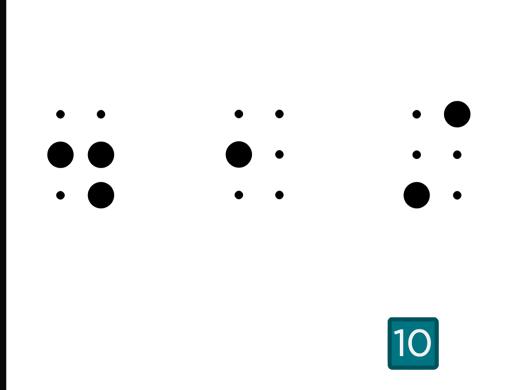
These are the lower groupsigns b-e, c-o-n, and d-i-s.
Above the middle line, you’ll find three rows of braille.
Feel the first line.
This is the lower groupsign “b-e.”
Now, feel the next line.
This is the lower groupsign c-o-n.
And on the last line, feel the lower groupsign d-i-s.
These three lower groupsigns can only be used at the beginning of words.
Below the middle line, you’ll find three rows of words that use the lower groupsigns “be,” “con,” and “dis.”
Let’s read the first row together.
Just like you’ve done with the other workshops in this series, use the Pause button or spacebar for as long as you need to complete an activity item.
Then, select the Play button or press the spacebar again to hear the feedback for that item.
It says, “behave,” “began,” “begin.”
These words all use the lower groupsign “be.”
Next, read the second row of words, which use the lower groupsign “con.”
If you read, “condo,” “content,” “concern,” you’re right!
How about the last row of words using the lower groupsign “dis?”
The last row reads, “displace,” “disco,” “disinfect.”
Turn the page.
Page 2
Feel the braille in the top-left corner of the page.
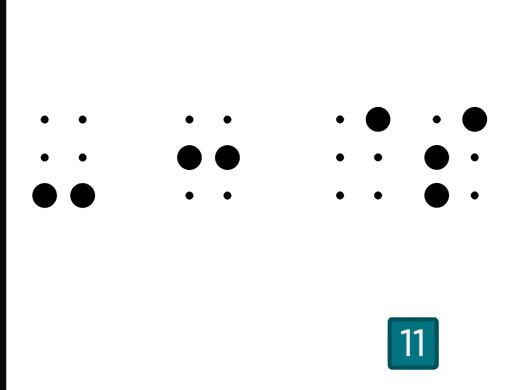
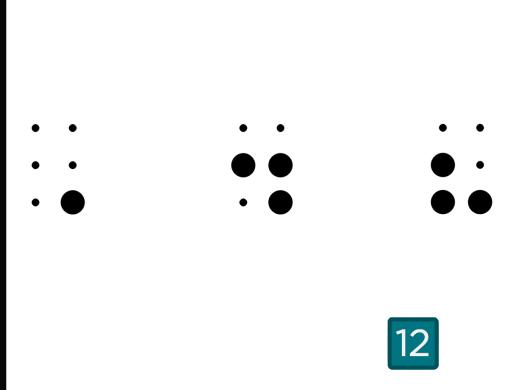
This is the lower groupsign “be,” dots 2-3.
The “be” groupsign uses the middle and bottom dots on the first side of the cell.
Earlier, you learned the lower wordsign “be.”
When this symbol is used at the beginning of a word, it’s a groupsign.
Above the middle line, you’ll find three rows of words that use the lower groupsign “be.”
Read the word on the first row.
Did you read the word “behavior?” If so, you got it!
Next, read the word on the second row.
This word is “bedazzle.”
And now, read the last row.
The last word is “befall.”
Below the middle line, you’ll find four phrases.
Read the first phrase and find the word that uses the “be” groupsign.
The second word is “believe.” This phrase says, “make believe.”
Now read the second phrase and find the word with the “be” groupsign.
The word “befooled” uses the groupsign “be” in the phrase, “befooled by a trick.”
Next, read the third phrase and find the word that uses the “be” groupsign.
The word “behavior” uses the “be” groupsign in the phrase, “bad behavior.”
Finally, find the word that uses the “be” groupsign in the last phrase.
If you said the word “beginning,” you’re right!
This phrase says, “beginning with the sun.”
Turn the page.
Page 3
Feel the braille in the top left corner of the page.
This is the lower groupsign “con,” dots 2-5.
“Con” uses the middle dot on the first side of the cell and the middle dot on the second side of the cell.
Above the middle line, you’ll find three words that use the lower groupsign “con.”
Read the first word.
The first word is “concept.”
Next, read the second word.
Did you read “conflict?” If so, you got it!
Now, read the last word.
This is the word “contest.”
Below the middle line are four phrases.
Read the first phrase and find the word that uses “con.”
Did you find the word “concept?”
Yes, the phrase says, “learn the concept.”
Now, read the second phrase and find the “con” word in this phrase.
The word “contact” uses the groupsign “con” in the phrase “contact a company.”
Next, read the third phrase and find the word that uses “con.”
In this phrase, the word “concrete” uses the groupsign.
It says, “pour concrete.”
Finally, find the word that uses “con” in the last phrase.
It’s the word “construct.”
The phrase says, “construct a house.”
Turn the page.
Page 4
Feel the braille in the top left corner of the page.
This is the lower groupsign “dis,” dots 2-5-6.
“Dis” uses the middle dot on the first side of the cell and the middle and bottom dots on the second side of the cell.
Above the middle line, you’ll find three rows of words that use the lower groupsign “dis.”
Read the word in the first row.
This is the word “discreet.”
Next, read the word in the second row.
Did you read “dislike?” That’s right!
Now read the third row.
The third row is the word “disagree.”
Below the middle line, you’ll find four phrases.
Read the first phrase and find the words that use “dis.”
This phrase says, “discard or dispose.”
The words “discard” and “dispose” both use “dis.”
Now, read the second phrase and find the “dis” word.
The word “discovery” uses the groupsign “dis” in the phrase, “make a discovery.”
Next, read the third phrase and find the word that uses “dis.”
“Disco” uses the groupsign “dis” in the phrase, “disco music.”
Finally, identify the word that uses “dis” in the last phrase.
If you said the word “disguise,” you got it!
The phrase says, “wear a disguise.”
Turn the page.
Page 5
Feel the lower groupsigns “dis,” “con,” and “be” in the top left corner of the page.
Near the top of the page, you’ll find three sentences.
Remember, you can use the Pause button or spacebar for as long as you need to.
Then select the Play button or press the spacebar again to hear the feedback.
Read the first sentence and find the words that use the lower groupsign “be.”
Did you identify the words “bewildered” and “behavior” in the first sentence?
If so, you found all the “be” groupsigns!
Now, read the second sentence and find the words that use the lower groupsign “con.”
This time “conflict,” “concern,” and “contest” all use the groupsign “con.”
Finally, read the last sentence and identify the words that use the lower groupsign “dis.”
The words “dismayed,” “disgracing,” and “dispute” all use the groupsign “dis.”
Continue down the page to find six phrases that use lower groupsigns.
Read the first phrase and find which lower groupsign is used.
The first phrase says, “a grand discovery.”
It uses the lower groupsign “dis.”
Now, read the second phrase and find what lower groupsigns are used.
Did you find the groupsigns “be,” and “con?” That’s right!
These groupsigns are used in the phrase, “water became contaminated.”
Next, read the third phrase and find any lower groupsigns that are used.
This time, the groupsign “be” is used in the phrase, “jewels bedazzled.”
Now, try the fourth phrase.
This one says, “disfigured and contorted,” and it uses the lower groupsigns “dis” and “con.”
Now, the fifth phrase.
This phrase says, “the beginning.”
It uses the lower groupsign “be.”
Finally, read the last phrase, and look for lower groupsigns.
The groupsign “dis” appears in the phrase, “dispute the claim.”
Did you find the lower groupsigns each time?
If not, feel free to pause the audio, or replay this page and check again.
When you’re ready, turn the page.
Page 6
Feel the word “better” in the top left corner of the page.
The lower groupsigns “be,” “con,” and “dis” not only have to be at the beginning of the word, they also must be the complete first syllable.
And they must be followed by a letter or a contraction.
Read the three words near the top of the page.
These words, “better,” “conch,” and “disk,” cannot use the lower groupsigns, because these groupsigns are not the complete first syllable in each word.
Continue down the page to find five rows of words.
Read the first row and find which word is written in correct braille.
If you said the second word, you’re right!
“Con” does not complete the first syllable in the word “cons.”
Now, read the second row. Which word is written correctly in this row?
The first word is correct for “belt.”
Next, read the third row and find which word is written correctly.
The second word is right.
“Dis” is the complete first syllable in the word “discern.”
And which one is correct in the fourth row?
“Belly” is written correctly in the second word.
Finally, read the last row. Which word is written correctly?
The first way to write “convert” is correct.
If you found this tricky, just reach out to a braille expert and we can talk about it.
Turn the page.
Page 7
Feel the word “well-behaved” in the top left corner of the page.
The lower groupsigns “be,” “con,” and “dis” can follow punctuation and indicators.
Find the two rows of braille near the top of the page.
The first row uses the lower groupsign “be” in the hyphenated word “well-behaved.”
Notice that this lower groupsign can be used after the hyphen.
Now read the second row.
This time the lower groupsign “con” is used next to the quotation marks in the word “context.”
Continue down the page to find two paragraphs.
Notice the correct formatting for a paragraph is to indent two spaces and start the braille in the third cell.
Pause the audio and read the paragraphs. Then, play the audio and we’ll read them again together.
And you can pause whenever you need extra time on a word.
Now, let’s read it together beginning with the first paragraph: Organizing a space may take self-discipline. If disorganized spaces are becoming a concern, don’t distress. Construct consistency by sorting the items!
Now let’s read the second paragraph: Begin by labeling three boxes. Label a box “keep,” a box “discard,” and a box “disinfect”. Sort items into the boxes. You may be bewildered by this tidying-conquest exercise.
If reading this long passage was tricky, don’t be discouraged.
Reading long passages takes time and practice.
For more practice and tips on reading passages like this one, check out the Techniques for Better Reading workshops or call a braille expert. We are happy to help!
Turn the page.
Page 8
Feel the word “O’Connor” in the top left corner of the page.
The lower groupsigns “be,” “con,” and “dis” cannot be used after an apostrophe or a forward slash, like in the name “O’Connor” or the phrase “concave/convex.”
Let’s read the two rows of braille near the top of the page.
The first row is the name “O’Connor.”
The second row is the phrase “concave/convex.”
Did you notice that the groupsign “con” can be used in “concave” because it comes before the forward slash.
But it cannot be used in “convex” after the forward slash, because it would be touching the forward slash.
Continue down the page to find three sentences.
Each sentence contains a word that cannot use a lower groupsign because the groupsign would come after an apostrophe or a forward slash.
Read the first sentence and find which word cannot use the groupsign “con.”
If you said the name, “O’Connell,” you got it!
Now, do the second sentence.
In this one, the word “disperse” cannot use the groupsign “dis” after a forward slash.
Now, read the third sentence.
What word cannot use a lower groupsign?
The word “befool” cannot use the groupsign “be” after a forward slash.
Turn the page.
Page 9
Feel the lower groupsigns “be,” “con,” and “dis” in the top left corner of the page.
Near the top of the page, you’ll find six rows of braille arranged in two columns.
Read the first word in the first column.
This word uses the “be” groupsign followed by r-r-y.
Now, read the first word in the second column.
This one starts with the letter b, then uses the e-r contraction, then r-y.
Which one is the correct braille for the word “berry?”
If you said the word in the second column, you’re right!
The “be” groupsign cannot be used because it does not complete the first syllable in the word “berry.”
Now, read the second word in the first and second columns.
Which column has the word “dishes” written correctly?
The word “dishes” is written correctly in the first column.
Next, read the words in the first and second columns in the third row and choose which column has the word “Behold” written correctly?
The word “Behold” is correct in the first column.
In the fourth row, which column has the word “constructed” brailled correctly?
If you said it’s correct in the second column, you got it!
Next, read the two words in the fifth row.
Which column has the name “O’Connor” written correctly?
The second column is correct.
Now select the column with the word “concrete” written correctly in the last row.
The second column is right again.
Continue down the page to find six fill-in-the-blank sentences.
Read the first sentence.
Then choose one of the words from the top half of the page to fill in the blank.
For sentence one, the word “O’Connor” from the second column is correct.
“Mrs. O’Connor was betrayed in the contest.”
Now try sentence 2.
This time, the word “dishes” from the first column works.
“Use disinfectant to wash the dishes.”
How about sentence 3?
This one should read, “The self-constructed bed he built converts into a bench.”
The word “constructed” from the second column fits here.
Which word works for sentence 4?
Did you choose the word “concrete” from the first column?
This sentence should read, “The wood/concrete material is better.”
Now for sentence 5.
Number 5 should read: “Behold!” she exclaimed.
If you chose the word “Behold” from the first column, you got it!
Finally, check out sentence 6.
This time, the word “berry” from the second column is right.
This one should read, “The berry jam has a sticky consistency.”
Turn the page.
Page 10
Feel the word “discovery” in the top left corner of the page.
You’ve made a lot of discoveries about braille and have learned many words and symbols.
On this page, you’ll find a story. Let’s read it together:
My beloved Aunt Belinda will disabuse you of any concept that people are constricted by age in beginning new skills. On behalf of future grandkids, she belatedly began to quilt at age 80. She has discovered it isn’t easy, but that does not stop her!
Belinda consulted a quilter to get knowledge of the beloved artform. She discarded negative behaviors, and concentrated on being positive. Next, she acquired a container of beloved old patterns and contrasting fabric. If Belinda is not beset with problems, she will not disappoint us and will be finishing a quilt very soon!
Now, go back and reread or scan through these paragraphs, and count the words that used the lower groupsign “be.”
Did you find nine words that used the lower groupsign “be?”
The words are “beloved,” “Belinda,” “beginning,” “behalf,” “belated,” “began,” “behaviors,” “being,” and “beset.”
Check the paragraphs again and find how many words used the lower groupsign “con.”
If you said six, you found them all!
The words are “concept,” “constricted,” “consulted,” “concentrated,” “container,” and “contrasting.”
And read or scan one more time to find how many words use the lower groupsign “dis.”
There are four. “Disabuse,” “discovered,” “discarded,” and “disappoint.”
Great practice! This was tricky so you might want to replay the audio and try it again.
If you’d like, create your own story about a time you or someone you know learned a new skill.
Select Next to complete this workshop.
Completion
Congratulations! You’ve learned three more lower groupsigns.
If you have any questions about using these lower groupsigns, or if you’d like more information on better reading techniques, or anything else, you can always contact a braille expert at 847-784-2816. We’re happy to help!
Contracted Braille Series
- Workshop
Explore
-
"I pick myself up"
Audio · 3 minutes
-
I can’t drive anymore
Resource guide
-
The Crochet Life: 7 Tips for Crocheting After Vision Loss
Article · 4 minutes
-
Resource Roundtable
Discussion
- Explore more
Members also liked
Join the Hadley Community
Hadley's resources are always available to you. Create a no-cost Hadley account to go further:
-
Pick up where you left off Everything you start is automatically saved across Hadley.
-
Personalized recommendations We'll suggest resources based on your interests.
-
Join live discussions Live and lively discussions on technology, cooking, and more, all geared toward the community of people living with vision loss.
-
Find peer support Connect with people who understand what you're going through.