
Workshop 11: More Lower Groupsigns ea, bb, cc, ff, gg
Hadley
Contracted Braille
Workshop 11, More Lower Groupsigns: ea, bb, cc, ff, gg
Opening
Hadley presents Contracted Braille Workshop 11, More Lower Groupsigns: ea, bb, cc, ff, gg.
Page 1
To begin, make sure you have your braille workbook with you.
If you don’t already have one, call Hadley at 847-784-2816 and we’ll mail one right out to you.
Now, we’re going to learn a few more lower groupsigns.
Feel the braille in the top left corner of the page.
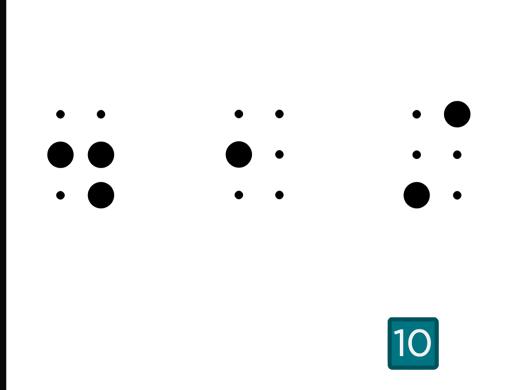
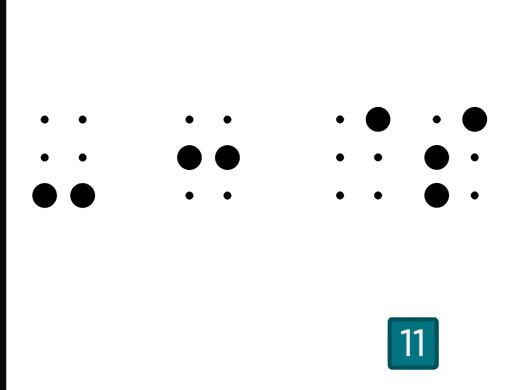
These are the lower groupsigns ea, bb, and cc when they’re used in the middle of a word.
Above the middle line, you’ll find three rows of braille.
Just like you’ve done with the other workshops in this series, use the Pause button or spacebar for as long as you need to read or complete an activity.
Then select the Play button or press the spacebar again to hear the feedback.
Read the first line.
This is the word “health,” and it uses the lower groupsign ea.
Now read the next line.
The word “nibble” uses the lower groupsign bb.
How about the last line?
This is the word “accept” and it uses the lower groupsign cc.
Below the middle line you’ll find a phrase. Let’s read this phrase together.
“Crabby beach occupant.” Great!
Turn the page.
Page 2
Feel the braille in the top-left corner of the page.
You’ve learned this symbol before as the comma. But when it’s used in the middle of a word, it’s the lower groupsign ea.
ea is dot 2. The middle dot on the first side of the cell.
Above the middle line are three rows of braille.
Which row contains a word that uses the lower groupsign ea?
If you found “heat” in the second row, you got it!
Below the middle line, you’ll find three sentences.
Read the first sentence.
If you read the question, “Peanut butter on yeast bread or turkey?” That’s it!
How many words in this sentence use the ea groupsign?
Three words use the ea groupsign: “peanut,” “yeast,” and “bread.”
Now read the second sentence.
This one reads, “To be healthy, eat less meat.”
How many of these words use the ea groupsign?
Two words have the ea groupsign: “healthy” and “meat.”
The word “eat” does not use the ea contraction because ea is at the beginning of the word.
Finally, read the last sentence.
This one says, “Please measure the steak, 3 oz only for me.”
And how many words in this sentence use the ea contraction?
You got it if you said three: “please,” “measure,” and “steak.”
If it was tricky to understand when the dot 2 contraction is ea and when it’s a comma, remember that ea only appears in the middle of a word, and a comma appears at the end of a word.
Feel free to replay this page and try again.
And you can reach out to a Hadley braille expert. We’re happy to help!
When you’re ready, turn the page.
Page 3
Feel the braille in the top left corner of the page.
You previously learned this symbol as “be” when it’s found at the beginning of a word.
But when it’s used in the middle of a word, it’s the lower groupsign bb.
bb is dots 2 and 3. It uses the middle and bottom dots on the first side of the cell.
Above the middle line, you’ll find three rows of braille.
Which row contains a word that uses the lower groupsign bb?
If you said “rabbit,” in the last row, you’re right!
Below the middle line you’ll find three sentences.
Read the first sentence.
The first sentence says, “That stubborn tabby eats kibble.”
How many words in this sentence use the lower groupsign bb?
There are three: “stubborn,” “tabby,” and “kibble.”
Now read the next sentence.
This one reads, “Beware to that rabbit who nibbles my cabbage.”
How many words with the lower groupsign bb did you find here?
If you said three again, that’s it!
“Rabbit,” “nibbles,” and “cabbage” all use the lower groupsign bb.
How about the last sentence?
This says, “Meet Gibbs at 3:45 in that shabby lobby.”
How many words use bb in this sentence?
Three words use the bb contraction in this sentence: “Gibbs,” “shabby,” and “lobby.”
Turn the page.
Page 4
Feel the braille in the top left corner of the page.
You learned this symbol before as “con” when it’s at the beginning of a word.
But it’s the lower groupsign cc when it’s found in the middle of a word.
cc is dots 2 and 5. It uses the middle dot on the first side of the cell and the middle dot on the second side of the cell.
Above the middle line are three rows of braille.
Which row has a word using the lower groupsign
cc?
If you found the word “occur” in the last row, you got it!
Below the middle line, you’ll find three sentences. Read the first sentence.
This reads, “Becca was able to accelerate the plane with success!”
Which words in this sentence use the cc lower groupsign?
The words that use cc are “Becca,” “accelerate,” and “success.”
Now read the next sentence.
This one says, “I adore that actor with the acclaimed French accent.”
Which of these words uses the cc contraction?
The cc words are “acclaimed” and “accent.”
And how about the last sentence?
If you read, “The contractor, who was accused of inaccurate billing, quit the job,” you got it!
Which words did you find that used the cc lower groupsign?
Did you find “accused” and “inaccurate?” Great practice!
Turn the page.
Page 5
Feel the braille in the top left corner of the page. These are the lower groupsigns, bb, cc, and ea.
Above the middle line are three rows of braille.
Which row has a word that uses the lower groupsign ea?
Did you find it on the last row? This row says “team.”
Which row has a word that uses the lower groupsign cc?
The first row is the word “broccoli,” and it uses the lower groupsign cc.
Now find the row with the word that uses the lower groupsign bb.
Yes, the second row uses bb in the word “bubble.”
Below the middle line, you’ll find three rows of words.
Read the first row and find which word uses the lower groupsign cc.
It’s the middle word, “occupies.”
What about the second row? Which word uses the lower groupsign bb?
If you picked the second word, “abbey,” that’s right!
Now read the last row.
Which word uses the lower groupsign ea?
It’s the last word, “teach.”
Did you notice that the bb and ea contractions were not used in words like “cobb” and “each?”
That’s because these letters were not in the middle of the words.
Turn the page.
Page 6
Let’s learn the last two lower groupsigns.
Feel the braille in the top left corner of the page.
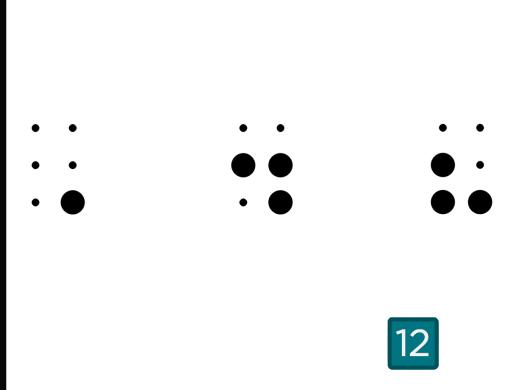
These are the lower groupsigns ff and gg when they’re found in the middle of a word.
Above the middle line, you’ll find two rows of braille. Read the first row.
This is the word “stuffy,” which uses the lower groupsign ff.
Now read the second row.
This is the word “muggy,” which uses the lower groupsign gg.
Below the middle line, you’ll find a sentence. Let’s read the sentence.
It says, “Reggie begged for fluffy peanut taffy.”
Which words in this sentence use the lower ff and gg groupsigns?
If you found “Reggie” and “begged,” along with “fluffy” and “taffy,” you found them all!
Turn the page.
Page 7
Feel the braille in the top left corner of the page.
This is the lower groupsign ff when it’s found in the middle of a word.
ff is dots 2-3-5. It uses the middle and bottom dots on the first side of the cell and the middle dot on the second side.
Above the middle line are two words.
Which word has the lower groupsign ff?
It’s the second word, “suffer.”
Below the middle line you’ll find three sentences. Read the first sentence.
This says, “Can we go to that diner with the fluffy peach waffles?”
How many words in this sentence use the lower groupsign ff?
There are two: “fluffy” and “waffles.”
Now read the second sentence.
This one reads, “Jeffrey heated muffins for breakfast.”
How many words in this sentence use the lower groupsign ff?
There are two words with ff: “Jeffrey” and “muffins.”
Finally, read the last sentence.
If you read, “Tiffany asked for salt taffy and stuffed animals,” you got it!
How many words in this sentence use the lower groupsign ff?
There are three, “Tiffany,” “taffy,” and “stuffed.”
Turn the page.
Page 8
Feel the braille in the top left corner of the page.
This is the lower groupsign gg, dots 2-3-5-6, when it’s found in the middle of a word.
gg is the middle and bottom dots on the first side of the cell and the middle and bottom dots on the second side.
Above the middle line are two words.
Which word contains the lower groupsign gg?
If you found gg in the second word, “soggy,” you got it!
Below the middle line, you’ll find two sentences. Read the first sentence.
This one says, “I suggested a boiled egg, but Jim ordered two fried eggs.”
Which two words use the lower groupsign gg?
If you said, “suggested” and “eggs,” you’re right!
Notice how “egg” does not use the groupsign gg because those letters don’t appear in the middle of the word.
Now read the second sentence.
This one says, “Meggan struggled getting her luggage to the lobby.”
Which words here use the lower groupsign gg?
The words that use gg are “Meggan,” “struggled,” and “luggage.”
Turn the page.
Page 9
Feel the groupsigns ea, bb, cc, ff, and gg in the top left corner of the page.
Recall that these lower groupsigns can only be used in the middle of words.
Near the top of the page, you’ll find four rows of braille. Read the first row.
This is the words “stuffy” and “stuff.”
Notice the ff groupsign can be used in “stuffy” because it’s in the middle of the word.
Now read the second row.
This is the words “sea” and “seashore.”
Again, the ea contraction is used in the middle of the word “seashore,” but it cannot be used at the end of “sea.”
Next, read the third row.
The third row says, “Scrabble” and “ebb.”
“Scrabble” has bb in the middle of the word, so the lower groupsign can be used here.
And now read the last row.
This is the words “egg” and “struggle.”
Only the word “struggle” can use the gg groupsign because these letters are in the middle of the word.
It can be tricky that these symbols have other meanings when they’re not in the middle of a word.
So, let’s practice some phrases that use these symbols two ways.
Near the bottom of the page, you’ll find four rows of braille. Read the first row.
This reads, “Scrabble; nice when it rains.”
Notice how bb and the semicolon are both made with dots 2-3.
Now read the second row.
If you read, “like the seashore, love the lake, too,” you got it!
The comma after “seashore” is dot 2 at the end of a word, and the ea contraction is dot 2 in the middle of a word.
What about the third row?
This one says, “soccer: a sport of accuracy.”
Notice the colon and the cc in “soccer” both use dots 2-5, but these symbols mean different things in different positions.
Finally, read the last row.
This row says, “Meetings can be stuffy!”
The lower ff groupsign in the middle of the word “stuffy” and the exclamation point both use
dots 2-3-5.
Feel free to replay this page if you’d like.
And if you have any questions about telling lower groupsigns and punctuation marks apart, reach out to a braille expert. We’d love to help!.
When you’re ready, turn the page.
Page 10
Feel the groupsigns ea, bb, cc, ff, and gg in the top left corner of the page.
On this page, you’ll find three pairs of sentences.
In each pair, one sentence is written correctly.
Pause the audio while you read the first two sentences and find which one is correct.
Then select Play when you’re ready for the feedback.
Sentences 1 and 2 say, “My grandkids dream of finding treasure in the ocean.”
Did you find which one is written correctly?
Sentence 1 is written correctly.
It uses the lower groupsign ea to write “dream,” “treasure,” and “ocean.”
Now read sentences 3 and 4 and find which one is written correctly.
Did you say sentence 4 is correct? That’s right!
It uses the lower groupsigns gg in “Peggy,” bb in “grabbed,” and gg again in “luggage.”
Finally, read sentences 5 and 6 and find which one contains words that correctly use the lower groupsigns.
Sentence 5 uses groupsigns correctly in “accepted” and “ribbon” and in “yeast” and “bread”
Turn the page.
Page 11
Feel the groupsign ea in the top left corner of the page.
Now find the word “bear” written two ways near the top of the page.
This is a tricky one. Should “bear” be written with the ar contraction or with the ea groupsign?
The first word, with ar, is correct.
ar is a strong contraction, and strong contractions should always be chosen over lower groupsigns.
Continue down the page to find six rows of braille.
Read the words in the first row and find which one is correctly brailled for the word “effort.”
The correct one is the second word using the strong contraction “for” rather than ff.
Now, read the second row and find which is correct for the word “sweater.”
The second word is correct.
The lower contraction ea should be used in sweater.
Next, read the third row and find which word is “search” written correctly.
“Search” is written correctly in the first word, because the ar strong contraction takes preference over the lower groupsign ea.
What about the next row? Which word is correct for “coffee?”
It’s the second word. The “of” strong contraction should be used.
Now, in the fifth row, which word is correct for “juggle?”
If you said the second word, you got it!
And finally, read the last row and choose the correct braille for the word “theater.”
It’s the first word. The strong contraction “the” should be used instead of the lower ea contraction.
If these were tricky for you, it may be useful to replay this page and try the activity again.
And feel free to reach out to a Hadley braille expert if you have questions about which contractions to use.
When you’re ready, turn the page.
Page 12
Feel the groupsign ea in the top left corner of the page.
Let’s look at some more information about using the lower groupsign ea.
Read the word on the first row, “preamble.”
The letters ea appear in “preamble,” but the ea lower groupsign can never be used to cross or bridge a prefix and the rest of the word.
The prefix “pre” and the word “amble” shows one example.
Let’s look at another. Read the second row, and you’ll find another word that has “e” in the prefix followed by “a” in the rest of the word.
Again, the lower ea groupsign would not be used in “react.”
Although ea cannot be used to bridge the prefix and the rest of the word, it can be used with a suffix, or word ending.
In the third row, notice the ea groupsign is used in the word “moveable.”
Now, pause to read the next two rows and notice where ea is used in the words “likeable” and “noticeable.”
In these words, the ea lower groupsign can be used with a suffix.
Next, find the two sentences at the bottom of the page and read sentence 1.
Which word in sentence 1 has a prefix that will not allow us to use the ea contraction?
If you said, “preapproval,” that’s right!
Which word in sentence 1 does let us use the ea contraction with a suffix?
The word “enforceable” uses the ea contraction.
Now let’s look at sentence 2.
Which word does not allow use of the ea groupsign with a prefix?
“Reapply” cannot use the ea groupsign.
And which word in sentence 2 does use a suffix with the lower groupsign ea?
The word “manageable” uses the ea lower groupsign correctly.
Great practice!
Turn the page.
Page 13
Feel the groupsigns ea, bb, cc, ff, and gg in the top left corner of the page.
Have you ever had to get creative while packing for a trip?
Here’s a story about two friends getting ready for a cruise.
Notice the sentences form four paragraphs in this story.
Pause the audio to read the story, and when you’re done, play the audio to answer some questions.
Let’s take a look at Maggy and Rebecca’s trip.
Where are the ladies going on their cruise?
They’re going to the Caribbean.
What did Rebecca do to flatten her luggage?
She sat on her duffle.
And where did Rebecca stuff her shoes?
Into her fluffy hat.
Finally, what did Maggy need after packing?
If you said Maggy really needed a break, you’re right!
You may have your own short story about your travel adventures.
Select Next to complete this workshop.
Completion
Congratulations! You’ve learned five more lower groupsigns.
The rules for using lower groupsigns are tricky, so if you have any questions or just want to order your next set of books, just reach out to a Hadley braille expert at 847-784-2816. We’re happy to help!
Contracted Braille Series
- Workshop
- Workshop
Explore
-
Painting Blind
Audio · 27 minutes
-
I can’t drive anymore
Resource guide
-
5 Talking Devices People with Vision Loss Find Super Helpful
Article · 5 minutes
-
Resource Roundtable
Discussion
- Explore more
Members also liked
Join the Hadley Community
Hadley's resources are always available to you. Create a no-cost Hadley account to go further:
-
Pick up where you left off Everything you start is automatically saved across Hadley.
-
Personalized recommendations We'll suggest resources based on your interests.
-
Join live discussions Live and lively discussions on technology, cooking, and more, all geared toward the community of people living with vision loss.
-
Find peer support Connect with people who understand what you're going through.