
Workshop 12: Dot 5 Words
Hadley
Contracted Braille
Workshop 12: Dot 5 Words
Opening
Hadley presents Contracted Braille Workshop 12: Dot 5 Words.
Page 1
To begin, make sure you have your braille workbook with you.
If you don't already have one, call Hadley at 847-784-2816, and we'll mail one right out to you.
Now let's learn some new symbols.
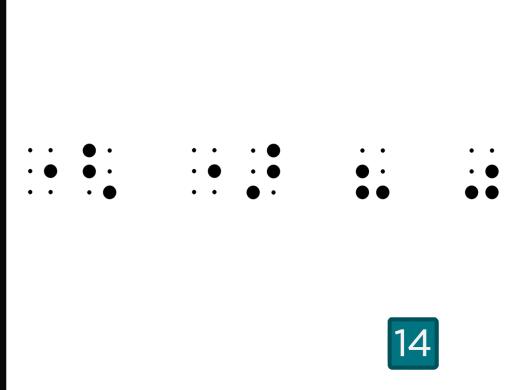
Feel the braille in the top left corner of the page.
These symbols are called dot 5 contractions.
These dot 5 contractions stand for the words "day," "some," "time," and "name."
Dot 5 contractions are initial letter contractions made using two cells: dot 5 followed by the first letter or symbol of the word.
Dot 5 is the middle dot on the second side of the cell.
Above the middle line you'll find four rows of words. Let's read the words in the first row.
This is the word "day."
Next, let's read the word in the second row.
This is the word "some."
Now, the third row.
This is the word "time."
And finally, let's read the word in the last row.
This is the word "name."
Below the middle line you'll find a row of words.
Let's read these words together: "day, some, time, name."
Turn the page.
Page 2
Feel the braille in the top left corner of the page.
This is "day," dot 5-d.
Above the middle line, you'll find four rows of braille.
As with the other workshops in this series, use the Pause button or spacebar for as long as you need to read or complete an activity.
Then select the Play button, or press the spacebar again to hear the feedback.
Read the four rows of words above the middle line, and find which row contains the word "day."
Did you find "day" in the second row? That's right!
Below the middle line are four more rows of words.
Read the four words in the first row and find which word is "day."
If you picked the first word, you got it!
Now find the word "day" in the next row.
"Day" is the last word.
Next, find the word "day" in the third row.
This time, "day" is the third word.
Finally, find the word "day" in the last row.
"Day" is the last word.
Turn the page.
Page 3
Feel the braille in the top left corner of the page.
This is "some," dot 5-s.
Above the middle line, read the four rows of words and find which row contains the word "some."
If you said the third row, you got it!
Below the middle line are four more rows of words.
Now, read the words in the first row and find which word is "some."
"Some" is the last word.
Next, find the word "some" in the second row.
If you picked the second word, you got it!
And which is the word "some" in the next row?
It's the second word again!
Finally, find the word "some" in the last row.
This time, "some" is the first word.
Turn the page.
Page 4
Feel the braille in the top-left corner of the page. This is "time," dot 5-t.
Above the middle line, read the four rows of words and find which row contains the word "time."
Did you find it on the second row? That's right!
Below the middle line are four rows of words.
Read the first row and find which word is "time."
"Time" is the third word.
Now, find the word time in the second row.
It's the first word.
Next, find the word "time" in the third row.
In this row, "time" is the third word.
Finally, find the word "time" in the last row.
If you said it's the second word, you're right!
Turn the page.
Page 5
Feel the braille in the top left corner of the page.
This is "name," dot 5-n.
Above the middle line, you'll find four rows of words.
Read all four rows and find which one contains the word "name."
Did you find it in the first row? Yes, this is "name."
Below the middle line are four more rows of words.
Read the words in the first row and find which one is "name."
In this row, "name" is the first word.
Next, find the word "name" in the second row.
If you picked the third word, you found it!
Now, which is the word "name" in the next row?
"Name" is the second word.
Finally, find the word "name" in the last row.
This time, "name" is the last word.
Turn the page.
Page 6
Read the words "day," "some," "time," and "name" in the top-left corner of the page.
Now, let's read these dot 5 contractions in some sentences.
Once again, use the Pause button or the spacebar to stop the audio for as long as you need to complete an activity.
Then select the Play button or press the spacebar again to hear the feedback.
Read the four sentences above the middle line. Which sentence uses the word "day?"
Did you choose the second sentence? That's right!
The second one says, "It is on that day."
Which sentence has the word "some?"
It's the first one. "Some like it hot."
Now, find the sentence that has the word "time" in it.
The last sentence says, "This is not the time."
And which sentence has the word "name?"
"Name" is in the third sentence; the question, "What is my name?"
Notice that dot 5 contractions can touch punctuation and indicators.
Below the middle line, you'll find four sentences.
Read the first sentence and find which dot 5 contractions are used.
If you said "some" and "time," you're right!
This sentence says, "Some remember the time an astronaut walked on the moon."
Now, read the second sentence and find which
dot 5 contractions are used.
"Day" and "name" are used in the sentence, "On this day in history, that star was given a name."
Do you find any dot 5 contractions in the third sentence?
This one has the word "time."
It says, "The sun is so intense that it will not burn out in our time."
Finally, read the last sentence. What dot 5 contractions are used here?
The last sentence says, "Some moons do not circle the planet in a day."
It has the words "some" and "day."
If any of these were tricky, feel free to replay the page. And you can always reach out to a Hadley braille expert; we're happy to help!
Turn the page.
Page 7
Now, let's look at three more dot 5 contractions.
Feel the braille in the top left corner of the page.
These dot 5 initial letter contractions stand for the words "here," "under," and "work."
Above the middle line, you'll find three rows of words.
Let's read the word in the first row.
This is the word "here."
Next, let's read the word in the second row.
This is the word "under."
And now, let's read the word in the last row.
This is the word "work."
Below the middle line, you'll find a row of words.
Let's read these words together: "here, under, work."
Turn the page.
Page 8
Feel the braille in the top left corner of the page.
This is "here," dot 5-h.
Above the middle line, you'll find three rows of words.
Read all three rows and find which row contains the word "here."
Did you find "here" in the second row? That's right!
Below the middle line are four rows of words.
Read the three words in the first row and find which one is "here."
If you picked the first word, you got it!
Next, find the word "here" in the second row.
In this row, "here" is the middle word.
Now, find the word "here" in the third row.
This time, "here" is the last word.
Finally, find the word "here" in the last row.
It's the first word.
Turn the page.
Page 9
Feel the braille in the top left corner of the page.
This is "under," dot 5-u.
Above the middle line, you'll find three rows of words.
Read these words and find which row contains the word "under."
Did you find "under" in the last row? That's right!
Below the middle line you'll find four rows of words.
Read the first row and find which word is "under."
"Under" is the last word.
Now, find the word "under" in the second row.
If you picked the first word, that's right!
Next, find the word "under" in the third row.
This time "under" is the middle word.
And finally, find the word "under" in the last row.
It's the last word.
Turn the page.
Page 10
Feel the braille in the top left corner of the page.
This is "work," dot 5-w.
Above the middle line, you'll find three rows of words.
Read all three rows and find which one contains the word "work."
Did you find "work" in the third row? You got it!
Below the middle line are four rows of words.
Read the words in the first row and find which one is "work."
The middle word is "work."
Now, find the word "work" in the second row.
If you said it's the middle word, again, that's right!
Next, find the word "work" in the third row.
In this row, "work" is the last word.
And finally, find the word "work" in the last row.
This time "work" is the first word.
Turn the page.
Page 11
Read the words "here," "under," and "work" in the top left corner of the page.
Now let's read these dot 5 contractions in sentences.
Read the three sentences above the middle line.
Which sentence uses the word "here?"
"Here" is in the first sentence, "Here I am."
Which sentence has the word "under?"
If you said the third sentence, you're right!
This one says, "Look under the bed."
And which sentence has the word "work?"
"Work" is in the second sentence, "Go to work."
Now, find the four sentences below the middle line.
Again, for each sentence select Pause to read or find, and then Play to get the feedback.
Read the first sentence.
Which dot 5 contractions are used in this sentence?
If you said "work" and "here," you're right!
The sentence says, "Will you bring the work key here?"
Now, read the second sentence.
Did you find any dot 5 contractions?
The dot 5 contraction "under" is used in this sentence. "Have them look under the desk for it."
And what dot 5 contractions do you read in the third sentence?
The third sentence has the words "under" and "work." It says, "Meet us under the bridge by my work."
Finally, read the last sentence.
Does this sentence include any dot 5 contractions?
This one says, "Honk when you get here." It has the word "here."
Turn the page.
Page 12
Read the words "day" and "work" in the top left corner of the page.
Now, find the four rows of braille near the top of the page.
Each row has four words.
Read the first row and find which word is "day."
If you said the first word, you got it!
Now, read the first row again and find which word is "name."
"Name" is the third word.
And now find the word "time."
It's the last word.
Now, let's do the second row. Which is the word "some?"
Did you select the last word? That's right!
Now, find the word "work."
"Work" is the first word.
Now move to the third row. Which is the word "under?"
The last word is "under."
And which is the word "here?"
"Here" is the first word.
Now, read the last row and find which word is "here."
"Here" is the second word.
And finally, which word is "name?"
"Name" is the third word.
Continue down the page to find four sentences.
Read the first sentence.
This one says, "Name the time and day you need help moving."
Now, read the next sentence.
Did you read, "What time will you get to work?" That's right!
How about the third sentence?
This says, "Do you have some boxes under here?"
Finally, read the last sentence.
The last one reads, "Some day Will may move here, too!"
Turn the page.
Page 13
Feel the word in the top left corner of the page.
This says, "payday."
Dot 5 contractions can also be used as groupsigns, like in the word "payday."
Find the three words near the top of the page.
What's the word in the first row?
Right, the first word is "payday."
How about the word in the second row?
This word is "timesheet."
And what's the word in the last row?
This is the word "Saturday."
Continue down the page to find three fill-in-the-blank sentences.
Read sentence number 1.
Now, read the words in the next row, and find which one is written correctly to complete the sentence.
If you chose the second word, you got it!
The contraction "day" can be used as a groupsign in the word "birthday."
It says, "My birthday is soon."
Now, read sentence number 2, and on the next line, choose the word that's written correctly to complete the sentence.
The second word is correct.
This sentence says, "Type in a username to log on."
The first word is missing the dot 5 in the contraction name.
Finally, read sentence three, and select the correct word to fill in the blank.
The first word, "thunderstorm," completes the sentence, "The thunderstorm was loud."
The second word uses the group sign sh instead of the initial letter u.
Turn the page.
Page 14
Read the word "timepiece" in the top left corner of the page.
When using dot 5 contractions in longer words, they need to keep their original sound, like in the word "timepiece."
Now, find the three words near the top of the page.
Let's look at the first word.
This word is "multimedia."
Notice that the contraction "time" cannot be used here for the letters t-i-m-e because it does not keep its original sound.
What's the word in the second row?
If you read "isometric," you got it!
Although the word "isometric" has the letters
s-o-m-e, the contraction "some" cannot be used here.
Now, read the word on the third row.
This one says, "centimeter."
Once again, the contraction "time" cannot be used here.
Continue down the page to the numbered sentences.
Each sentence is written twice.
Read sentences 1 and 2 and find which one is brailled correctly.
If you chose sentence 1, you're right!
The name "Mortimer" cannot use the contraction for "time."
And "Vietnamese" cannot use the contraction for "name."
Now, read sentences 3 and 4 and find which one is written correctly.
Sentence 4 is correct.
The word "sometime" should use the contractions "some" and "time" because they keep their original sounds.
If you have any questions about the rules for dot 5 contractions, reach out to a braille expert for some tips and more practice.
Turn the page.
Page 15
Read the word "itinerary" in the top left corner of the page.
You can use braille to make an itinerary for a trip.
Read the itinerary on this page, and then you'll be ready to answer some questions.
You can always pause the audio for as long as you need, and then play the audio when you're ready.
This sounds like quite a trip. What needs to be packed on Day 1?
If you said "paperwork" and a "nametag," you got it!
What route will be taken on Day 3?
The Ring of Kerry route is planned for Day 3.
On Day 1, at what time of day will the group eat at Patty's Cafe?
The group will visit Patty's Cafe at lunchtime.
Now, what will happen in the lobby?
This is where the group will meet.
And what will the group do near Blarney Woolen Mills?
If you said, "eat dinner," you're right!
What are some fun things you like to do on a trip?
You might enjoy jotting a few of them down with your growing braille skills.
Select Next to complete this workshop.
Completion
Congratulations! You've learned seven Dot 5 contractions.
If you have questions about using these contractions, or anything else you've learned in these workshops, reach out to a Hadley Braille Expert at 847-784-2816. We're happy to help!
Contracted Braille Series
- Workshop
- Workshop
Explore
-
Vision Loss and Senior Living Communities
Audio · 18 minutes
-
I was just diagnosed
Resource guide
-
Dialing the Phone Made Easier
Article · 3 minutes
-
Tech It Out
Discussion
- Explore more
Members also liked
Join the Hadley Community
Hadley's resources are always available to you. Create a no-cost Hadley account to go further:
-
Pick up where you left off Everything you start is automatically saved across Hadley.
-
Personalized recommendations We'll suggest resources based on your interests.
-
Join live discussions Live and lively discussions on technology, cooking, and more, all geared toward the community of people living with vision loss.
-
Find peer support Connect with people who understand what you're going through.