
Workshop 28: Grade 1 Indicator
Hadley
Contracted Braille Workshop 28:
Grade 1 Indicator
Opening
Hadley presents Contracted Braille Workshop 28: Grade 1 Indicator.
Page 1
To begin, make sure you have your braille workbook with you.
If you don’t already have one, call Hadley at 847-784-2816 and we’ll mail one right out to you.
Now let’s learn about the grade 1 indicator.
Feel the braille in the top left corner of the page. This is the grade 1 indicator, dots 5-6.
You’ve learned about certain symbols in braille that are called indicators.
They tell us something important about the symbols that come next.
For example, the numeric indicator tells us the next symbol is a number, not a letter.
Read the number “4” in the first row of braille near the top of the page.
You’ve also learned the capital indicator tells us the next symbol is an uppercase letter instead of a lowercase letter.
Read the capitalized word “March” in the second row.
Now, let’s look at the grade 1 indicator.
It tells us the next symbol is read as a letter and not an alphabetic wordsign.
In the third row, read the grade 1 indicator and letter “d.”
This is read as “d,” not “do.”
Next, let’s read the row of braille below the middle line.
This row has the abbreviation for “apartment” and then the grade 1 indicator and letter b.
It says, “APT b,” not “APT but.”
Turn the page.
Page 2
Feel the grade 1 indicator, dots 5-6, in the top left corner of the page.
It uses the middle and bottom dots on the second side of the cell.
As you read the braille and work through the activities on these pages, use the Pause button or spacebar for as long as you need to.
Then, select the Play button, or press the spacebar again, to hear the feedback for that item.
Above the middle line, you’ll find three rows of braille.
Read the first row and find which symbol is the grade 1 indicator.
It’s the middle symbol.
Now, read the second row and find the grade 1 indicator.
In this row, it’s the last symbol.
And now, find the grade 1 indicator in the last row.
Yes, this time it’s the first symbol.
Below the line are four more rows of braille.
Read the first row and find the letter “m” with a grade 1 indicator before it.
If you said it’s the middle choice, you’re right!
Now, the second row.
Where is “o” with a grade 1 indicator?
“O” is the first choice.
And which option in the third row has a grade 1 indicator?
It’s the middle one.
Finally, where is the grade 1 indicator-l in the last row?
The first option is correct.
Move to the next page.
Page 3
Feel the grade 1 indicator-s in the top left corner of the page.
Next, read the two rows of braille near the top of the page.
Which row says, “Make x?”
If you said the first row, that’s right!
And what does the second row say?
The second row says, “Make it.”
Continuing down the page, you’ll find four more rows of braille.
Go ahead and read the first row.
This row says, “x and y” rather than “it and you.”
Now, read the second row.
This one says, “E coli,” not “Every coli.”
Notice the grade 1 indicator comes before the capital indicator when both are used.
The capital indicator is always right next to the letter being capitalized.
What about the next row?
If you read, “vitamin C,” rather than “vitamin Can,” you got it!
Finally, what does the last row say?
The last row says, “M and M,” not “More and More.”
Turn the page.
Page 4
Feel the braille, a, i, and o in the top left corner of the page.
The letters a, i, and o do not have alphabetic wordsigns, so they do not need a grade 1 indicator to avoid confusion with words.
Near the top of the page, you’ll find four rows of braille.
Once again, use the Pause button or the spacebar to stop the audio for as long as you need to complete an activity.
Then, select the Play button, or press the spacebar again, to hear the feedback.
Read the first row and find which phrase is the correct braille for “Mrs. I.”
If you picked the first phrase, that’s right!
Now, read the second row and find which is the correct braille for “Building O.”
If you said the second phrase, you’re right!
In the third row, which phrase is the correct braille for “U of I?”
The first phrase is correct.
And in the last row, which phrase says “Wham-O Frisbee?”
It’s the second phrase.
Continuing down the page, you’ll find three sentences.
What does the first sentence say?
If you read, “My favorite author is M. A. Johnson,” you got it!
What about the second sentence?
This one reads, “The letters a, e, i, o, and u are vowels.”
Notice that a, i, and o do not need the grade 1 indicator.
Finally, read the last sentence.
The last sentence is, “You can make a U-turn on my street.”
Go to the next page.
Page 5
Feel the grade 1 indicator-j in the top left corner of the page.
When a letter follows a number, a grade 1 indicator is needed for letters a through j because they can be confused with a number.
For example, read the row of braille near the top of the page.
This row says, “Seats 34a and 341.”
Notice that you need a grade 1 indicator in “34a” so it isn’t the same as “341.”
Continuing down the page, you’ll find four rows of braille.
Read the first row of braille.
Why does one of these options use a grade 1 indicator while the other one doesn’t?
The first one uses a grade 1 indicator so it’s read as “5g,” not “57.”
Now, read the second row.
Why doesn’t “5w” need a grade 1 indicator?
If you said it’s because the w could not be confused with a number, you’re right!
Now, for the third row: why does only one of these use a grade 1 indicator?
The first one, “23f,” uses a grade 1 indicator so the f is not confused with a 6.
The second one, “23m,” does not need a grade 1 indicator, because the m in “23m” cannot be confused with a number.
Now, read the last row, and find why one of the options needs a grade 1 indicator.
“22 apples” needs a grade 1 indicator so the a in “apples” isn’t confused with a number.
Turn the page.
Page 6
Feel the grade 1 indicator-w in the top left corner of the page.
On this page, you’ll find five sentences. What does sentence 1 say?
Sentence 1 reads, “Jim contributes to a 401a retirement account.”
Now, read sentence 2.
This one says, “Take I-14n until you cross the B25 bridge.”
What about sentence 3?
If you read, “Please come to apartment 6d to fix the leaky faucet,” you got it!
Now, read sentence 4.
Sentence four says, “We can get tickets in sections 21a, 22b, 23i, or 24k.”
Finally, read sentence 5.
This last one says, “Our 501c3 organization cannot support political candidates.”
Now, let’s look at those sentences again.
In sentence 1, where do you find a grade 1 indicator?
If you said it’s in 401a, you’re right!
And where do you find the grade 1 indicator in sentence 2?
It’s in “B25.”
In sentence 3, where’s the grade 1 indicator?
It’s in “6d.”
What about sentence 4?
Sentence 4 has three grade 1 indicators. They’re in “21a,” “22b,” and “23i.”
Finally, where’s the grade 1 indicator in sentence 5?
In this sentence, the grade 1 indicator is in “501c3.”
Great reading! If these were tricky and you'd like to try this page again, you can always select Replay.
And if you have any questions, reach out to talk with a Hadley braille expert.
Move to the next page.
Page 7
Feel the braille in the top-left corner of the page. This is “21D.”
When a capital letter comes after a number, the capital letter indicator already tells us the next symbol is a letter. So a grade 1 indicator is not needed.
For example, read the row of braille near the top of the page.
This row says, “Page 1B” with a capital B.
Now, read the second row of braille.
Did you read, “742G” with a capital G? That’s right!
Continue down the page and you’ll find 10 more rows of braille.
Read rows 1 and 2 and find which one is the correct way to braille “formula C3H7” with a capital C and capital H.
Row 1 is correct.
Now, read rows 3 and 4 and find the correct braille for the phrase, “catalog item 743d.”
Row 4 is correct because a grade 1 indicator is needed before the d.
In rows 5 and 6, which phrase shows the correct braille for “62cm road bike” using the abbreviation for centimeter?
The correct braille is in row 5.
Next, read rows 7 and 8 and find the correct braille for the phrase, “530j Madison Ave.”
Row 7 is correct.
Finally, read the last two rows and find the correct braille for the phrase, “Model 391BNK.”
If you said it’s correct in row 10, you’re right!
A grade 1 indicator is not needed because there’s a capital word indicator before the letter b.
Turn the page.
Page 8
Feel the grade 1 indicator, capital indicator, and the letters A-l in the top left corner of the page.
You’ve learned that the grade 1 indicator tells you the next symbol is not an alphabetic wordsign or a number.
The grade 1 indicator also tells you the next symbol or sequence cannot be a shortform word, and it must be read as letters.
Read the first row of braille near the top of the page and find which phrase says, “Al also runs”.
The second phrase is correct for “Al also runs.”
The grade 1 indicator helps us know that Al is the name “Al,” not the shortform “also.”
Now, read the two phrases in the next row and find which phrase says, “find three xs”.
If you said the first phrase is correct, that’s right!
The second phrase says, “find three its.”
Finally, read the third row and find which phrase correctly says, “Chicago PD.”
It’s the first phrase. The second phrase says, “Chicago PAID.”
Continue down the page to find four sentences.
Go ahead and read the first sentence.
The first sentence reads, “Jessica learned that her niece COULD visit TN this summer.”
The sentence uses the grade 1 indicator to make the abbreviation for Tennessee.
Now, read the second sentence.
This one says, “Were all US Cars R Us stores bought by Firstmerit Bank?”
How about the third sentence?
In this sentence, the letters yr are used for the abbreviation “year,” not the shortform “your.”
The sentence says, “Danette said her 19 yr old is going to U of SD.”
That’s a handy way of brailling “University of South Dakota.”
Finally, what does the last sentence say?
If you read, “We must R.S.V.P. as The BL, The British Library, requires it,” you got it!
Go to the next page.
Page 9
Feel the grade 1 indicator-l in the top left corner of the page.
On this page, you’ll find 10 sentences.
Read sentences 1 and 2, and find which one is brailled correctly to say, “Our seats are in row 33B,” with the B capitalized.
Sentence 1 is correct.
Now, read sentences 3 and 4, and find which one reads, “Education for 2 Day helps students get tuition grants,” with “Day” capitalized.
If you said row four, that’s it!
This time, read sentences 5 and 6, and find the correct braille for, “Hwy 491M,” with “highway” abbreviated and a capital M.
The correct braille is in row 5.
And in sentences 7 and 8, which one has the locker number “420d215g?”
Sentence 7 is correct.
Finally, read sentences 9 and 10, and find which sentence has “PAID” in all capitals written correctly.
It’s correct in sentence 10.
Turn the page.
Page 10
Feel the hyphen in the top left corner of the page.
You’ve learned that alphabetic wordsigns are standing alone when they’re next to a hyphen.
When a letter is touching a hyphen, and the letter does not stand for the alphabetic wordsign, the grade 1 indicator is used.
For example, read the first row of braille.
The grade 1 indicator shows these phrases are read as “E-book,” not “Every book,” and “U-turn,” not “Us turn.”
Now, read the second row of braille and find which phrase reads, “people-friendly.”
If you said the first phrase, you’re right!
What about the third row?
Which phrase reads, WD-40?
It’s the second phrase.
And in the fourth row, which phrase says, “Q-tip?”
The first phrase says, “Q-tip.”
Continuing down the page, you’ll find five sentences. What does the first one say?
If you read, “Take the C-Bus to Alabama Dr., then transfer to the F-Bus,” that’s right!
Now, read the second sentence.
This one says, “Mimi was proud of her niece’s 4-H prize lamb.”
What about the third sentence?
The third sentence is, “We drove the US east coast and got 14 state t-shirts.”
Finally, what does the last sentence say?
It says, “The Navy arranged for a U-Haul to move my son’s furniture.”
Move to the next page.
Page 11
Feel the braille in the top left corner of the page.
This is the grade 1 word indicator, dots 5-6 dots 5-6.
The grade 1 word indicator tells you the symbols that follow are read as letters and not as contractions until you get to a space.
Read the first row.
This says, “w-i-n.”
The grade 1 word indicator tells us that “w-i-n” does not read as “will I not.”
Now, read the second row.
Here, the grade 1 word indicator tells us, “t-t-t-truck” does not read “that that that truck.”
Continuing down the page, you’ll find four sentences.
Go ahead and read the first sentence.
The first sentence reads, “That b-b-b-boy can read b-r-a-i-l-l-e like you do!”
What about the second sentence?
This one reads: Carla’s 7-yr-old said, “D-d-d-dad, I lost the key.”
Now, read the third sentence.
If you read, “C-SPAN has a 24/7 news cycle,” you got it!
Finally, read the last sentence.
The last sentence reads, “Ricky makes a g-r-e-a-t T-bone steak!”
Turn the page.
Page 12
Feel the grade 1 indicator-b in the top left corner of the page.
On this page, you’ll find four entries from an address book.
And each one has notes that might help someone navigate to these places.
Read the four entries, and then we’ll look at a few questions.
Now that you’ve read the entries and notes, let’s check out a few details.
Which entry mentions there’s a broken sidewalk to avoid?
It’s the E. B. Smith Grocery.
And who has carpet and tile in their building?
If you said Dr. C. Banks, you got it!
Finally, whose office building has a water cooler in the hall?
It’s Dr. Al Jones, the dentist.
Notes that tell you what to expect when you’re looking for a building or an office can make it much easier to get where you’re going.
If you’d like more ideas and helpful tips, check out the “Navigating Unfamiliar Places and Spaces” series on the Hadley website.
You’ll find workshops like, “Finding the Right Address” and “Using Landmarks and Clues.”
When you’re ready to complete this workshop, select Next.
Completion
Congratulations! You’ve learned Contracted Braille!
If you’d like to continue learning special braille symbols, reach out to a Hadley braille expert at 847-784-2816.
Contracted Braille Series
- Workshop
Explore
-
"I'm not alone"
Audio · 4 minutes
-
I can’t drive anymore
Resource guide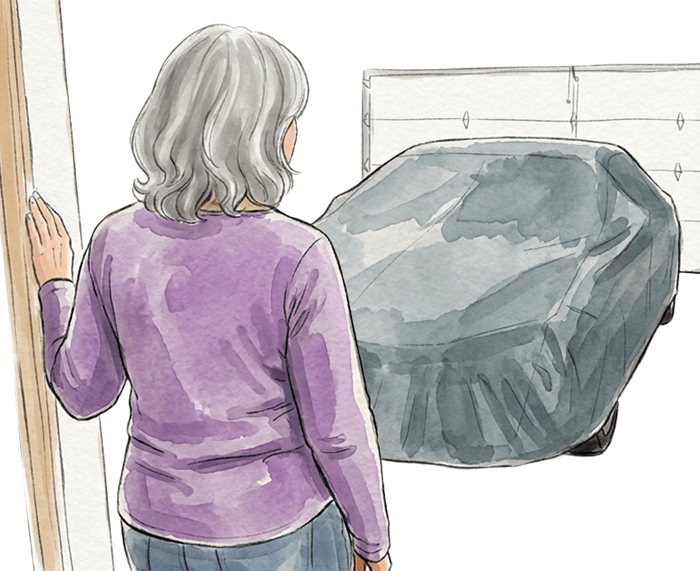
-
Anxiety and Depression: Finding a way forward
Article · 4 minutes
-
Embracing Braille
Discussion
- Explore more
Members also liked
- Video · 8 minutes

- Video · 7 minutes

- Video · 5 minutes
- Video · 8 minutes
Join the Hadley Community
Hadley's resources are always available to you. Create a no-cost Hadley account to go further:
-
Pick up where you left off Everything you start is automatically saved across Hadley.
-
Personalized recommendations We'll suggest resources based on your interests.
-
Join live discussions Live and lively discussions on technology, cooking, and more, all geared toward the community of people living with vision loss.
-
Find peer support Connect with people who understand what you're going through.