
Workshop 6: Strong Groupsigns ch, sh, th, wh, ou, st
847-784-2816 and we’ll mail one right out to you. Feel the braille in the top left corner of the page.
Hadley
Contracted Braille
Workshop 6: Strong Groupsigns ch, sh, th, wh, ou, st
Opening
Hadley presents Contracted Braille, Workshop 6, Strong Groupsigns: ch, sh, th, wh, ou, st.
Page 1
First, make sure you have your braille workbook with you.
If you don’t already have one, call Hadley at
847-784-2816 and we’ll mail one right out to you.
Feel the braille in the top left corner of the page.
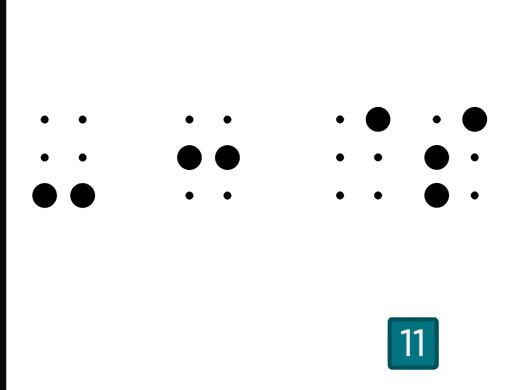
You already know these symbols as the wordsigns “shall,” “which,” and “child” when they stand alone.
These same symbols can also be used as parts of words to represent the letters “sh,” “wh,” and
“ch.”
When these symbols are used as parts of words, they’re called strong groupsigns.
Above the middle line are three words using the strong groupsigns sh, wh, and ch.
As in previous workshops, use the Pause button or spacebar for as long as you need to read a section or complete an activity item.
Then select the Play button, or press the spacebar again, when you’re ready to hear the feedback for that item.
Go ahead and read the first word.
If you read the word “ashes,” you got it!
The word “ashes” uses the sh groupsign. Now, read the second word.
The second word is “white,” and it uses the wh groupsign.
Did you notice that the wh is the first cell in the word? Finally, read the last word.
This word is “pitch,” and it uses the ch groupsign as the last cell in the word.
These groupsigns can be used at the beginning, middle, or end of a word.
Below the middle line are three rows of braille. Each row has three words.
Find the first row and read the three words.
If you read “shop,” “washtub,” “fresh,” you got it!
Now, read the words in the second row.
The second row says, “who,” “what,” “bullwhip.”
Finally, read the last row.
These words are “itch,” “batch,” “hatchet.”
Turn the page.
Page 2
Feel the word “she” in the top left corner of the page.
The word “she” uses the sh groupsign, dots 1-4-6 at the beginning of the word.
Above the middle line are three rows. Each row contains three words that all have sh.
Find the first row and read all three words.
This row reads, “cash,” “smash,” “mash.”
Next, read the second row of words.
If you read “ship,” “short,” “shape,” great job!
And now, read the last row.
This row says, “wishes,” “washes,” “smashes.”
Below the middle line, you’ll find five rows of braille with three words each.
Some of these might be a bit tricky.
Read the first row and find the word “shell.”
Did you pick the last word? Great job!
Now, read the second row and find the word “lash.”
“Lash” is the first word.
In the third row, find the word “clash.”
“Clash” is the last word, and it was a tricky one.
Now for the fourth row, find “shop.”
“Shop” is the middle word.
Finally, read the last row, and find the word “sheet.”
It’s the middle word.
Turn the page.
Page 3
Feel the word “why” in the top left corner of the page. It uses the wh groupsign, dots 1-5-6.
Above the middle line are three rows with three words in each row. Each word contains wh.
In the first row, read all three words.
The first row says, “whirl,” “whiz,” “whom.”
Next, read the second row of words.
This row says, “awhile,” “whale,” “what.”
And now read the words in the last row.
Did you read, “wheeze,” “bobwhite,” “Whitney?” That’s right!
Below the middle line, you’ll find five rows of braille with three words in each row.
Once again, some of them are tricky, so you’ll want to read carefully.
Read the first row and find the word “whittle.”
“Whittle” is the middle word.
Now read the second row and find the word “wheel.”
It’s the first word.
Go to the third row and find the word “whip.”
The last word is “whip.”
Onto the fourth row, find “whack.”
Did you pick the middle word? That’s right.
Finally, go to the last row, and find the word “whale.”
“Whale” is the last word.
Turn the page.
Page 4
Feel the word “chop” at the top left corner of the page.
This word uses the ch groupsign, dots 1-6.
Above the middle line are three rows, each containing three words.
All of the words use ch.
Find the first row and read all three words.
Did you read, “chant,” “chilly,” “change?” If so, great!
Now read the second row of words.
This says, “twitch,” “catch,” “scorch.”
How about the last row?
The last row reads, “church,” “achieve,” “approach.”
Below the middle line are four sentences. Read the first sentence.
The first one reads, “Whitney loves chocolate candy with a crunch.”
How about the second sentence?
This one says, “Andy has a wish for a sheepdog as a gift.”
Next, read the third sentence.
It reads, “A milkshake is what I want for lunch.”
And finally, what does the last sentence say?
The last sentence says, “My riches shake people up so they will not chat with me.”
Turn the page.
Page 5
Feel the words, “she,” “why,” “chop” in the top left corner of the page.
Above the middle line are five rows with three words in each row.
As always, just use the Pause button or the spacebar to stop the audio for as long as you need.
Then select the Play button, or press the spacebar again, to hear the feedback.
Read the first row and find the word “chuck.”
“Chuck” is the first word.
Now read the second row and find the name “Chip.”
If you picked the last word, well done!
Go to the third row and find the word “chick.”
The middle word is “chick,” and it was a tricky one!
Now, for the fourth row, find “punch.”
It’s the middle word.
And finally, read the last row and find the word “chill.”
“Chill” is the last word. That one was tricky too!
Below the middle line are four sentences. Go ahead and read the first sentence.
This sentence reads, “I made a black and white sketch with ash.”
How about the second sentence?
This one says, “The selfish whiz kid chuckles the whole way.”
Now read the third one.
The third one reads, “Which do you like–to whittle wood or catch fish?”
Finally, read the last sentence.
If you read, “Whether Whit checks out the ship or not, I will,” that’s right!
Turn the page.
Page 6
Feel the braille in the top left corner of the page.
You already know these symbols as the wordsigns “this,” “still,” and “out” when they stand alone.
These same symbols can also be used as groupsigns, or parts of words, for the letters th, st, and ou.
Above the middle line are three braille words.
Read the word in the first row.
This word is “bath.”
Did you find the th groupsign? It’s the last cell.
Next, read the word in the second row.
This is the word “history,” and it uses the st groupsign.
The st is the third cell in the word. Now check the word in the last row.
It’s the word “our” which uses the ou groupsign.
Did you find the ou as the first cell in the word? Nice work!
Below the middle line are three rows of braille. Each row has three words.
Read the three words in the first row.
These words are “depth,” “lethal,” “thumb.” Now read the words in the second row.
If you read, “stretch,” “upstairs,” “last” that’s great!
Finally read the last row.
This row has the words “double,” “couch,” “ours.”
Turn the page.
Page 7
Feel the word “than” in the top left corner of the page.
The word “than” uses the th groupsign, dots
1-4-5-6, at the beginning of the word.
Above the middle line, you’ll find three rows, each containing three words.
All the words have th.
Find the first row and read all three words.
The first row reads, “thank,” “truth,” “lethal.”
Now read the second row of words.
This row says, “athlete,” “three,” “cloth.” And let’s try that last row.
Did you read, “bath,” “thump,” “worthy?” That’s it!
Below the middle line are five rows of braille with three words in each row.
Some of these might be a bit tricky. Read the first row and find the word “thunk.”
The last word is “thunk.”
Now read the second row and find the word “broth.”
“Broth” is the first word.
Go to the third row and find the word “thug.”
In the third row, “thug” is the last word.
Onto the fourth row, find the word “thaw.”
Did you pick the middle word? You got it!
Finally, let’s try the last row. Find the word “sloth.”
It’s the first word.
Turn the page.
Page 8
Feel the braille word at the top left corner of the page.
This is the word “stop.” It uses the st groupsign, dots 3-4.
Above the middle line are three rows, each containing three words.
All of the words have st.
Read the three words in the first row.
Did you read, “stay,” “west,” “stretch?” If so, that’s great!
Now read the second row of words.
These words are, “waste,” “mistake,” “thirst.”
And let’s try the last row of words.
This row says, “upstairs,” “postal,” “castle.”
Below the middle line are four rows with three words each.
Read the first row and find the word “post.”
“Post” is the last word in the row.
Give the second row a try and find the word “stew.”
It’s the first word.
Now, go to the third row and find the word “stop.”
“Stop” is the middle word.
Finally, let’s look at the fourth row. This one is tricky. Find “stick.”
“Stick” is the last word.
Turn the page.
Page 9
Feel the word “our” at the top left corner of the page.
This word uses the ou groupsign, dots 1-2-5-6.
Above the middle line are three rows with three words in each row.
All of the words contain ou.
Find the first row and read all three words.
The first row says, “mouth,” “our,” “detour.” Now read the second row of words.
If you read, “shout,” “group,” “cloud,” you’re right!
Next, read the last row.
This is, “youth,” “joyous,” “hour.”
Below the middle line are four rows, each containing three words.
Which row contains the word, “flour?”
Pause as long as you need. Then select Play when you’re ready for the feedback.
If you picked the first row, you got it!
Now, find which row contains the word “pouch.”
“Pouch” is in the last row.
Next, find the row containing “scour.”
It’s the second row.
And finally, which row contains the word “oust?”
“Oust” is in the third row.
Turn the page.
Page 10
Feel the words, “shall,” “which,” “child,” “this,” “still,” “out” in the top left corner of the page.
Let’s look at some words that can be tricky.
You’ve already learned that wordsigns must stand alone.
That means you cannot use the wordsign ch to make “child” in the word “childish,” or use the ou wordsign to make the word “out” in “outside.”
Above the middle line are two examples.
Read the words in the first row.
These are the words “child” and “childish.”
Notice that the word “childish” is spelled using the ch contraction, then i-l-d-i and the sh contraction.
Dots 1-6 cannot be used for the word “child” here.
Next, read the words in the second row.
These are the words “out” and “outside.”
In “outside,” the t and the rest of the word that follows must be spelled out.
Because the word “out” isn’t standing alone, the wordsign “out” cannot be used, but the ou groupsign can be.
Below the middle line are five rows with two words on each line.
Find the first row and read the words.
Which is the correct braille for “out-of-the-way?”
The first choice is right. You can use a wordsign when it touches a hyphen.
Now, let’s try the second row and find the correct braille for the word “outcome.”
The first word is brailled correctly, because when “out” is not standing alone, only the groupsign can be used and the t must be included.
In the third row, which is the correct braille for “thistle?”
The second word is correct.
Next, read the fourth row and find the word that’s brailled correctly.
If you chose the first word for “grandchild,” you got it!
Finally, read the last row and see which word is brailled correctly.
The second word is correct for “child-like.” Wordsigns can touch the hyphen.
Turn the page.
Page 11
Feel the words, “she,” “why,” “chop” in the top left corner of the page.
So far in these workshops, you’ve been reading sentences that fit on one line.
Sometimes a sentence is so long, it must go on a second, or even a third line.
The part of this sentence that continues on extra lines is called a “runover.”
In braille, each runover line is indented two spaces. This format helps you read longer sentences.
Above the middle line is a long sentence with runover.
Scan to find the beginning of the sentence.
Find the beginning of the sentence, and let’s read it together.
It says, “He likes to shop for all of the new clothes fashions, (shoes too).”
Notice the runover part of the sentence is indented two cells.
What’s the first word of the runover?
If you said, “fashions,” you found it!
Below the middle line are two sentences.
Scan the left margin to locate the first sentence and read the full sentence.
If you read, “Who shall we go out to visit on Fri., Dec. 31, 2026?” you read the sentence correctly!
Which part of that sentence contains the runover?
The runover is “Dec. 31, 2026.”
Now, read sentence two, and find the words in the runover.
The runover is, “soup as another choice.”
Turn the page.
Page 12
Feel the words, “shall,” “which,” “child,” “this,” “still,” “out” in the top left corner of the page.
Above the middle line are five words.
Read all five words. You’ll be using these words to fill in the blanks below.
Below the middle line are five sentences with a blank in each one.
Read sentence one and decide which word from above the line fills in the blank.
You can always Pause for as long as you need, then select Play when you’re ready.
Did you choose “mistake?” That’s correct! “Our mistake will waste hours.”
Now, check out sentence two and choose a word to fill in the blank.
“Athlete” works well here. “The athlete ran that race fast!”
Next, read sentence three. Which word completes it?
This time, “whistle” is a good choice. “The whistle of the bobwhite is loud.”
Now give sentence four a try.
The word “without” fits here. “The cat with asthma can go without the pet wheelchair.”
Did you notice this sentence has a runover?
Finally, fill in the blank for sentence five.
The word “shutout” completes this sentence. “The hockey fans shout if the goalie gets a shutout.”
Turn the page.
Page 13
Feel the word “they” in the top left corner of the page.
Above the middle line are two rows of braille.
Earlier, you learned the strong contractions.
Read the strong contractions in the first row.
Yes, these are, “and,” “for,” “of,” “the,” “with.”
Sometimes you need to choose between two contractions when writing words.
When a word could be written with either a strong contraction or a groupsign, always use a strong contraction.
Now read the two words in the second row.
The first word is “they” brailled correctly, because it uses the strong contraction “the” instead of the groupsign th.
Below the middle line, you’ll find four sentences.
Read the first two sentences and choose which one is the correct way to braille, “What is the theme of CATCH-22?”
If you chose the second row, you got it!
In this row, the word “theme” is written correctly.
Now, read the last two sentences and find which one has all the words brailled correctly.
Notice that both of these sentences have runover lines.
These two sentences say, “The youth will have to go to school so we can watch them play football.”
The first sentence is correct. The word “them” uses the strong contraction for “the” and not the th groupsign.
Feel free to replay this page if you’d like.
And if you have any questions about using strong contractions and groupsigns reach out to a braille expert. We’d love to help!
Turn the page.
Page 14.
Feel the braille “sh,” “th,” and “st” in the top left corner of the page.
Above the middle line are four rows of braille.
Let’s talk about a few more things to keep in mind about groupsigns.
Read the braille in the first row.
It says “Sh!”
When sh stand alone, the sh contraction would be confused with the wordsign “shall.”
So, the contraction cannot be used here.
Instead, use the individual letters, s and h. Now check out the second row.
This row says, “Th-th-this,” like someone is stammering.
Here, if the th contraction were used, the braille would read “this-this-this.”
Now read the third and fourth rows.
These rows say, “1st” and “8th.”
When you use numbers that have an st or th on the end, you need to use individual letters. The groupsigns cannot be used.
Below the middle line, you’ll find three sentences.
Read the first sentence.
If you read, “The 5th region of the metropolis is kept safe by the 21st police squad,” you got it right!
Now read the second sentence.
This sentence reads: “Sh,” Joshua says, “the child is still asleep.”
Next, give the last sentence a try.
This one says, “Th-th-th-this is a huge lion!”
Turn the page.
Page 15
Feel the letters “st” in the top left corner of the page.
Now, let’s look at a couple more exceptions to the way groupsigns are used.
Above the middle line are two rows of braille. Read the first row.
This says, “St. Patrick.” Notice the abbreviation for Saint. Now read the second row.
Did you read, “Maple St?” That’s right!
When the letters s-t, with or without a period, stand for the abbreviation for saint or street, the groupsign cannot be used.
Below the middle line, you’ll find a short phrase and a longer sentence. Read the phrase in the first row.
If you read “St. Andrew’s Church,” you got it!
Now read the full sentence.
The sentence reads, “Did you see that 24th St. is an offshoot from Maple St.?”
Turn the page.
Page 16
Feel the letters “t-h” and “s-h” in the top left corner of the page.
Above the middle line, you’ll find two words. Read the first one.
This is the word “anthill.” Groupsigns cannot be used across compound words.
So the th contraction would not be used in the word “anthill.”
The t is in the first word, “ant,” and the h is in the second word, “hill.”
Now read the word in the second row.
This is the word “mishap.”
It also has the s and h spelled out instead of the sh groupsign.
Just like in compound words, groupsigns cannot be used in words when you hear the h sound, like in the word “mishap.”
Below the middle line are three rows of braille.
Read the first row and choose which word is brailled correctly.
If you picked the first one, you got it!
The wh in “rawhide” needs to be spelled out, because the wh groupsign cannot cross the compound word.
Now read the second row. Which word is brailled correctly here?
This time, it’s the second choice.
Again, the th groupsign cannot be used for letters that cross syllables in a compound word like “boathouse.”
In this example, the t ends the first syllable, and the h begins the second syllable.
Go ahead and read the third row and pick the word that’s brailled correctly.
The second choice is right.
Here the sh groupsign cannot be used, because the h sound can be heard when the word “mishandle” is pronounced.
Turn the page.
Page 17
Feel the word “anthill” in the top left corner of the page.
Above the middle line are two columns of braille.
Which column has all the words brailled correctly?
If you chose the second column, you got it!
In the first column, “mishap” and “grandchild” are not brailled correctly.
Below the middle line are three sentences with blanks.
Read the first fill-in-the-blank sentence.
Now read the two words on the next row. Notice they are indented.
Which word would you use to fill in the blank and complete the sentence?
The second word is correct!
The wh contraction cannot be used to cross the syllables in the compound word “sawhorse.”
Now, read the second sentence and the two words below it.
Then choose the word that’s brailled correctly to fill in the blank.
If you chose the second word, that’s right!
The th contraction can be used in “fathom.”
Finally, read the last sentence, and the two words below it.
Which word completes the sentence correctly?
The first one is right this time. This is the correct spelling for “makeshift.”
Turn the page.
Page 18
Feel the braille in the top left corner of the page. These are the letters, “ch,” “sh,” “th,” “wh,” “ou,” “st.”
Above the middle line are three sentences. Read sentence one.
Did you read, “Go north on Whitman’s Street, and then turn south onto Whitehurst St.?” Well done!
Notice the word “Street” uses the st groupsign, but the abbreviation for Street” does not use the st groupsign.
Now try sentence two.
This one says, “What shall the couple do with the childish boy if the rest of us go outside?”
This is a tricky one, because the groupsigns are used in the words “childish” and “outside” rather than the wordsigns.
Finally, read the last sentence.
The last sentence reads, “It is so ch-ch-chilly outdoors.”
Below the middle line are two sentences.
Read the first sentence and count how many contractions you find in it, including alphabet wordsigns, strong wordsigns, and groupsigns.
Four contractions are used in this sentence. The sh groupsign in “push,” the alphabetic wordsign “that,” the t-h-e strong contraction in “thermostat,” and the st groupsign in “thermostat.”
Now read the second sentence and count all the contractions.
This one has a lot. If you counted 14, great work!
Feel free to replay this page if you’d like to go through it again.
And if you have any questions, reach out to a braille expert, we’d love to help!
Turn the page.
Page 19
Feel the title, “Catalog of Activities” in the top left corner of the page.
Above the middle line are two rows of braille.
These are the first two rows in the catalog’s table of contents.
Notice that after the words in each row, a braille line continues with cells containing dots 3-6.
That helps you follow to the end of each line and find the page number in the table of contents.
Let’s read the first row together, including the page number, to get an idea of the layout.
The first row says, “Watch Movies.”
Then follow the line of the hyphens ending with the number 4.
This tells you the list of movies you can choose from begins on page 4.
Now read the second row.
If you read, “Go for a Hike” on page 27, you got it!
Below the middle line are four more rows from the table of contents.
Read all four rows and then answer the questions that follow.
On what page will you find information about crafts?
Page 47 is about crafts.
Which page has something about nature?
Did you choose page 79? Well done!
Now find the page about journals.
“Write a Journal Item” is on page 63.
Finally, what activity is on page 36?
This is, “Outdoor Sports.”
Select Next to complete this workshop.
Completion
Congratulations! You’ve learned six strong groupsigns.
If you have questions about using strong groupsigns, you can always contact a learning expert at 847-784-2816. We’re happy to help!
Contracted Braille Series
- Workshop
Explore
-
"You put one foot forward"
Audio · 3 minutes
-
I'm feeling overwhelmed
Resource guide
-
Diabetic Retinopathy: Questions & Answers
Article · 5 minutes
-
Resource Roundtable
Discussion
- Explore more
Members also liked
- Workshop

- Workshop
Join the Hadley Community
Hadley's resources are always available to you. Create a no-cost Hadley account to go further:
-
Pick up where you left off Everything you start is automatically saved across Hadley.
-
Personalized recommendations We'll suggest resources based on your interests.
-
Join live discussions Live and lively discussions on technology, cooking, and more, all geared toward the community of people living with vision loss.
-
Find peer support Connect with people who understand what you're going through.