
Workshop 7: More Strong Groupsigns ar, ed, ow, er, gh, ing
Hadley
Contracted Braille
Workshop 7: More Strong Groupsigns: ar, ed, ow, er, gh, ing
Opening
Hadley presents, Contracted Braille, Workshop 7, More Strong Groupsigns: ar, ed, ow, er, gh, ing.
Page 1
First, make sure you have your braille workbook with you.
If you don’t already have one, call Hadley at 847-784-2816 and we’ll mail one right out to you.
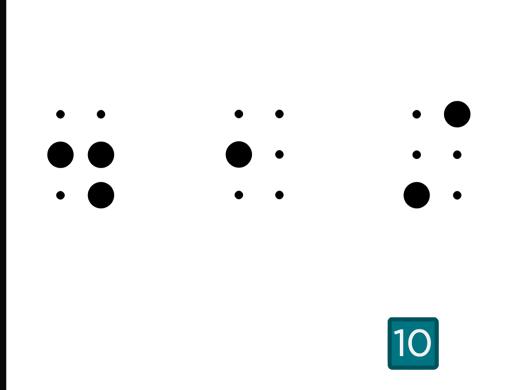
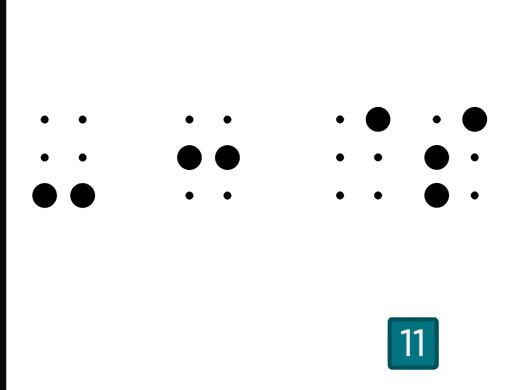
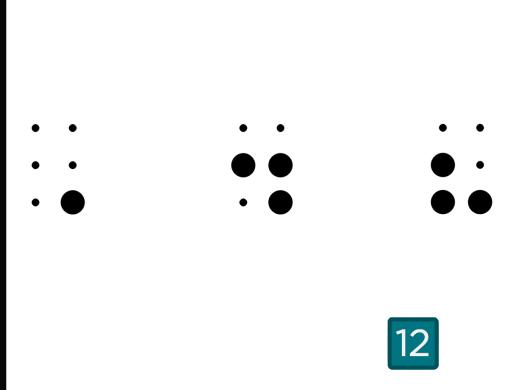
Feel the braille in the top left corner of the page. These are the strong groupsigns, “ar,” “ed,” and “ow.”
Above the middle line, you’ll find three rows of braille. Feel the first row.
This is the groupsign “ar.” Now feel the next row.
This one is the groupsign “ed.” And now, the last row.
This last one is the groupsign “ow.”
Below the middle line, you’ll find a row of three groupsigns. Let’s read them together: “ar, ed, ow.”
Turn the page.
Page 2
Feel the braille in the top left corner of the page. This is the strong groupsign “ar,” dots 3-4-5.
ar is the bottom dot on the first side of the cell and the top and middle dots on the second side.
Above the middle line, you’ll find three rows of braille.
As in previous workshops use the Pause button or spacebar for as long as you need to read a section or complete an activity item.
Then select the Play button, or press the spacebar again, when you’re ready to hear the feedback for that item.
In the rows above the middle line, which one contains the groupsign ar?
Did you find the groupsign ar in the second row? That’s correct!
Below the middle line are four rows of groupsigns.
Read the first row and find which groupsign is ar.
If you picked the middle one, you got it!
Now, find the groupsign ar in the second row.
This time it’s the last one.
Check out the third row and find the groupsign ar.
ar is the first groupsign.
And finally, find the groupsign ar in the last row.
This time it’s the last one.
Turn the page.
Page 3
Feel the braille in the top left corner of the page.
This is the strong groupsign “ed,” dots 1-2-4-6.
ed is the top and middle dots on the first side of the cell and the top and bottom dots on the second side.
Above the middle line, you’ll find three rows of braille. Which row contains the groupsign ed?
If you said the last row, you found it!
Below the middle line, you’ll find four rows of groupsigns.
Read the first row. Which groupsign is ed?
ed is the first one. Now find the groupsign ed in the second row.
If you picked the middle one, that’s right!
Next, find the groupsign ed in the third row.
It’s the middle one again!
Finally, find the groupsign ed in the last row.
This time, it’s the first one.
Turn the page.
Page 4
Feel the braille in the top left corner of the page.
This is the strong groupsign “ow,” dots 2-4-6.
ow is the middle dot on the first side of the cell and the top and bottom dots on the second side.
Above the middle line, you’ll find three rows of braille.
Which row contains the groupsign ow?
Did you find it in the second row? Great!
Below the middle line, you’ll find four rows of groupsigns.
Read the first row and find which groupsign is ow.
ow is the middle one.
Next, find the groupsign ow in the second row.
This time, it’s the first one.
Now, find the groupsign ow in the third row.
Here, it’s the middle one.
Finally, find the groupsign ow in the last row.
If you picked the first groupsign, that’s it!
Turn the page.
Page 5
Feel the strong groupsigns ar, ow, and ed in the top left corner of the page.
Above the middle line are three rows of braille.
As always, just use the Pause button or the spacebar to stop the audio for as long as you need.
Then select the Play button, or press the spacebar again, to hear the feedback.
Which row contains a word that uses the groupsign ar?
Did you find it in the first row? That’s right!
The word in the first row is “care.”
Which row has a word that uses the groupsign ow?
The last row has the word “crown,” which uses the groupsign ow.
And which row has a word with the groupsign ed?
The second row uses ed in the word “media.”
Below the middle line, you’ll find three rows of words.
Read the words in the first row.
Which word uses the strong groupsign ar?
The last word, “cart,” uses the groupsign ar.
Read the words in the second row and find which one uses the strong groupsign ow.
If you picked the first word, “gown,” that’s right!
Now, read the words in the last row. Which word uses the strong groupsign ed?
This time, it’s the last word, “red.”
Turn the page.
Page 6
Feel the braille in the top left corner of the page.
These are three more strong groupsigns, “er,” “ing,” and “gh.”
Above the middle line, you’ll find three rows of braille. Feel the first row.
This is the groupsign “er.”
Now feel the next row.
This is the groupsign “ing.”
And now, the last row.
This one is the groupsign “gh.”
Below the middle line, you’ll find a row of groupsigns.
Let’s read these groupsigns together: “er, ing, gh.”
Turn the page.
Page 7
Feel the braille in the top left corner of the page.
This is the strong groupsign “er,” dots 1-2-4-5-6.
er is the first and second dots on the first side of the cell and all three dots on the second side.
Above the middle line, you’ll find three rows of braille.
Which row contains the groupsign er?
Did you find it in the second row? That’s correct!
Below the middle line, you’ll find four rows of strong groupsigns.
Read the first row and find which groupsign is er.
er is the first one. Now find the groupsign er in the second row.
In this row, it’s the middle one.
Next, find the groupsign er in the third row.
This time it’s the last one.
Finally, find the groupsign er in the last row.
Did you pick the middle one? That’s it!
Turn the page.
Page 8
Feel the braille in the top left corner of the page.
This is the strong groupsign “ing,” dots 3-4-6.
ing is the bottom dot on the first side of the cell, and the top and bottom dots on the second side.
Above the middle line, you’ll find three rows of braille.
Which row contains the groupsign ing?
Did you find it in the last row? You got it!
Below the middle line, you’ll find three rows of groupsigns.
Read the first line and find which groupsign is ing.
ing is the first one.
Now, find the groupsign ing in the second row.
If you picked the last groupsign, that’s right!
Next, find the groupsign ing in the third row.
It’s the last one, again.
And finally, find the groupsign ing in the last row.
In this row, ing is the first one.
Turn the page.
Page 9
Feel the braille in the top left corner of the page. This is the strong groupsign “gh,” dots, 1-2-6.
gh is the top and middle dots on the first side of the cell and the bottom dot on the second side.
Above the middle line, you’ll find three rows of braille.
Which row contains the groupsign gh?
Did you find it in the second row? You got it!
Below the middle line, are four rows of groupsigns.
Read the first row and find which groupsign is gh?
It’s the middle one.
Now, find the groupsign gh in the second row.
If you picked the middle one again, that’s right!
Next, find the groupsign gh in the third row.
This time, it’s the first groupsign.
Finally, find the groupsign gh in the last row.
gh is the last one.
Turn the page.
Page 10
Feel the strong groupsigns er, gh, and ing in the top left corner of the page.
ing is the only strong groupsign that cannot be used at the beginning of a word.
Above the middle line are three rows of braille.
Which row contains a word that uses the groupsign, er?
Did you find it in the last row? That’s correct!
The third row has the word “error.”
Which row has a word that uses the groupsign gh?
The second row is the word “night,” which uses the groupsign gh.
Now find the row that contains a word which uses the groupsign ing.
The first row uses ing in the word “bring.”
Below the middle line, you’ll find three rows of braille words.
Read all three words in the first row and find which word uses the groupsign er.
If you picked the middle word, “baker,” you got it!
Now, read the words in the second row and find which one uses the groupsign gh.
The gh groupsign is in the last word, “sight.”
Finally, read the last row and find the word that uses the groupsign, ing.
ing is in the first word, “spring.”
If you have questions about using any of these contractions so far, just reach out to a Hadley braille expert.
Turn the page.
Page 11
Feel the braille in the top left corner of the page. These are the strong groupsigns ar, gh, and st.
Above the middle line, you’ll find three words.
Read all three words and find which one is the best match for a costume that could be used for Halloween.
The second word, “ghost,” is correct!
Which word could be used to describe someone who paints pictures?
If you picked the first word, that’s right! The first word is “artist.”
And now find which word is another name for dog food.
The last word, “chow,” can be used to describe dog food.
Below the middle line, you’ll find five phrases. Read all five phrases.
You can always pause for as long as you need. Then select Play when you’re ready.
Which phrase describes an item that might be displayed in the windshield of a car?
The phrase in the second row, “parking permit,” is correct!
Which phrase describes where you would power up your phone on the go?
The last phrase is, “car charger.”
Now, choose the phrase for an ingredient you might use in the kitchen.
The first phrase is, “crushed ginger.”
And which phrase describes an athlete who can paddle across the ocean?
That’s in the third row. This phrase is, “mighty rower.”
Finally, which phrase is a class you may have taken in school?
If you chose the phrase in the fourth row, you got it!
This is, “math course.”
Turn the page.
Page 12
Feel the strong groupsigns ed and ow in the top left corner of the page.
ed and ow are the only strong groupsigns that sometimes stand alone as whole words, like in the name “Ed,” or the exclamation “Ow!”
Above the middle line, you’ll find two words. Read the word in the first row.
This is the name “Ed.” Now, read the second row.
This row reads, “Ow!”
Below the middle line are two sentences.
Which sentence uses the strong groupsign ow as a whole word?
If you chose the second one, you’re right!
The strong groupsign ow stands alone in the sentence, “Ow! I hit my elbow.”
And which sentence uses the strong groupsign ed as a whole word?
The first sentence has the name Ed. It reads, “Ed needs a chair.”
Turn the page.
Page 13
Feel the braille in the top left corner of the page.
This is the letters gh and the strong groupsign gh.
As you’ve already learned, groupsigns cannot be used to cross the two words in a compound word.
Above the middle line, you’ll find three rows of braille.
Read the words “foghorn” and “flight” in the first row and notice which word cannot use the groupsign gh.
The first word, “foghorn,” cannot use the groupsign gh across the words “fog” and “horn.”
Now, read the words in the second row, and notice which word cannot use the groupsign ed.
The groupsign ed cannot be used to cross the words “dare” and “devil” in the word “daredevil.”
The first word, “cared,” can use the groupsign ed.
Now, read the words in the last row, and notice which word cannot use the groupsign er.
The first word, “storeroom,” cannot use the groupsign er. But the second word, “erase,” can.
In the compound word, “storeroom,” e is the last letter of the word “store,” and r is the first letter of the word “room.”
Below the middle line are three fill-in-the-blank sentences. Read the first sentence.
Did you find the blank?
The first row says, “The __ is spicy.”
Now, read the two words in the second row, and find the one that’s brailled correctly to fill in the blank.
If you chose the first word for “horseradish,” you’re right!
Now, read the sentence in the third row.
This one says, “We will still drive on the __.”
Which word below the sentence is written correctly?
The first way to spell “highway” is correct.
The gh groupsign can be used here. It does not cross the words “high” and “way.”
Now read the sentence in the fifth row.
This sentence reads, “An unjust war is __ to failure.”
Which word below the phrase fills in the blank correctly?
The second word is the correct way to write, “foredoomed.”
Turn the page.
Page 14
Feel the braille in the top left corner of the page.
This is the strong contraction “the.”
You’ve learned about the strong contractions, “and,” “for,” “of,” “the,” and “with.”
And you’ve learned when choosing between two contractions, always use the strong contraction instead of the groupsign. Let’s practice!
Above the middle line, read the word “thermal.”
The word “thermal” uses the strong contraction “the,” not the strong groupsigns th and er.
Below the middle line, you’ll find five rows of words.
Read the first row and find which word has the word “gather” written correctly.
If you chose the second word, you found it!
Now read the second row. Which word shows the correct way to write the word “withered?”
The first word is correct!
The word “withered” uses the strong contraction “with” and the strong groupsigns er and ed.
Notice in this word, using the strong contraction “with” saves more space than using the strong contraction “the.”
Choose the contraction that saves the most space.
Next, read the words in the third row, and choose which one has “brother” written correctly.
It’s the second word.
How about the word “withholding” in the fourth row?
The second word is right for “withholding.”
Finally, which word is the correct way to write “bothered” in the last row?
The first word is correct.
Feel free to replay this page if you’d like to go through it again.
And if you have any questions, reach out to a braille expert. We’d love to help!
Turn the page.
Page 15
Feel the strong groupsigns ar and er in the top left corner of the page.
Above the middle line are three sentences.
Which sentence is written correctly? Be sure to look for those groupsigns.
Did you choose the last sentence? If so, you got it!
If you didn’t find the right answer, go ahead and pause the audio, and check the first two sentences again to find the errors.
The first sentence should use the groupsign ch in the word “change,” and it should use the groupsign ar in the word “dollar.”
The second sentence should use the groupsigns ou and gh in the word “dough.”
Below the middle line are four rows of braille.
In the first row, read the word “ginger” written two different ways.
Which word is brailled correctly?
The second word is correct.
In the second row, which one is correct for the word “brother?”
If you chose the second word, you’re right!
The strong contraction “the” should be used instead of the groupsigns th and er.
Now, read the third row, and find which word is “sighed” brailled correctly.
Did you choose the first word? Yes, “sighed” is brailled right the first way.
Finally, read the fourth row to see which is correct for the word “lightning.”
The first word is brailled correctly for “lightning.”
Turn the page.
Page 16
Feel the strong groupsigns ow, ar, and ing in the top left corner of the page.
Above the middle line is a list of three how-to ideas.
Read the first row.
This reads, “How to make a bed.”
Now, count how many strong groupsigns are in that row.
Did you find two? That’s right!
The groupsign ow is used in “how,” and the groupsign ed is used in “bed.”
Read the second row.
The second row says, “How to build a birdhouse.”
How many strong groupsigns are in that phrase?
Once again, there are two!
The ow in “how” and the ou in “birdhouse.”
Now, read the last row.
This row says, “How to start a blog.”
How many strong groupsigns do you count?
There are three this time: the ow in “how,” and the st and ar groupsigns in “start.”
Below the middle line, you’ll find some cooking instructions.
Read the first row.
This says, “How to Make Brownies.”
The strong groupsign ow is used twice. It’s in the words “how” and “brownies.”
Now, read the sentence in the second row.
Can you name the groupsigns in this sentence?
This one uses the strong groupsigns st and ar in the word “start,” ing in the word “mixing,” and er in “mixer” and “batter.”
Read the sentence in the third row. This sentence runs over to the fourth row.
Find the strong groupsigns and name them.
sh is used in the word “brush,” er is used in the words “butter” and “batter,” and ou is used in the word “pour.”
Now, read the sentence that starts in the fifth row and name the strong groupsigns.
ch and ing are used in the word “watching,” er is used in “overcook,” ed is used in the word “edges,” and ar is used in the word “hard.”
Finally, read the last sentence. Can you find all the groupsigns?
ar and sh are used in the word “garnish,” ch is used in the words “chocolate,” “chips,” and “chopped,” and ed is also used in “chopped.”
Great practice!
Select Next to complete this workshop.
Completion
Congratulations! You’ve learned six more strong groupsigns.
If you have questions about using strong groupsigns or want to order the next set of workbooks, you can always contact a learning expert at 847-784-2816. We’re happy to help!
Contracted Braille Series
- Workshop
Explore
-
"It's not often we encounter an angel"
Audio · 6 minutes
-
I'm feeling overwhelmed
Resource guide
-
10 Tips for Knitting with Vision Loss
Article · 5 minutes
-
Book Nook
Discussion
- Explore more
Members also liked
Join the Hadley Community
Hadley's resources are always available to you. Create a no-cost Hadley account to go further:
-
Pick up where you left off Everything you start is automatically saved across Hadley.
-
Personalized recommendations We'll suggest resources based on your interests.
-
Join live discussions Live and lively discussions on technology, cooking, and more, all geared toward the community of people living with vision loss.
-
Find peer support Connect with people who understand what you're going through.