
Workshop 8: Lower Wordsigns his, was, were, be
Hadley
Contracted Braille
Workshop 8, Lower Wordsigns: his, was, were, be
Opening
Hadley presents Contracted Braille Workshop 8: Lower Wordsigns, his, was, were, be.
Page 1
To begin, make sure you have your braille workbook with you.
If you don’t already have one, call Hadley at 847-784-2816, and we’ll mail one right out to you.
Feel the braille in the top left corner of the page.
These new symbols are called, “lower wordsigns.”
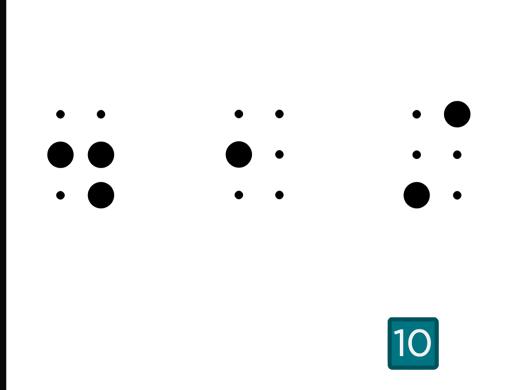
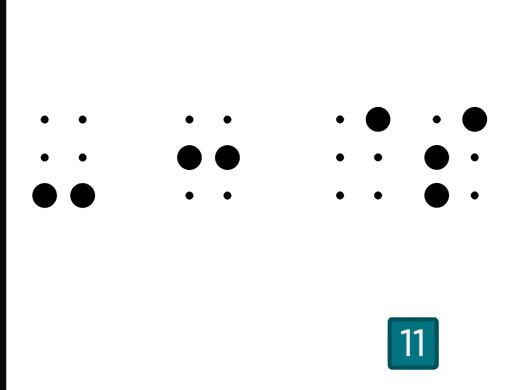
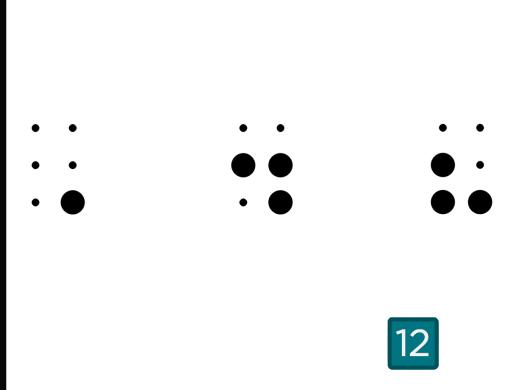
Lower wordsigns use only the bottom two rows of dots in the cell, dots 2-3-5 and 6.
These lower wordsigns stand for the whole words “his,” “was,” “were,” and “be.”
Above the middle line, you’ll find four braille phrases. Let’s read the first phrase.
This says, “got his mower.”
You’ll notice that lower wordsigns feel similar to letters you already know.
When you’re reading, the words and symbols next to these wordsigns will show you that they are lower in the cell.
Now let’s read the second row.
This says, “I was.”
Next, let’s read the third row.
This is the phrase, “we were.”
And finally, let’s read the last row.
It says, “will you be.”
Below the middle line, you’ll find a row of words.
Let’s read these words together: “his, was, were, be.”
Turn the page.
Page 2
Feel the braille in the top left corner of the page.
This is the lower wordsign, “his,” dots 2-3-6.
“His” is the middle and bottom dots on the first side of the cell and the bottom dot on the second side of the cell.
Above the middle line, you’ll find two rows of braille.
As you read the braille and work through the activities on these pages use the Pause button or spacebar for as long as you need.
Then select the Play button or press the spacebar again to hear the feedback for that item.
Read the phrase in the first row.
This phrase says, “his car.” Now go ahead and read the second row.
If you read, “get his,” you got it!
Below the middle line are three rows of braille.
Read the first row and count how many times you find the word “his” in this row.
The word “his” appears six times in this row.
Notice when the word “his” is near other braille, it’s easier to tell that it’s in the bottom part of the braille cell.
Now, read the next row and again, count the word “his.”
This time the word “his” appears seven times.
Finally, count the word “his” in the last row.
This one is a little tricky because you’re reading the word “his” with the word “have,” and they feel similar.
Did you count “his” six times? That’s right!
Turn the page.
Page 3
Feel the braille in the top left corner of the page.
This is the word “was,” dots 3-5-6.
“Was” uses the bottom dot on the first side of the cell and the middle and bottom dots on the second side of the cell.
Above the middle line, you’ll find two rows of braille.
Read the phrase in the first row.
It says, “I was.” Now, go ahead and read the second row.
This one says, “was it.”
Below the middle line are three rows of braille.
Read the first row and count how many times you find the word “was” in this row.
The word “was” appears five times in this row.
Now, read the second row, counting the word “was.”
If you counted “was” five times again, you got it!
Finally, count the word “was” in the last row.
This one is a little tricky because you’re reading the word “was” with the word “just.”
This time “was” appears six times.
Turn the page.
Page 4
Feel the braille in the top left corner of the page.
This is the word “were,” dots 2-3-5-6.
“Were” uses the middle and bottom dots on the first side of the cell and the middle and bottom dots on the second side of the cell.
Above the middle line, you’ll find two rows of braille.
Read the phrase in the first row.
This phrase says, “They were.” Now read the second row.
If you read, “Were you,” that’s right!
Below the middle line are three rows of braille.
Read the first row and count how many times you find the word “were.”
If you counted “were” five times, you got it!
Now, read the next row, again counting the word “were.”
This time, “were” appears four times.
Finally, count the word “were” in the last row.
This one is a little tricky again, because you’re reading the word “were” with the word “go.”
“Were” appears six times.
Turn the page.
Page 5
Feel the braille in the top left corner of the page.
This is the word “be,” dots 2-3.
“Be” uses the middle and bottom dots on the first side of the cell.
Above the middle line you’ll find two rows of braille.
Read the phrase in the first row.
This phrase says, “will you be.”
Now, read the phrase in the second row.
Did you read, “be well?” That’s correct!
Below the middle line are three rows of braille.
Read the first row and count how many times you find the word “be” in this row.
In this row, the word “be” appears seven times.
Now, read the second row again counting the word “be.”
This time the word “be” appears five times.
Finally, count the word “be” in the last row.
Once again, this one is tricky, because you’re reading the word “be” with the word “but.”
Did you count “be” six times? You found them all!
Turn the page.
Page 6
Feel the lower wordsigns “his,” “was,” “were,” “be,” in the top left corner of the page.
Now let’s try something a little different.
When you’re reading braille, it’s always a good idea to scan each page before you begin.
This lets you know what to expect on the page.
On this page in the workbook, start by scanning the entire page.
Notice there’s no middle line. Some of the pages in these next workshops do not have a middle line.
Near the top of the page, you’ll find two columns of words.
Once again, use the Pause button or the spacebar to stop the audio for as long as you need to complete an activity.
Then select the Play button, or press the spacebar again, to hear the feedback.
Which column has the words in this order: be, was, were, his?
If you chose the second column, that’s it!
The first column says, “be, his, were, was.”
Now, move down the page and find the sentence marked number 1.
Read the sentence and find which word in the sentence is “be.”
In this sentence, “be” is the fifth word.
Next try sentence 2 and find which word is “was.”
If you said “was” is the fifth word you’re right!
Now, give that third sentence a try. Find the word “his.”
This time the fourth word is the wordsign “his.”
What about the last sentence? Find “were.”
The second word is “were.”
Turn the page.
Page 7
Scan the entire page to get a preview of what you’ll be reading.
Now, feel the lower wordsigns, “his,” “was,” “were,” “be,” in the top left corner of the page.
Next, find and read the words in the first row. Which word is “be?”
If you chose the third word, you got it!
On the second row, find the word “was.”
“Was” is the second word.
Next, on the third row, which is the word “were?”
It’s the first word. Finally, which is “his,” on the last row?
“His” is the last word.
Now, continue down the page to find four fill-in-the-blank sentences.
Each sentence has two words below it.
Read sentence 1 and decide which word below this sentence you would use to fill in the blank.
The first word or the second word?
This sentence says, “I __ so hungry!”
If you said the second word should fill in the blank, you’re right. This is, “was.”
Now read sentence two and find which word correctly fills in this blank.
This time, the first word, “be,” is correct.
Did you notice the word “were” is also in this sentence?
Next, read sentence 3. Which word would you pick here?
The second word is right, “were.”
Finally, give that last one a try.
The first word fills in the blank, “his.”
Turn the page.
Page 8
Feel the braille “his,” “was,” “were,” “be,” in the top left corner of the page.
Lower wordsigns can be in contact with capital indicators.
Find the first sentence near the top of the page and let’s read it.
This sentence says, “Be sure.”
Notice the wordsign “be” is right next to the capital letter indicator.
Now let’s read the second sentence.
It says, “WERE you?”
In this sentence, the wordsign “were” is touching the capital word indicator.
Now, let’s move down the page and find the first pair of phrases.
In this pair, which phrase says, “HIS hat,” with “his” in all capital letters, brailled correctly?
Did you say the first phrase is brailled correctly?
That’s right, because the lower wordsign can touch the capital word indicator.
Now, read the second pair of phrases and find which one is brailled correctly.
This time, it’s the second phrase. The lower wordsign “be” touches the capital letter indicator.
Turn the page.
Page 9
Feel the words “his,” “was,” “were,” “be,” in the top left corner of the page.
These lower wordsigns, including capitalized lower wordsigns, can touch punctuation as long as it includes dot 1 or dot 4, except they cannot touch the forward slash.
Let’s look at the examples at the top of the page.
The sentence in the first row says, “You were.”
Notice that the wordsign “were” is not used here because it touches the period.
Instead, the word is spelled out as w, then the e-r group sign, then e.
Now, let’s read the second row.
It says, “His/hers.”
These lower wordsigns can never be used next to the forward slash, so “his” must be spelled out.
Finally, let’s read the third row.
It says, “(be still).”
See how the lower wordsign can touch the opening parenthesis?
That’s because the opening parenthesis has a dot 1.
At the bottom of the page are three columns of braille.
When you’re reading multiple columns, start with the first column on the left, and read from the top to the bottom.
Then, go back to the top of that column and move to the right to read the next column.
Then follow the same pattern until you’ve read all the columns on the page.
For each column, be sure to read the entire phrase on one row before moving to the next row.
You can always pause the audio for as long as you need, then play the audio when you’re ready.
Now, go ahead and read the three phrases in the first column, and choose which is the correct way to write the question, “Were we?” within quotation marks.
If you picked the last phrase in this column, you got it!
The lower wordsign “were” cannot touch the opening quotation mark. And the contraction for e-r should be used.
Now, find the second column and read the three phrases for “his-and-hers.”
Which one is brailled correctly?
This time, the correct braille is in the first phrase.
The lower wordsign “his” cannot touch the hyphen.
Finally, read the last column to find the correct braille for “(Be safe.)”
The middle phrase is correct.
The wordsign “be” can touch the punctuation because of the dot 1 in the opening parenthesis.
Feel free to practice this page as many times as you’d like. And reach out to a braille expert if you have any questions.
When you’re ready, turn the page.
Page 10
Feel the symbol in the top left corner of the page, dots 2-3-6.
Let’s look at the different ways this symbol can be used.
Find the sentences at the top of the page and read the first sentence.
What does this symbol with dots 2-3-6 stand for in this sentence?
Did you read, “Will you go?” That’s right!
And the symbol with dots 2-3-6 is a question mark.
Now, read the next sentence and find what is the symbol with dots 2-3-6 in this sentence.
This one says, “His book is torn!” and the symbol with dots 2-3-6 is the word “his.”
Finally, read the last sentence. What does the symbol with dots 2-3-6 stand for here?
This time it’s an opening quotation mark in the sentence, “It is OK.”
Some of the other symbols that represent lower wordsigns also have multiple meanings depending on the way they’re used in a sentence.
Continue down the page and find the numbered sentences.
Each pair of sentences is written using the dot configuration of a lower wordsign in two different ways.
Let’s find the sentence and each pair that’s written correctly.
Read the first pair of sentences, numbers 1 and 2, and find which one is brailled correctly.
If you picked the second sentence, that’s it!
It says, “Is the car his?”
Notice how confusing the first sentence is when the wordsign for “his” is used next to the question mark.
Now try sentences 3 and 4. Which one is correct?
This one says, “What will be, will be; at any rate, we need to go now!”
Sentence number 3 is brailled correctly.
Did you notice that the lower wordsign “be,”
dots 2-3, is the same symbol as the semicolon?
Finally, read the last pair of sentences and find which one is correct.
This says, “I wonder what his job was,” Tamara stated.
Sentence 6 is correct.
Did you notice which lower wordsign in this sentence looks like punctuation?
It’s the word “was,” which looks like the closing quotation mark. Great practice!
Turn the page.
Page 11
Feel the words “his,” “was,” “were,” “be,” in the top-left corner of the page.
On this page, you’ll find meeting minutes for a flower club.
Go ahead and read the first two rows of braille.
What did you notice about the word “was,” and why it was written this way?
If you said it was spelled out because the lower wordsign cannot touch the dash, you’re right!
Now, read sentences 1 through 5, and then we’ll look at a few questions.
You can always pause the audio for as long as you need then play the audio when you’re ready.
One of the sentences tells us that somebody’s terrace needs new flower pots.
Who needs new pots and why?
Sentence number four tells us that Sam needs new pots because his are on loan.
Now, who were the fundraising facilitators?
In the first sentence, it says that Layla and Malik were the facilitators.
How much did the club raise?
Did you say the profit estimates were about $275? Yes, that’s what the third sentence says.
What does Jackson need help with?
The fifth sentence tells us Jackson needs help affording his nursery.
Now, read the next heading and the three sentences at the bottom of the page.
Let’s look at a few more questions.
When will the next meeting take place?
It’s “on 3-7 at 3:00.”
And finally, what will the next meeting focus on?
The club will discuss whether they have enough money and how it will be used.
They’ll also talk about who will be in charge of the next fundraiser.
Select Next to complete this workshop.
Completion
Congratulations! You’ve learned four lower wordsigns.
If you have questions about using lower wordsigns, you can always contact a braille expert at
847-784-2816. We’re happy to help!
Contracted Braille Series
- Workshop
Explore
-
Helpful Hints on Handwriting
Audio · 27 minutes
-
I was just diagnosed
Resource guide
-
The Crochet Life: 7 Tips for Crocheting After Vision Loss
Article · 4 minutes
-
What's Cooking?
Discussion
- Explore more
Members also liked
Join the Hadley Community
Hadley's resources are always available to you. Create a no-cost Hadley account to go further:
-
Pick up where you left off Everything you start is automatically saved across Hadley.
-
Personalized recommendations We'll suggest resources based on your interests.
-
Join live discussions Live and lively discussions on technology, cooking, and more, all geared toward the community of people living with vision loss.
-
Find peer support Connect with people who understand what you're going through.