
Workshop 9: Lower Contractions enough/in, en/in
Hadley
Contracted Braille
Workshop 9, Lower Contractions: enough/in and en/in
Opening
Hadley presents Contracted Braille, Workshop 9, Lower Contractions: enough/en and en/in.
Page 1
To begin, make sure you have your braille workbook with you.
If you don’t already have one, call Hadley at 847-784-2816 and we’ll mail one right out to you.
Now, let’s learn some more lower contractions.
Feel the braille in the top left corner of the page.
These lower contractions stand for the whole words “enough” and “in.”
Like the other lower contractions you learned, these symbols only use dots in the lower half of the cell.
Above the middle line, you’ll find two rows of braille.
Place your fingers on the first row and let’s read it.
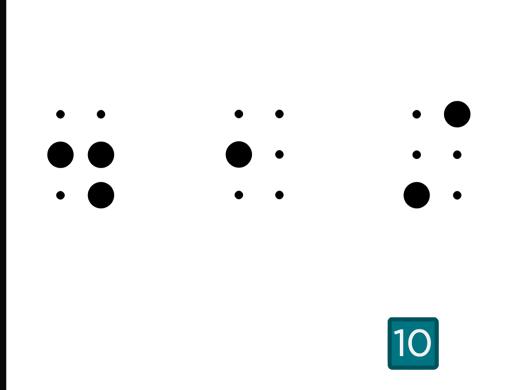
This says, “enough of this.”
Notice how the word “enough” feels like the letter “e,” but it’s lower in the cell.
Now let’s read the second row.
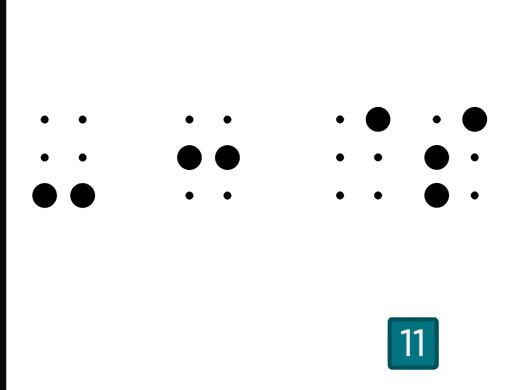
It reads, “in and out.”
Here, the word “in” feels similar to the letter “i.”
When you’re reading, the braille around the lower wordsigns will help you feel that these wordsigns are lower in the cell.
Below the middle line, you’ll find a row of lower wordsigns.
Let’s read these words together.
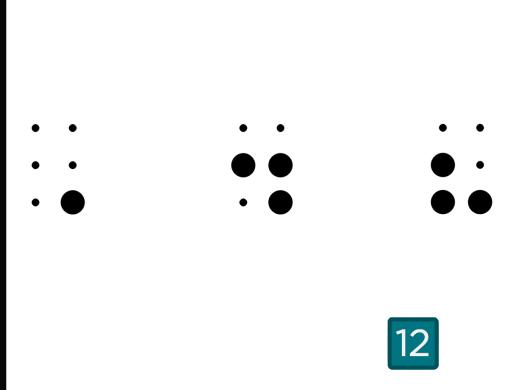
“enough in enough in enough in”
Turn the page.
Page 2
Feel the braille in the top left corner of the page.
This is the lower wordsign, “enough,” dots 2-6.
“Enough” is the middle dot on the first side of the cell and the bottom dot on the second side.
Above the middle line, you’ll find two words. Which word is “enough?”
Did you choose the second word? That’s right!
Below the middle line, you’ll find four rows of braille words.
While you’re reading, and for each activity, use the Pause button or spacebar for as long as you need.
Then select the Play button, or press the spacebar again to hear the feedback for that item.
Read the words in the first row and find which word is “enough.”
If you picked the second word, you got it!
Now find the word “enough” in the second row.
In this row, it’s the first word.
Next, find the word “enough” in the third row.
This time, the word “enough” is the third word.
Finally, find the word “enough” in the last row.
“Enough” is the last word.
Turn the page.
Page 3
Feel the braille in the top left corner of the page.
This is the lower wordsign “in,” dots 3-5.
“In” uses the bottom dot on the first side of the cell and the middle dot on the second side.
Above the middle line, you’ll find two words. Which word is “in?”
If you chose the first word, you got it!
Below the middle line, you’ll find four rows of braille words.
Read the words in the first row and find which word is “in.”
In this row, “in” is the last word.
Now, go to the second row and find the word “in.”
If you picked the first word, that’s right!
Next, read the third row and find “in.”
This time, the word “in” is the second word.
Finally, read the last row and find “in.”
“In” is the third word.
Turn the page.
Page 4
Scan the entire page to get a preview of what you’ll be reading.
Then feel the words “enough” and “in” in the top left corner of the page.
Now, find and read the first sentence near the top of the page.
Once again, use the Pause button or the spacebar to stop the audio for as long as you need to complete an activity.
Then select the Play button or press the spacebar again to hear the feedback.
If you read, “You did enough for the job,” you got it!
Now, try the next one.
This one says, “Which towel goes in the closet?”
Now, read the last one.
This sentence says, “I have enough in the box.”
Continue down the page to find three rows of braille.
Which row has the words, “enough, every, in, I” in that order?
Did you choose the last row? That’s right!
Turn the page.
Page 5
Feel the braille in the top left corner of the page.
These same symbols that stand for the words “enough” and “in” are also used as groupsigns that stand for the letters e-n and i-n in longer words.
Find the column of words near the top of the page, and let’s read the first word.
This is the word “bend.”
Did you notice the lower e-n groupsign in the middle of the word?
Now, let’s read the second word.
This is the word “find,” and it uses the lower i-n groupsign.
Now, try the next word.
Did you read the word “hen?” That’s right!
This is “hen,” not “he.”
And what’s the last word?
This is “tin.”
Continue down the page and find the first braille sentence.
Read the sentence and find the words that contain the lower e-n and i-n groupsigns.
The words “Elaine,” “invent,” and “machine” have the lower e-n and i-n groupsigns.
Just pause and check the sentence again if you didn’t find them all.
How about the second sentence? Which words contain e-n and i-n?
If you found them in “trains” and “independent,” you found them all!
Now read the third sentence and find the words with e-n and i-n.
In this sentence, these groupsigns are in the words, “generate” and “interest.”
Which words contain e-n and i-n in the fourth sentence?
They’re in “enterprise,” “destined,” and “enormously.”
Finally, where are e-n and i-n in the last sentence?
Here, the word “intrigued” uses the i-n groupsign.
And the word “enough” is the e-n wordsign.
Don’t worry if you found this activity tricky. Just replay this page to practice again.
Turn the page.
Page 6
Feel the braille contractions i-n-g and t-h-e in the top left corner of the page.
You’ve learned that when a word could be written with a strong contraction or a groupsign, strong contractions get preference.
You’ve learned that the strong contractions, “and,” “for,” “of,” “the,” and “with” get preference over other contractions.
Recall that strong contractions and strong groupsigns have dots in the top and bottom, and in the left and right sides of the cell.
Always use a strong contraction instead of the lower groupsigns.
Let’s look at an example in the first row near the top of the page.
This row shows the word “then” written two different ways.
Notice how the first word “then” uses the strong contraction t-h-e, and the second word “then” uses the groupsigns t-h and e-n.
The first word is correct.
Now, read the words in the second row and choose which is the correct way to write the word “dingy.”
If you chose the second word with the strong groupsign i-n-g, that’s right!
Check out how it also takes less space to write the word this way.
Continue down the page until you find the row that begins with number 1.
Here are two ways to braille the word “hinge” with contractions.
Which one is correct?
Did you choose the first way with the i-n-g contraction? If not, just pause, and try it again.
Now, read the words in row 2.
Which word is the correct way to braille the name “Athena?”
Yes, the first one is correct using the strong contraction t-h-e.
How about number 3? What’s the correct way to contract the word “ingrown?”
This one is tricky.
This time, it’s the second word using the i-n groupsign instead of the i-n-g groupsign.
Recall that the i-n-g groupsign cannot be used at the beginning of a word.
Finally, read the words in row 4.
Which one is the correct way to contract “earthen?”
The second word is right!
Use the t-h-e contraction here instead of the t-h and e-n.
If you’d like to practice this page again, just choose Replay as many times as you like.
And be sure to call a braille expert if you have any questions.
Turn the page.
Page 7
Feel the words “in” and “enough” in the top left corner of the page.
Now, read the chore list near the top of the page, and then we’ll look at a few questions.
The chore list tells you to do some cooking.
How many people will you cook for?
There should be enough for seven men.
What should you clean while getting ready?
You should wash ten windows.
What will you need to do when you get tickets?
Unfortunately, you’ll have to wait in line.
And what needs mending?
Did you say socks? That’s right! They must have holes!
Now, besides the seven men, who else needs to be fed?
Those little kittens need some food!
Continue down the page to find the list of uncontracted, spelled-out words.
Check out the first word, “challenge.”
If you braille this word using contractions, how many contractions should you use, and what are they?
“Challenge” should have two contractions: the c-h groupsign and the e-n groupsign.
How about the next word? How many contractions should you use for this one?
The word “interested” would have four contractions: the i-n, e-r, s-t, and e-d groupsigns.
Now try the third word. How many contractions should be used?
There would be three groupsigns in the word “ingredient”: i-n, e-d, and e-n.
Finally, how many contractions should be used in the last word?
“Engineering” has four: e-n, i-n, e-r, and i-n-g.
This activity is tricky, but great practice for knowing when contractions should be used.
Just replay this page if you want to try it again.
And reach out to a braille expert if you’d like to talk this one through.
Turn the page.
Page 8
Feel the words “enough” and “in,” which are also the groupsigns e-n and i-n, in the top left corner of the page.
Unlike the other lower wordsigns you’ve learned, these lower wordsigns and groupsigns can touch other lower symbols as long as the upper dots 1 or 4 appear in the series of touching symbols.
Let’s look at a few examples.
Find the first row near the top of the page. Let’s read it together.
This is a series of symbols that contain the opening parenthesis, the word “enough,” exclamation point, closing parenthesis.
Because the parentheses contain dots 1 and 4, the lower wordsign for “enough” can be used here, even though it also touches the exclamation point.
Now let’s read the second row.
This series of symbols contains the opening quotation mark, the word “enough,” exclamation point, closing quotation mark.
Since neither the quotes nor the exclamation point contains dots 1 or 4, the lower wordsign for enough cannot be used here.
Instead, use the e-n, o-u, and g-h groupsigns to make enough.
Now read the third row.
This is the word “linen.”
Did you notice the i-n and e-n groupsigns are touching each other?
They can, because the series of symbols includes the letter l, and that letter has dot 1.
Finally, read the last row.
This row says, “Come in.”
The word “in” is touching the period, which does not include a dot 1 or dot 4.
So the lower wordsign “in” cannot be used here.
Continue down the page and find the sentences.
Read sentences 1 and 2, pausing for as long as you need, and find which one is brailled correctly.
If you said sentence 2, you got it!
The e-n and i-n groupsigns can both be used in the word “peninsula,” because there are other symbols in the word that contain upper dots.
Now, read sentences 3 and 4 and choose which is correctly brailled.
This time, sentence 3 is correct.
There is nothing in the series of symbols with the word “enough” that has a dot 1 or 4.
So the lower wordsign cannot be used.
How about sentences 5 and 6? Which is correct?
Sentence 6 is correct. The lower wordsign “in” cannot be used here.
Finally, read sentences 7 and 8 to find which of these is correct.
Number 7 is correct.
In the word “listen,” you can use the e-n groupsign, even though it’s next to the period.
The letter i and the s-t groupsign both have upper dots.
Turn the page.
Page 9
Feel the words “men” and “me” in the top left corner of the page.
On this page, you’ll find six fill-in-the-blank sentences.
Read sentence 1. Which word on the next row would you use to complete this sentence?
The second word, “ten,” is correct, using the lower groupsign.
Now, read sentence 2, and choose the word below it that fills in the blank.
For this sentence, the first word, “hit,” is correct.
The second word is “hint,” which doesn’t work in this sentence.
Next, read sentence 3. Which word completes this one?
If you chose the first word, the lower wordsign “in,” that’s right!
You can use the lower wordsign here after the parenthesis.
How about sentence 4?
The best word to fill in this blank is the second word, “bet.”
The first word says, “bent.”
Now for sentence 5. Which word completes it?
It’s the second word, “enough.” He doesn’t have “enough” adventure.
Finally, read sentence 6 and fill in the blank.
Can you use the word “grin” with the lower groupsign here?
Yes, you can! So, choose the first word.
Turn the page.
Page 10
Feel the word “Menu” in the top left corner of the page.
Many restaurants now offer braille menus.
If you haven’t already, scan the page and notice that this menu is divided into two sections.
What are the titles of the two sections?
If you said the “STARTERS” are at the top and the “ENTREES” are at the bottom, you got it!
Now read the first item under “STARTERS.”
This menu item reads, “Spinach salad: baby spinach tossed with marinated tomatoes, zucchini, and basil and sprinkled with pecorino cheese.”
Now read the second starter.
This one says, “French onion soup: sweet yellow onions trimmed into 1/8-inch pieces, caramelized, and added to a rich stock. Served with French croutons.”
Now continue down the page and read all three entree items. And then we’ll look at some questions.
Now that you’ve read the entrees, what’s on the pizza?
It has spicy marinara and mini pepperoni.
Does the linguini come with meat? Not this one!
Now, which item comes with herb butter?
The herb butter is on the oven-roasted chicken.
Next time you’re at a restaurant, you might want to ask if they have a braille menu.
Then you can read the menu options on your own.
Select Next to complete this workshop.
Completion
Congratulations! You’ve learned two more lower contractions.
If you have any questions about using lower contractions, you can always contact a braille expert at 847-784-2816. We’re happy to help!
Contracted Braille Series
- Workshop
Explore
-
Shame and Vision Loss
Audio · 29 minutes
-
It's hard to ask for help
Resource guide
-
Dialing the Phone Made Easier
Article · 3 minutes
-
Recreation Chat
Discussion
- Explore more
Members also liked
Join the Hadley Community
Hadley's resources are always available to you. Create a no-cost Hadley account to go further:
-
Pick up where you left off Everything you start is automatically saved across Hadley.
-
Personalized recommendations We'll suggest resources based on your interests.
-
Join live discussions Live and lively discussions on technology, cooking, and more, all geared toward the community of people living with vision loss.
-
Find peer support Connect with people who understand what you're going through.