
Workshop 15: Dot 45 Contractions
Hadley
Contracted Braille
Workshop 15: Dot 45 Contractions
Opening
Hadley presents Contracted Braille Workshop 15: Dot 45 Contractions.
Page 1
To begin, make sure you have your braille workbook with you.
If you don’t already have one, call Hadley at 847-784-2816, and we’ll mail one right out to you.
Now, let’s learn the dot 45 initial letter contractions.
Feel the braille in the top left corner of the page.
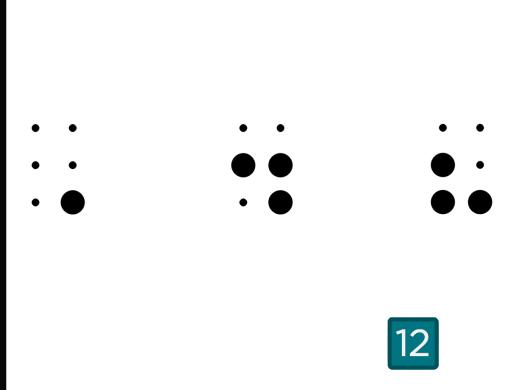
These new words are the dot 45 contractions, “upon,” “word,” and “these.”
Each one begins with dots 4 and 5 followed by the first letter or groupsign of the word they represent.
Dots 4 and 5 are the top and middle dots on the second side of the cell.
Above the middle line, you’ll find three rows of braille. Let’s read them together.
The first row is the word, “upon.”
Now, the second row.
This is, “word.”
And the last row.
It is, “these.”
Below the middle line, you’ll find a row of words.
Let’s read these words together: “upon, word, these.”
Turn the page.
Page 2
Feel the braille in the top left corner of the page.
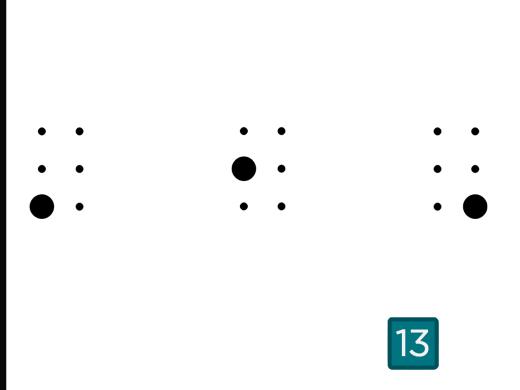
This is “upon,” dots 45-u.
Above the middle line, you’ll find three rows of braille.
As you read the braille and work through the activities, use the Pause button or spacebar to pause for as long as you need to.
Then select the Play button, or press the spacebar again, to hear the feedback for that item.
Read the three rows of braille above the middle line, and find which row has the dot 45 contraction “upon.”
If you said the middle row, you’re right!
Below the middle line, you’ll find four more rows of braille.
Read the words in the first row.
Which word is “upon?”
If you picked the last word, you got it!
Now, find “upon” in the next row.
“Upon” is the first word.
Next, find the word “upon” in the third row.
This time, “upon” is the middle word.
Finally, find “upon” in the last row.
It’s the first word.
Turn the page.
Page 3
Feel the braille in the top left corner of the page.
This is “word,” dots 45-w.
Above the middle line, you’ll find three rows of braille.
Read these three rows and find which one has the dot 45 contraction, “word.”
If you said the first row, you’re right!
Below the middle line, you’ll find four rows of braille.
Read the three words in the first row.
Which one is “word?”
“Word” is the first one.
Next, find “word” in the second row.
If you picked the last one, that’s right!
Where is “word” in the next row?
This time, “word” is the middle choice.
Finally, find “word” in the last row.
It’s the last one.
Turn the page.
Page 4
Feel the braille in the top left corner of the page.
This is “these,” dots 45 and the contraction for “the.”
Above the middle line, you’ll find three rows of braille.
Read these three rows.
Which row has the dot 45 contraction, “these?”
If you said the last row, you’re right!
Below the middle line, you’ll find four rows of braille.
Read the words in the first row.
Which word is “these?”
“These” is the last word.
Now, read the next row and find which word is “these.”
It’s the first word.
Next, find “these” in the third row.
This time, “these” is the middle word.
Finally, find “these” in the last row.
If you picked the first word, that’s it!
Turn the page.
Page 5
Feel the braille words, “upon,” “word,” and “these” in the top left corner of the page.
Above the middle line, you’ll find three rows of braille.
Which row has the words “these,” “upon,” and “word” in that order?
If you said the middle row, you got it!
Below the middle line, you’ll find three sentences.
Read the first sentence.
This sentence reads, “I will call upon my return.”
Now, read the second sentence.
This one says, “Jeff gave his word to help me move.”
And finally, read the last sentence.
Did you read, “Do these shoes match my dress?” That’s right!
Turn the page.
Page 6
Feel the braille in the top-left corner of the page.
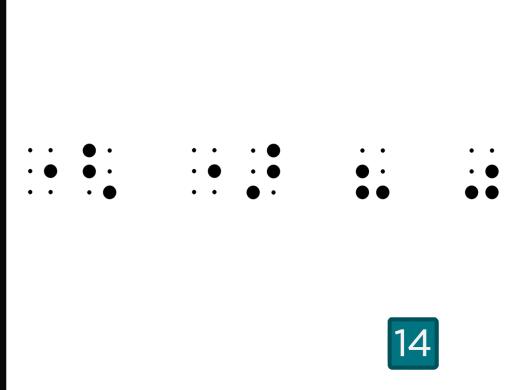
These are two more dot 45 contractions: “those” and “whose.”
Above the middle line, you’ll find two rows of braille. Let’s read them together.
The first row is the word “those.”
The second row is “whose.”
Below the middle line, you’ll find a row of braille with two words.
Let’s read these words together: “those, whose.”
Turn the page.
Page 7
Feel the braille in the top left corner of the page.
This is “those,” dots 45 and the “th” groupsign.
Above the middle line, you’ll find two rows of braille.
Read these two rows and find which one has the dot 45 contraction “those.”
If you said the first row, you’re right!
Below the middle line, you’ll find four rows of braille.
Read the words in the first row.
Which word is “those?”
“Those” is the last word.
Which word is “those” in the next row?
If you picked the first word, that’s right!
Next, find “those” in the third row.
This time, “those” is the middle word.
Finally, find “those” in the last row.
It’s the first word.
Turn the page.
Page 8
Feel the braille in the top left corner of the page.
This is “whose,” dot 45, and the “wh” groupsign.
Above the middle line, you’ll find two rows of braille.
Read the two rows.
Which row has the dot 45 contraction, “whose?”
If you said the second row, you’re right!
Below the middle line, you’ll find four rows of braille.
Read the words in the first row. Which one is “whose?”
“Whose” is the middle word.
Now read the next row and find which word is “whose.”
It’s the first one.
Next, find “whose” in the third row.
This time, “whose” is the middle word.
Finally, find “whose” in the last row.
If you picked the first word, that’s right!
Turn the page.
Page 9
Feel the words “upon,” “word,” “these,” “those,” and “whose” in the top left corner of the page.
Above the middle line, you’ll find five rows of braille.
Read the five rows.
You’ll be using these words to complete the sentences below.
Once again, use the Pause button or the spacebar to stop the audio for as long as you need to complete each of the activities.
Then select the Play button or press the spacebar again to hear the feedback.
Below the middle line, you’ll find five fill-in-the-blank sentences.
Read sentence 1 and choose which row above the line has the correct word to complete the sentence.
The right answer is, “word” in the third row.
This sentence should read, “The Latin word for water is aqua.”
Now read sentence 2 and choose which row above the line contains the right word to complete it.
The second row is correct, “upon.”
“A dove landed upon the tree branch.”
What about sentence 3?
This time, the correct word is in the first row, “those.”
Now the sentence reads, “Those steps over there lead to the state capital.”
Next, read sentence 4, and choose which row has the right word.
The last row has the right word, “whose.”
Sentence 4 should read, “Whose baseball broke the window?”
Finally, complete sentence 5.
If you chose the word in the fourth row, “these,” you got it!
The last sentence says, “She wanted a word that rhymed with sneeze, so I suggested these.”
Turn the page.
Page 10
Feel the braille words, “those,” “word,” “whose,” “these,” and “upon” in the top left corner of the page.
On this page, you’ll find eight sentences.
Read sentences 1 and 2.
One of these sentences reads, “These apples are sweeter than those apples.”
Which one is correct?
If you said sentence 2, you got it!
Now, read sentences 3 and 4.
Which of these says, “I just got word that I need to be at work at 7:30 A.M.”
Sentence 3 is correct.
Next, read sentences 5 and 6.
One of these says, “My trip depends upon finishing physical therapy.”
Which one is it?
Sentence 5 is the correct one.
Finally, read sentences 7 and 8.
Choose which one says, “Janice, whose cat is Ralph, just moved next door.”
It’s sentence 8.
If any of these were tricky, feel free to replay the page and try again.
And you can always reach out to a Hadley braille expert for more help.
Turn the page.
Page 11
Feel the words, “whose,” “those,” “these,” “upon,” and “word” in the top left corner of the page.
Dot 45 words can be used as part of longer words if they keep their meaning.
Let’s look at some examples.
Near the top of the page, you’ll find three rows of braille. Let’s read them together.
The first row is the word, “hereupon.”
“Hereupon” uses the dot 45-u contraction, because “upon” keeps its original meaning.
Now let’s read the second row.
This is the word “coupon.”
“Coupon” has the letters u-p-o-n, but that part of the word does not keep the meaning for “upon.”
There is one exception to this rule.
Let’s read the word in row three.
This is “sword.”
The dot 45 contraction for “word” can be used wherever the letters w-o-r-d are found, like in “sword.”
Continue down the page and find two sentences.
Read the first sentence.
If you read, “Those are misworded, but these are word-for-word,” you got it!
What about the second sentence?
This one reads, “Mr. Dupont’s hypotheses were reworded twice.”
Did you notice that “Dupont” cannot use the dot 45 contraction for “upon,” and “hypotheses” cannot use the dot 45 contraction for “these?”
Turn the page.
Page 12
Feel the words “these” and “those” in the top left corner of the page.
Near the top of the page, you’ll find five rows of braille.
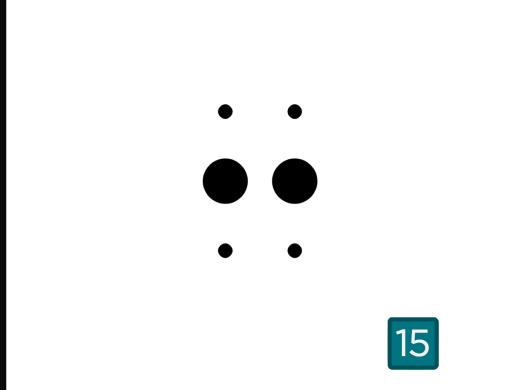
Read the contraction at the beginning of the first row.
Now, read the three words that follow the contraction.
Which of these is the right word for the contraction at the beginning?
The second one, “whose,” is the correct word for the dot 45-wh contraction.
Now, read the second row.
Which word is the right word for the contraction at the beginning of this row?
If you said the last word, “upon,” you got it!
Now try the third row.
Which is the right word for this contraction?
The first choice, “these,” is correct.
Next, read the fourth row, and find which choice is correct.
It’s the last choice, “word.”
Finally, find the correct word in the last row.
The middle choice is correct.
“Those” is the word for the dots 45-th contraction.
Continue down the page to find four fill-in-the-blank sentences.
Read sentence 1 along with the two words below it, and choose which word fills in the blank.
If you said the first word, “hereupon,” you’re right!
Now, read sentence 2, and the words below it, and choose which word correctly completes the sentence.
This time, it’s the second word.
This is “workbench.”
What about sentence 3?
The first word is correct, “buzzword.”
And last, which word completes sentence 4?
The second choice is right, “anywhere.”
Turn the page.
Page 13
Feel the words, “those,” “these,” “upon,” “word,” and “whose” in the top left corner of the page.
On this page, you’ll find 11 rows of braille.
Read the first row. It says, “Glossary:”
This is an example of a glossary.
Now, read the rest of the glossary. And when you’re finished, we’ll take a look at some questions.
Now, let’s answer some questions about these words.
Which word refers to the items that are nearby?
“These” refers to things that are nearby.
Which word is about ownership?
Did you say, “whose?” That’s right!
Next, which entry refers to an important word on the subject?
This one is “keyword.”
And which entry is something that groups words together?
“Parentheses” group words together.
Finally, which of these words refers to witty use of the language?
This one is, “wordplay.” Great reading!
Glossaries like this one come in handy when you’re reading a book about hobbies or another non-fiction subject.
Select Next to complete this workshop.
Completion
Congratulations! You’ve learned the dot 45 contractions.
If you have questions about using these contractions or anything else you’ve learned in these workshops, reach out to a Hadley braille expert at 847-784-2816. We’re happy to help!
Contracted Braille Series
- Workshop
- Workshop
Explore
-
My Heart is Not Blind
Audio · 22 minutes
-
A family member has vision loss
Resource guide
-
Travel with Vision Loss: 11 Tips from Experienced Travelers
Article · 8 minutes
-
Book Nook
Discussion
- Explore more
Members also liked
Join the Hadley Community
Hadley's resources are always available to you. Create a no-cost Hadley account to go further:
-
Pick up where you left off Everything you start is automatically saved across Hadley.
-
Personalized recommendations We'll suggest resources based on your interests.
-
Join live discussions Live and lively discussions on technology, cooking, and more, all geared toward the community of people living with vision loss.
-
Find peer support Connect with people who understand what you're going through.