
Contracted Braille Writing 8: Lower Wordsigns his, was, were, be
Hadley
Contracted Braille Writing 8 – Lower Wordsigns: his, was, were, be
Hadley Presents Contracted Braille Writing, Workshop 8, Lower Wordsigns: his, was, were, be.
If you don't already know how to read these lower wordsigns, we recommend first completing Hadley's Reading Workshop, Contracted Braille Workshop 8, Lower Wordsigns: his, was, were, be.
Begin by putting paper in your writing device using the writing device you have available to you, including the slate and stylus, the Perkins brailler, or an electronic note taker. Also, you will need your braille workbook. If you don't already have one, call Hadley at 847-784-2816 and we'll mail one right out to you.
Okay, first, let's check out these lower wordsigns. Turn to page 1 in the workbook. At the top of the page, read the lower word signs: was, his, were, and be.
Now, let's start writing these wordsigns in sentences. The sentences you'll be writing will be read in this audio and the uncontracted braille is provided for your convenience in the workbook. Turn to page 2 of the workbook to find the uncontracted braille sentences. You can use these uncontracted braille sentences on pages 2 and 3 to check the spelling of words and names, and to check how numbers and other symbols are to be written. Capitalization and punctuation will be read aloud only as needed for clarity.
Write these sentences in contracted braille. To begin, start on a new line and indent two spaces. Be sure to use capitalization and punctuation as you would in print, and do not divide words between lines.
Let's write:
Mike planned to adapt his home to meet his future loss of sight.
Skip to the next line, indent two spaces and braille:
He knew that his sight needs were likely to change rapidly, comma, so he decided to have a multi, hyphen, step plan.
Now write:
Step 1, colon, Mike needed to remove carpet and rugs that were a tripping hazard if they folded up.
And braille the sentence:
He was aware that furniture sticking out was a danger, comma, so he moved his furniture to better spots.
Now try the sentence:
He'd have to be sure to keep chairs out of the way.
Next, write:
Step 2: Mike next marked hallways and stairs with vivid tape to show edges.
Now braille:
His brother came to put up handrails and grab bars.
Write the sentence:
Mike's goal was to remove items like wires that might be a safety problem.
Try writing:
Step 3: Mike needed shades and drapes to adjust lighting and glare.
Now braille:
Lamps were a help to modify lighting needs.
Next, write:
Step 4: Mike was planning to reduce clutter.
Now try the sentence:
Items that were not used were transported to a thrift store.
Try writing:
Step 5: Color coding food for the pantry was a way to help get the correct items for now.
Next, braille:
Later, comma, he might add raised dot labels if needed.
Now write:
Step 6: If Mike replaced furniture soon, comma, he was choosing fabric with varying textures and replacing low tables with higher tables.
Next, try:
Opening quotation mark, Were the steps going to be adequate, question mark, closing quotation mark, Mike wondered.
Finally, braille:
The plan might change, comma, but having a plan is important to help with what Mike's future needs might be.
You can now check your work using the contracted braille sentences pages 4 and 5 of the workbook.
Did you recall that lower wordsigns cannot be used next to punctuation, but they may be used with capital letter indicators as long as no other punctuation is present?
So, in the second sentence after Step 2, the lower wordsign, his, is used after the capital indicator. But near the end of the passage, the lower wordsign, were, cannot be used after the opening quotation mark, even though there is a capital indicator in between. And in the last sentence the word, be, is spelled out. We would not use the lower wordsign next to the period.
Congratulations! You've learned to write four lower wordsigns. Did questions come up for you as you brailled these sentences? Just connect with the Hadley Braille experts at 847-784-2816. We'd love to help.
Contracted Braille Writing Series
- Video · 7 minutes

- Video · 9 minutes

- Video · 7 minutes

- Video · 7 minutes

Explore
-
"There's no way around it, just a way through it"
Audio · 6 minutes
-
I'm having trouble reading
Resource guide
-
How to Choose the Right Magnifier for Low Vision
Article · 7 minutes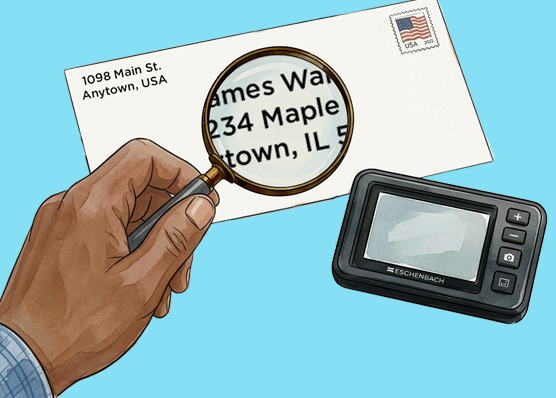
-
What's Cooking?
Discussion
- Explore more
Members also liked
- Video · 10 minutes
- Video · 9 minutes
- Video · 8 minutes
- Video · 7 minutes
Join the Hadley Community
Hadley's resources are always available to you. Create a no-cost Hadley account to go further:
-
Pick up where you left off Everything you start is automatically saved across Hadley.
-
Personalized recommendations We'll suggest resources based on your interests.
-
Join live discussions Live and lively discussions on technology, cooking, and more, all geared toward the community of people living with vision loss.
-
Find peer support Connect with people who understand what you're going through.