
Outlook Screen Reader: Email Folders
Ricky: Hello my name is Ricky Enger and today we'll learn about folders in Microsoft Outlook. We'll explore existing folders, and we'll create a new one of our very own. Folders, why are we talking about folders instead of mailboxes? We've talked about our Inbox in other workshops in this series, and now suddenly we're switching gears? What's with that?
Well it's not as weird as it seems, our Inbox is similar to a physical mailbox, right? But we don't usually have physical mailboxes for things we've sent, or things we wanna save. For that, a folder makes more sense. It's a place where we store a collection of things that are related to each other, and we can flip through folders until we find the collection of things we want. It's the same in Outlook. We've got our Inbox of course, but what else do we have? To find out, we'll use a shortcut key to bring up a list of folders we can flip through. So let's use Ctrl+Y, as in Yankee.
Screen Reader: Go To Folder Dialog. Folders, tree view, Inbox one of one, level one.
Ricky: Great, when we press that a dialogue pops up which let's us choose the folder we wanna check out. Now, all we have to do is use our Arrow keys to explore what's here. Our screen reader tells us we're focused on the Inbox. So we'll press Down Arrow to see what else is here.
Screen Reader: Drafts one of one, level one.
Ricky: Drafts is where we might have emails we've started writing but haven't sent yet for whatever reason.
Screen Reader: Sent Items one of one, level one.
Ricky: There's where Outlook automatically stores the emails we've sent to people. Kind of cool, right? We don't even have to do anything to save those. It just happens automatically.
Screen Reader: Deleted Items collapsed one of one, level one.
Ricky: Now, why is Outlook saving deleted messages? For some of us, this folder might actually be called Trash but anyway, didn't we get rid of these messages with our Delete key? Sometimes maybe we're a little too quick to press that key and we might wanna just reach in here and grab a message that we accidentally threw away. So here's where all those messages end up. There are other folders in this list in addition to what we found already but let's go ahead and close this dialogue box with our Escape key for now.
Screen Reader: Inbox Enger at Hadley.edu/outlook.
Ricky: In here, we are back in our Inbox. Okay, so some things we get don't need to be saved but there are times when someone sends us something we'd really like to keep. We can leave all those things in the Inbox but wow, we might end up with a whole pile of stuff to sort through just to find one message. That sounds unpleasant so instead of just having everything in one big list, we'll create folders that can help us stay organized. How do we do that? We've got a great little shortcut key Ctrl+Shift+E as in Echo. So if we press that,
Screen Reader: Create new folder, dialogue folder contains. Select where to place the folder. Tree view, Inbox one of one, level one. Name, Edit Alt+N, blank.
Ricky: We've got a dialogue box and the screen reader really goes into overdrive here with the information it's giving us. Let's just take things one at a time. Right now, we're in an Edit box where we can type in the name of this folder. We'll call this one Recipes. Now, we'll move forward in our dialogue with Tab.
Screen Reader: Recipes, folder contains combo box collapsed. Folder contains, edit mail and post items.
Ricky: We don't have a need to change this right now but if we ever get curious, we can move through these options here using our Arrow keys. Let's press Tab and see what's next.
Screen Reader: Select where to place the folder. Tree view, Inbox one of one, level one.
Ricky: Outlook is asking us where to place the folder and it's currently focused on the Inbox. So what this means is that if we leave things as they are, we're going to have a new folder called Recipes and that folder is actually a sub-folder of the Inbox. Folders within folders? Wow! As strange as it seems though, that's just what we're going to do. We'll press Enter here and create our Recipes folder.
Screen Reader: Inbox Enger at Hadley.edu/outlook.
Ricky: So let's go find out how easy it is to get to this folder we just created. We'll use our Ctrl+Y keystroke to bring up the "Go to Folder" dialogue again. And let's listen.
Screen Reader: Go to folder dialogue. Folders, tree view. Inbox collapse one of one, level one.
Ricky: Collapsed? Our Inbox is tired and it just fell over? Well, no. This actually means that there are additional things under the Inbox but they aren't showing now. We'll make the Inbox folder expanded by using our Right Arrow key.
Screen Reader: Expanded, zero items.
Ricky: Cool, our Inbox is expanded but the screen reader says zero items. Is that really true though? Let's use our Down Arrow key.
Screen Reader: Level two Recipes, one of one.
Ricky: And hey, there's our Recipes folder. We'll press Enter here to go there. And that's it. We've created a new folder and we just moved to that folder. Too bad it's empty for now but it sure won't stay that way for long. Meanwhile, how do we move back to our Inbox? Yup, it's Ctrl+Y again.
Screen Reader: Go to folder dialogue. Folders, tree view, Recipes one of one, level two.
Ricky: And here in our folder dialogue, we are focused on our Recipes folder which is actually under our Inbox. So, let's move with our Up Arrow key.
Screen Reader: Level one Inbox expanded one of one.
Ricky: And there's our Inbox again. We'll press Enter.
Screen Reader: Inbox Enger at Hadley.edu/outlook.
Ricky: And we're right back where we started. I'm Ricky Enger and I'm glad you could spend a little time with me today learning about folders in Microsoft Outlook.
-
Handouts
Email: Folders Quick-Start Guide (PDF)
This quick-start guide helps you create folders to organize your email.
This handout lists keyboard shortcuts so you have an alternative way to do something that you'd typically do with a mouse.
Outlook: Screen Reader Series
- Video · 6 minutes

- Video · 10 minutes
- Video · 7 minutes
- Video · 7 minutes
Explore
-
Keeping Your Job After Vision Loss
Audio · 25 minutes
-
It's hard to ask for help
Resource guide
-
Celebrating Braille for Daily Life
Article · 6 minutes
-
What's Cooking?
Discussion
- Explore more
Members also liked
- Video · 6 minutes
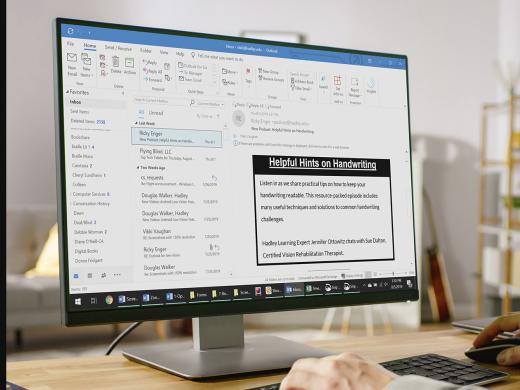
- Video · 5 minutes
- Video · 4 minutes
- Video · 6 minutes
Join the Hadley Community
Hadley's resources are always available to you. Create a no-cost Hadley account to go further:
-
Pick up where you left off Everything you start is automatically saved across Hadley.
-
Personalized recommendations We'll suggest resources based on your interests.
-
Join live discussions Live and lively discussions on technology, cooking, and more, all geared toward the community of people living with vision loss.
-
Find peer support Connect with people who understand what you're going through.